Masterpiece
Aeneas, Anchises and Ascanius
Details
About
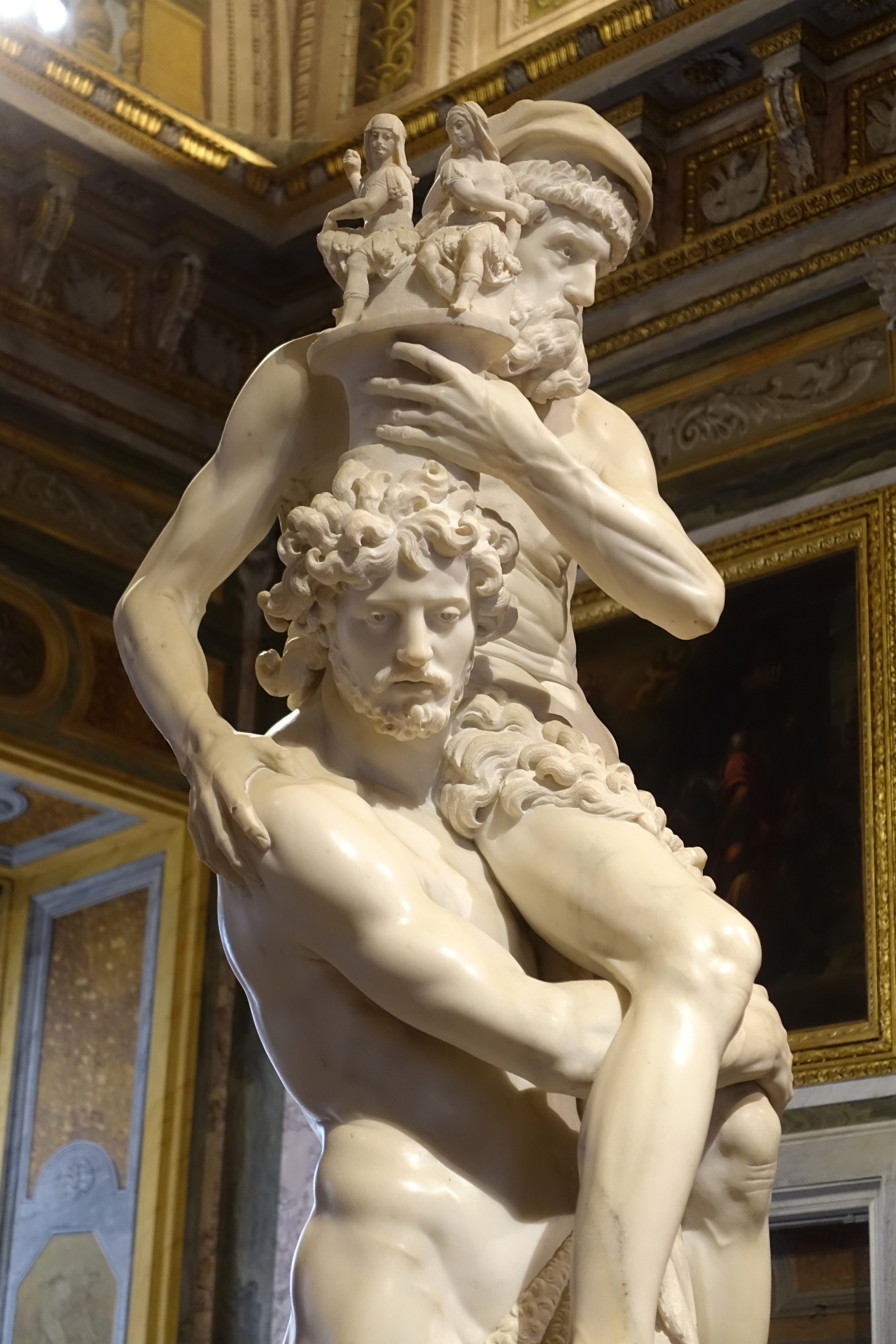
Bernini at 20, still working with his father Pietro. Three generations of Trojans stack vertically: old Anchises carrying the household gods, his son Aeneas carrying Anchises, and his grandson Ascanius trailing the sacred flame. The old man's skin is genuinely wrinkled marble, the middle-aged flesh smoother, the child's soft â a treatise on aging in stone. Compare it to his Pluto and Daphne three years later to see how fast Bernini evolved.
The full story
Technical details
- Medium
- Marble
- Dimensions
- H. 220 cm
- Date
- 1618–1619
- Commissioned by
- Cardinal Scipione Borghese
- Location
- Room II, Galleria Borghese, Rome
Historical context
In 1618, Gian Lorenzo Bernini was a mere twenty years old, yet he was already the protégé of Cardinal Scipione Borghese, the most voracious and powerful art collector in Rome. The city was undergoing a profound transformation as the papacy of Paul V (Scipione’s uncle) sought to restore Rome’s grandeur through massive architectural projects and the reclamation of its classical heritage. This was the dawn of the Roman Baroque, a period defined by emotional intensity and theatrical movement. The subject of Aeneas fleeing its destruction was deeply resonant for a Roman audience. Virgil’s Aeneid, which chronicles the Trojan prince's journey to Italy to found the Roman race, served as the foundational myth of the city. By commissioning this work for his suburban villa, Scipione Borghese was not just acquiring a masterpiece of marble carving; he was reaffirming his family’s connection to the legendary origins of Rome and showcasing the arrival of a prodigious talent who would redefine sculpture for the next century.
Symbolism & iconography
- The Penates: The small figurines held by Anchises represent the protective household gods of Troy, symbolizing the continuity of culture and religion.
- The Eternal Flame: Young Ascanius carries a tripod with a small flame, representing the 'Vesta' or the sacred hearth of the family and the future of the Roman state.
- The Lion Skin: The pelt draped over Aeneas's shoulder is a classic attribute of a hero, linking him to the strength and lineage of Hercules.
- The Three Ages: The juxtaposition of the child, the man, and the elder serves as a 'memento mori' and a meditation on the inevitable passage of time.
What to look for in person
- Look at the base of the sculpture to see the contrast between the polished marble of the figures and the rough-hewn 'rocky' terrain they walk upon.
- Crouch down slightly to see the expression on young Ascanius's face; he looks back with a mixture of fear and wonder that is often missed from a standing height.
- Observe the grip of Aeneas’s hand on his father's thigh; Bernini captures the way flesh pinches under pressure, a detail he would famously perfect in 'Proserpina' two years later.
- Check the back of the sculpture to see how Bernini handled the flow of the drapery, which creates a sense of wind and movement even in the static stone.
Fun facts
- Though Virgil describes Aeneas carrying his father on his back, Bernini placed Anchises directly on Aeneas's shoulder, a technical feat that creates a more compact and stable vertical structure.
- Some scholars believe the face of Aeneas is a subtle self-portrait of the young Bernini, while the face of Anchises reflects the features of his father, Pietro.
- For years, art historians debated if Pietro Bernini helped his son, but a receipt discovered in the Borghese archives confirmed Gian Lorenzo was paid the full sum as the sole sculptor.
- The sculpture was originally positioned against a wall, but is now displayed in the center of the room to allow visitors to appreciate its 360-degree 'serpentine' composition.
Rating
Notes
Loading…