Masterpiece
Apollo Belvedere
Details
About
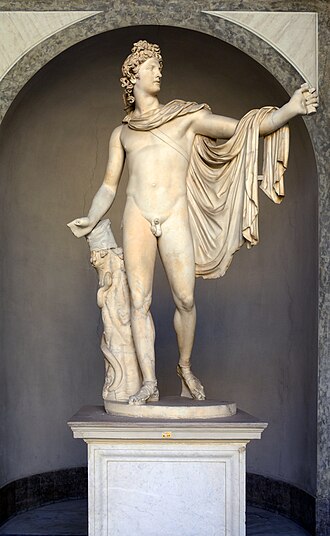
For three centuries after its rediscovery around 1489, this was considered the greatest sculpture in the world â the yardstick for classical perfection. Winckelmann wrote pages of ecstatic prose about it. The god has just released an arrow (perhaps at the Python); his weight shifts elegantly onto his right leg in a perfect contrapposto. It's actually a Roman marble copy of a lost Greek bronze, but its influence â on Neoclassicism, on academic drawing, on our idea of what a god looks like â is total.
The full story
Technical details
- Medium
- White marble
- Dimensions
- H. 224 cm (approx. 7.3 feet)
- Date
- c. 120–140 AD (Adriatic period)
- Commissioned by
- Unknown (Roman-era copyist)
- Location
- Octagonal Court, Pio-Clementine Museum, Vatican Museums
Historical context
The Apollo Belvedere entered the Vatican’s collection in the early 16th century, during the height of the Italian Renaissance. It was likely rediscovered near Rome in the late 1480s or early 1490s and was acquired by Cardinal Giuliano della Rovere. When he was elected Pope Julius II in 1503, he brought the statue to the Vatican, making it one of the cornerstones of the newly founded Belvedere Courtyard. This was an era of intense classical revival, where the recovery of Greek and Roman antiquities was seen as a recovery of human potential and divine grace. At the time, Rome was transforming from a crumbling medieval city into a global center of art and power. The papacy sought to legitimize its authority by aligning itself with the grandeur of the Roman Empire. The Apollo Belvedere served as the supreme archetype of male beauty and intellectual clarity, or 'ratio,' contrasting with the raw emotional agony seen in the Laocoön, which was discovered shortly thereafter. For centuries, this statue was considered the greatest masterpiece of world art, influencing every major artist from Michelangelo to Antonio Canova.
Symbolism & iconography
- The Pharos (Quiver): Hanging over his shoulder, the quiver signals his role as the archer-god, bringer of both sudden death and protection.
- The Tree Trunk and Serpent: A subtle iconographic nod to the Python, the monstrous serpent Apollo slew at Delphi to establish his oracle.
- The Sandals: These are more than footwear; their intricate straps identify him as a figure of high status and Greco-Roman refinement.
- The Laurel: Though the original branch is lost, the tree trunk includes laurel leaves, Apollo's sacred plant representing victory and poetic inspiration.
What to look for in person
- Look closely at the hair; it is carved with deep undercuts that create dark shadows, intended to make the golden-haired god look radiant under the Mediterranean sun.
- Step to the right of the statue to see the tension in his neck; it is the only part of the body that hints at the action he has just completed.
- Observe the sandals—they are among the most detailed in ancient sculpture and were used by the famous archeologist Winckelmann to try and date the piece.
- Check the left hand; you can still see the attachment points where the original marble bow was once held.
Fun facts
- When Napoleon Bonaparte looted Italy in 1797, the Apollo Belvedere was his primary target; it was moved to the Louvre and became the star of his museum until its return in 1815.
- The statue's hands were missing when it was found and were restored in the 1530s by Giovanni Angelo Montorsoli, a pupil of Michelangelo.
- For centuries, it was believed to be a Greek original, but late-20th-century analysis confirmed it is a Roman copy, evidenced by the distinctively Roman design of its sandals.
- The 'tree trunk' support, which modern viewers often find distracting, was a structural necessity added by the Roman marble sculptor to support the weight of a bronze design translated into stone.
Rating
Notes
Loading…