Masterpiece
Apollo and Daphne
Details
About
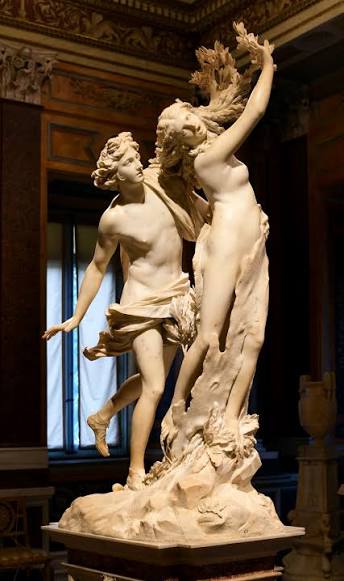
Bernini was 24 when he began this. Ovid's story: Apollo chases Daphne, who prays to be delivered â and turns into a laurel tree the instant he catches her. Bernini froze that instant in marble. Her fingertips are already leaves, bark climbs her thighs, her hair is becoming branches, and Apollo's expression shifts from lust to horror as he feels wood under his hand. Walk the full 360° â Bernini designed it to be experienced as you circle: first Apollo alone, then the chase, then the transformation. The marble is so thin at the leaves that light passes through it.
The full story
Technical details
- Medium
- Carrara Marble
- Dimensions
- H. 243 cm
- Date
- 1622–1625
- Commissioned by
- Cardinal Scipione Borghese
- Location
- Room III, Galleria Borghese, Rome
Historical context
Gian Lorenzo Bernini was only twenty-four years old when he began this masterpiece for his most significant patron, Cardinal Scipione Borghese. It was the final of four monumental groups commissioned for the Cardinal’s suburban villa on the Pincian Hill, a space designed to showcase one of the most prestigious private collections in seventeenth-century Rome. At this time, Rome was the beating heart of the Counter-Reformation, and the Papacy was using art as a grand instrument of persuasion and prestige. Despite the secular and erotic themes of Ovid’s 'Metamorphoses'—the source of the Apollo and Daphne myth—the climate of the time required a moralizing justification. To ensure the sculpture’s presence in a cardinal’s home was beyond reproach, a Latin couplet was composed by Cardinal Maffeo Barberini (the future Pope Urban VIII) and inscribed on the pedestal. It warned that those who chase fleeting pleasures will find only bitter leaves and berries in their hands. This blending of classical mythology with Christian morality allowed Bernini to push the boundaries of stone-carving to their absolute limit.
Symbolism & iconography
- The Laurel Leaves: Represent the ultimate irony of the chase; Apollo seeks a lover but wins only a crown of leaves, which later became the symbol of poets and victors.
- The Lead and Gold Arrows: Though not physically carved, their effect is the engine of the plot—the gold causing Apollo's obsession and the lead causing Daphne's terror.
- The Bark: Represents the loss of autonomy and the physical manifestation of Daphne’s plea for 'destruction' to preserve her chastity.
- Apollo’s Foot: Resting only on the ball of his foot, it symbolizes the fleeting, momentary nature of the pursuit and the swiftness of the divine.
What to look for in person
- Slowly circle the sculpture clockwise to experience the 'metamorphosis' in order, watching her fingers turn from skin to leaf.
- Look closely at Daphne's toes; you can see the roots literally pulling her down and into the soil.
- View the sculpture from the side to see the incredible 'undercutting' of Apollo's cloak, which seems to hover in the air unsupported.
- Pay attention to the facial expressions—contrast Apollo's confusion and dawning disappointment with the pure, primal fear in Daphne’s eyes.
Fun facts
- Bernini was only 24 when he began the work and 26 when he finished it, cementing his reputation as the 'new Michelangelo.'
- The sculpture was originally positioned against a wall near the entrance of the room, meaning viewers would first see Apollo’s back and then experience the shock of Daphne’s transformation as they walked around it.
- Daphne’s hair and the leaves are carved so thinly that several pieces have broken over the centuries and been discreetly reattached.
- The Latin poem on the base was a 'moral safety net' designed to prevent critics from accusing the Cardinal of owning 'indecent' pagan art.
Rating
Notes
Loading…