Masterpiece
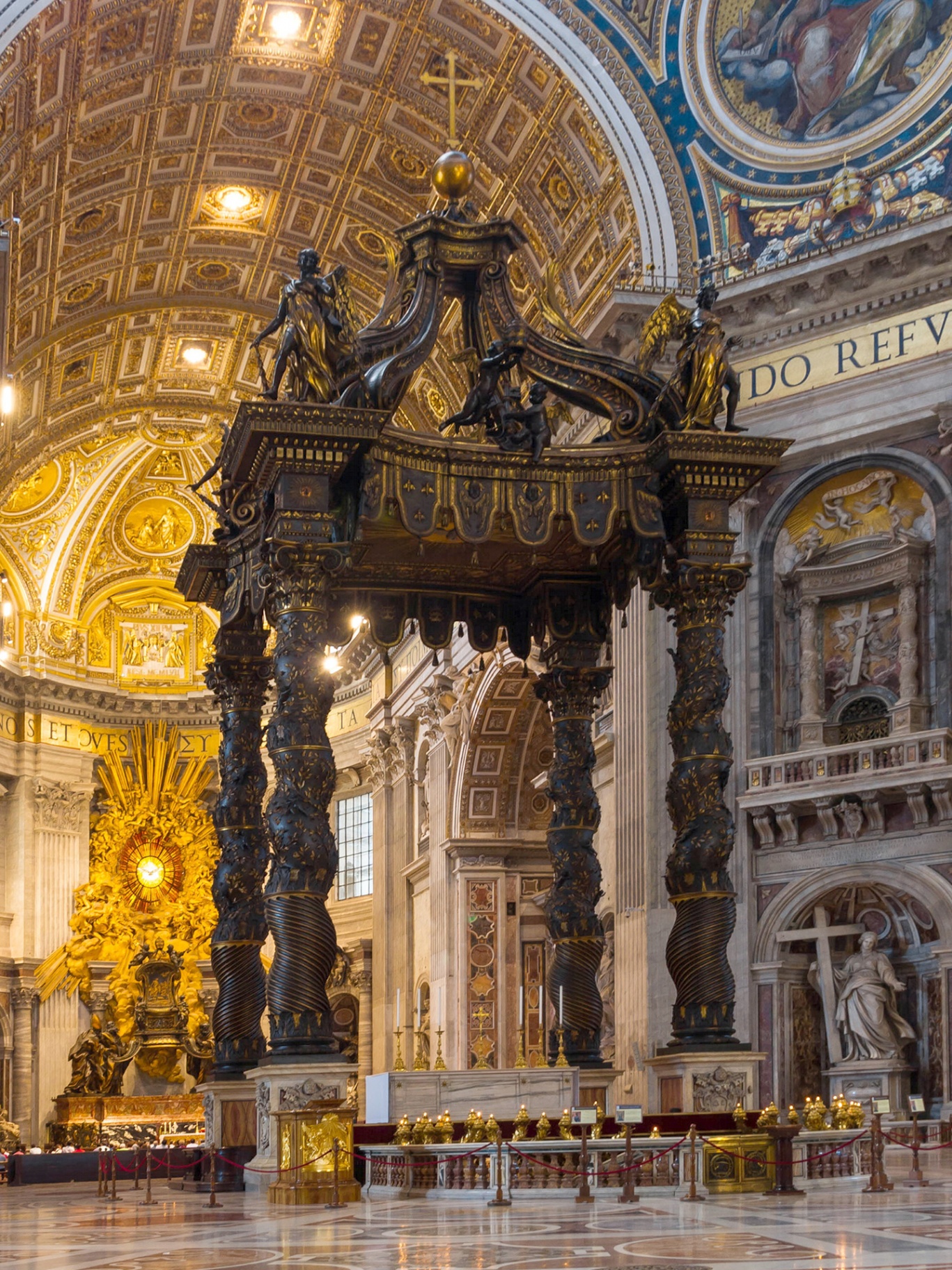
St. Peter's Baldachin
Details
About
Bernini's 29-meter bronze canopy over the tomb of St. Peter â four twisting Solomonic columns of blackened bronze crowned with an ornate baldachin that Barberini bees swarm across. The bronze was famously stripped from the Pantheon's portico ('what the barbarians did not do, the Barberini did'). Walk beneath it: the scale is absurd and the columns wobble in your peripheral vision. Look at the bases â reliefs of Urban VIII's niece giving birth, from labor pains to newborn cry, an unlikely private drama at the center of the basilica.
The full story
Technical details
- Medium
- Gilded bronze, marble (bases)
- Dimensions
- H. 28.74 meters (94 feet)
- Date
- 1624–1633
- Commissioned by
- Pope Urban VIII (Maffeo Barberini)
- Location
- Crossing, directly beneath the Dome, St. Peter's Basilica
Historical context
The St. Peter’s Baldachin was commissioned by Pope Urban VIII of the Barberini family, a man determined to solidify the prestige of his papacy and the aesthetic dominance of the Catholic Church. Rome in the early 17th century was the heart of the Counter-Reformation, a period when the Church utilized breathtaking art to reassert its spiritual authority against the rise of Protestantism. Urban VIII sought a monument that would both honor the tomb of St. Peter and bridge the immense architectural gap between the floor of the basilica and Michelangelo’s towering dome. Bernini was only twenty-five when he received this colossal commission in 1624. At the time, the interior of the new St. Peter’s was a vast, somewhat empty shell. The Baldachin served as the visual anchor for the entire building, marking the "center of the world" where the first Pope was buried. Its creation was an industrial-scale undertaking that spanned nine years, requiring the melting down of ancient Roman bronze and the collaboration of the city’s finest craftsmen, including Bernini’s rival, Francesco Borromini.
Symbolism & iconography
- Solomonic Columns: The helical shape refers to the Temple of Solomon in Jerusalem, symbolizing the link between the Old Testament and the Catholic Church.
- Bee Motifs: The three bees represent the Barberini family crest, but in a religious context, they also symbolize industry, divine sweetness, and the organized community of the Church.
- The Globe and Cross: Positioned at the very top, this represents the triumph of Christianity over the entire world.
- Laurel Leaves: The columns are wrapped in laurel, a symbol of victory and eternity, which was also a personal emblem of Pope Urban VIII.
- The Sunbursts: Gilded suns on the canopy represent the light of God and the divine wisdom illuminating the papal office.
What to look for in person
- Walk all the way around the marble bases to see the varied facial expressions on the crests, which transition from pain to joy.
- Look up from directly underneath the canopy to see the 'Holy Spirit' dove cast in bronze, radiating light from the center of the ceiling.
- Notice how the columns are not perfectly smooth; they are textured with realistic bronze vines and tiny insects that are only visible from a few feet away.
- Observe the monument from the nave entrance to see how Bernini perfectly framed the Cathedra Petri (Peter's Chair) through the legs of the Baldachin.
Fun facts
- To gather enough bronze for the casting, Urban VIII ordered the stripping of the ancient bronze beams from the ceiling of the Pantheon's portico.
- Look closely at the Barberini coats of arms on the marble bases; they depict a sequence of a woman's face throughout the stages of labor, allegedly representing a niece of the Pope who had a difficult pregnancy.
- Francesco Borromini, who would later become Bernini’s bitterest rival, contributed significantly to the technical design of the upper volutes.
- The bronze bees crawling over the columns are the heraldic symbol of the Barberini family, acting as a permanent 'signature' of the Pope's patronage.
Rating
Notes
Loading…