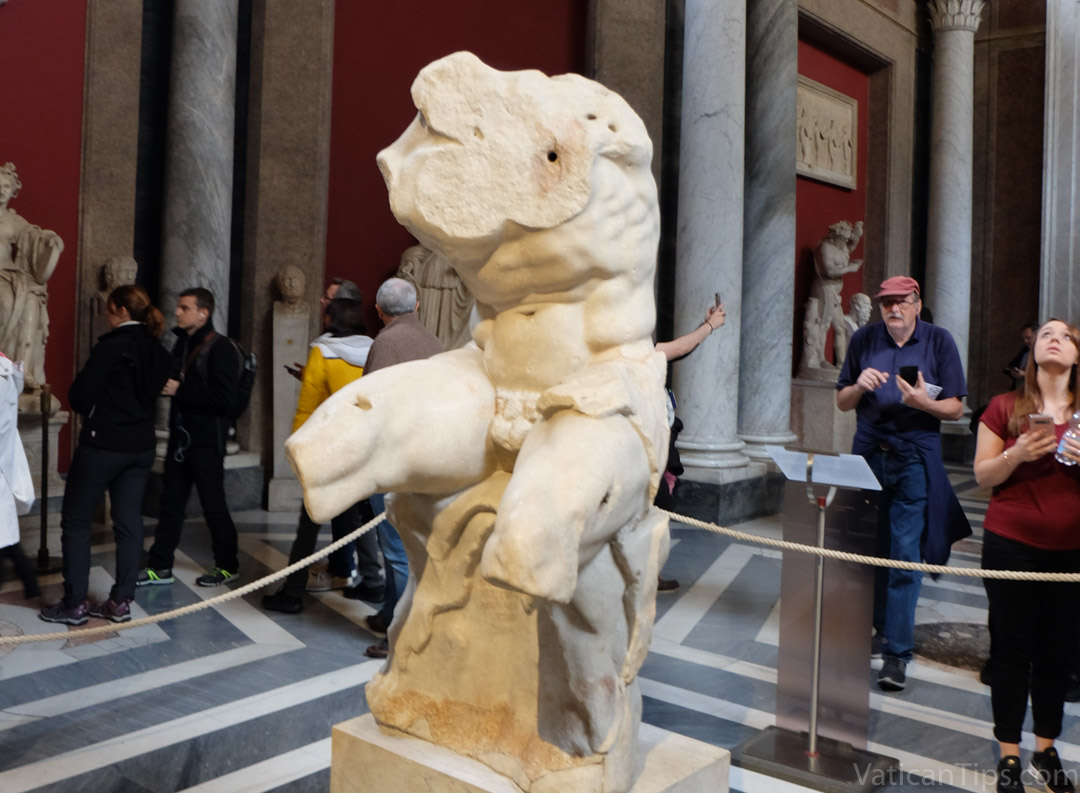
Masterpiece
Belvedere Torso
Details
About
A fragment â no head, no arms, no lower legs â and yet Michelangelo called it his master. The torque of the twisting torso, the deep-cut abdominal muscles, the way the whole body coils around an invisible axis: every ignudo on the Sistine ceiling owes it a debt. Signed by an Athenian sculptor named Apollonios. Michelangelo refused to 'restore' the missing limbs, insisting the fragment was already complete.
The full story
Technical details
- Medium
- Marble
- Dimensions
- H. 159 cm (including base)
- Date
- c. 1st century BC (Hellenistic/Neo-Attic)
- Commissioned by
- Unknown (likely a wealthy Roman patron or public gymnasium)
- Location
- Room of the Muses (often associated with the Octagonal Court), Vatican Museums
Historical context
Created during the 1st century BC, the Belvedere Torso emerged during a period of Roman fascination with Hellenistic Greek aesthetics. This was an era where Roman patrons and artists sought to capture the "pathos" and extreme muscularity of the Late Classical and Hellenistic periods. The work is signed by Apollonios of Athens, a Neo-Attic sculptor, though scholars debate whether it is an original creation or a masterful Roman copy of a lost 2nd-century BC bronze. Discovered in the late 15th century, likely in the Campo de' Fiori, the sculpture entered the Vatican collection under Pope Clement VII. It arrived during the height of the High Renaissance, a time when Rome was undergoing a massive urban and artistic reclamation. The city was being transformed from a medieval ruin into the capital of the Catholic Reformation, fueled by the rediscovery of such ancient masterpieces which provided a visual vocabulary for the genius of Michelangelo and his contemporaries.
Symbolism & iconography
- The animal skin: The figure sits on a pelt that most likely belongs to a lion, a traditional attribute of Hercules (the Nemean Lion skin).
- The Seated Pose: Suggests a moment of 'rest after toil' or profound contemplation, shifting the focus from physical feat to internal psychology.
- The Torsion: Represents 'Pathos'—the Greek concept of suffering or emotional intensity expressed through the straining of the body.
- The Missing Limbs: While accidental, they have come to symbolize the 'non-finito' (unfinished) aesthetic that influenced modern sculpture from Rodin to Moore.
What to look for in person
- Walk slowly around the back of the sculpture; the musculature of the spine and shoulder blades is where Michelangelo found his greatest inspiration.
- Look at the piece from a low angle to appreciate the massive scale of the thighs and the Herculean power of the lower abdomen.
- Notice the deep undercutting where the figure meets the rock/skin base, which creates dramatic shadows that emphasize the figure's weight.
- Try to visit early in the morning when the natural light from the courtyard hits the marble, highlighting the subtle 'skin' texture of the stone.
Fun facts
- Michelangelo was so obsessed with this statue that in his old age, when he was nearly blind, he was seen running his hands over the marble to 'feel' its form.
- The signature of the artist, 'Apollonios, son of Nestor, Athenian,' is still clearly visible on the front of the pedestal.
- During the Napoleonic Wars, the torso was looted by French forces and taken to Paris, only to be returned to the Vatican in 1815 after the fall of Napoleon.
- The hole in the top of the thigh suggests that the figure originally held something, possibly a sword hilt or a club, which would help identify the subject.
Rating
Notes
Loading…