Masterpiece
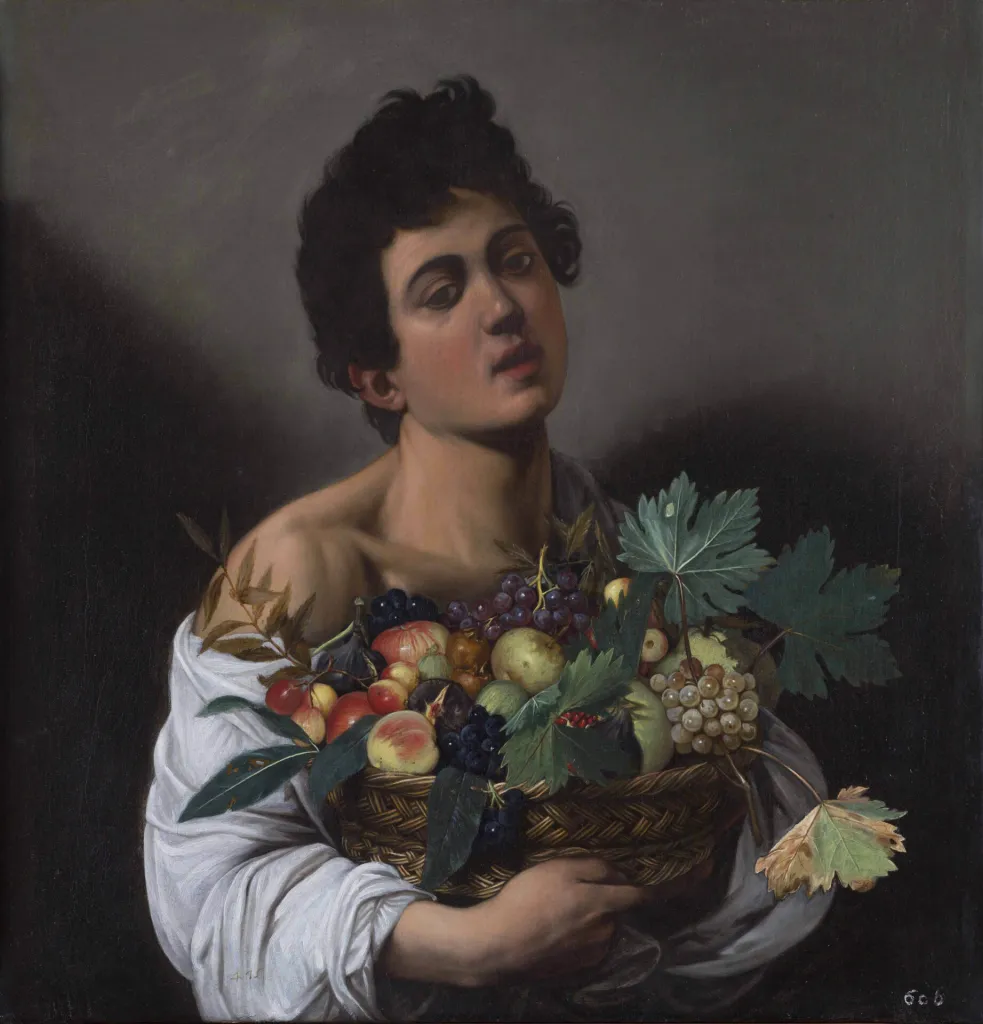
Boy with a Basket of Fruit
Details
About
One of Caravaggio's earliest surviving paintings, from his hungry years in Rome. The model is his friend and probable lover Mario Minniti. The real subject is the fruit: every leaf spotted with disease, apples bruised, grapes overripe. Caravaggio painted decay with the same fidelity as the boy's exposed shoulder â an early sign that his realism would refuse to look away from anything.
The full story
Technical details
- Medium
- Oil on canvas
- Dimensions
- 70 × 67 cm
- Date
- c. 1593–1594
- Commissioned by
- Uncommissioned (likely painted for the open market or Cavalier d'Arpino)
- Location
- Room VIII (The Caravaggio Room), Galleria Borghese, Rome
Historical context
When Caravaggio painted "Boy with a Basket of Fruit" around 1593, he was a young, struggling artist who had recently arrived in Rome from Lombardy. The city was a melting pot of Counter-Reformation fervor and a burgeoning market for secular art. Caravaggio had just left the workshop of Giuseppe Cesari—Pope Clement VIII’s favorite painter—where he had been employed to paint "flowers and fruits," a lowly genre compared to historical or religious narratives. This work represents Caravaggio’s early effort to elevate the status of still life and genre painting by infusing it with a startling, tactile realism. The era was marked by a shift away from the stylized, elongated forms of Mannerism toward a more direct observation of nature. Scientists and collectors in the circle of Cardinal Francesco Maria del Monte, who would soon become Caravaggio’s most important patron, were fascinated by the botanical precision of the New World’s flora and the raw reality of the streets. This painting was likely held in the collection of Cesari before being seized by the tax authorities and eventually handed over to Cardinal Scipione Borghese, the nephew of Pope Paul V and a voracious collector of Caravaggio’s revolutionary works.
Symbolism & iconography
- The Burst Pomegranate: A symbol of the Church or the Resurrection, but here it likely signifies the fullness and eventual decay of sensual pleasure.
- The Discolored Leaves: Represent 'Vanitas,' a reminder that all living things wither and die, regardless of their current beauty.
- The Exposed Shoulder: A provocative gesture common in 16th-century 'pitture ridicole' or 'low genre' paintings, signaling a sense of availability and street-level realism.
- Wicker Basket: Pushed to the edge of the table, it serves as a bridge between the fictional space of the painting and the real space of the viewer.
What to look for in person
- Note the 'pentimenti' or artist's changes; if you look closely at the edges of the boy's hair against the background, you can see where Caravaggio adjusted the silhouette.
- Lean in to see the 'bloom' on the grapes; Caravaggio used tiny dabs of white to simulate the waxy, dusty coating of the fruit.
- Observe the shadow on the back wall; it’s one of the earliest examples of Caravaggio using a diagonal shadow to create a sense of three-dimensional depth without using traditional architectural perspective.
- Look at the painting from the right side; the basket of fruit appears to protrude even further into your space due to the clever use of foreshortening.
Fun facts
- The painting was part of a group of works confiscated by Pope Paul V from the studio of Cavalier d'Arpino in 1607 after the latter failed to pay his taxes.
- The model, Mario Minniti, would later become a successful painter in his own right in Sicily.
- Botanists have identified the specific diseases on the leaves, including 'Cercospora' spots, proving Caravaggio painted from actual, ailing specimens rather than memory.
- This is one of the few Caravaggio paintings where the light source is almost fully ‘outdoor’ in quality, lacking the cellar-dark backgrounds of his later works.
Rating
Notes
Loading…