Masterpiece
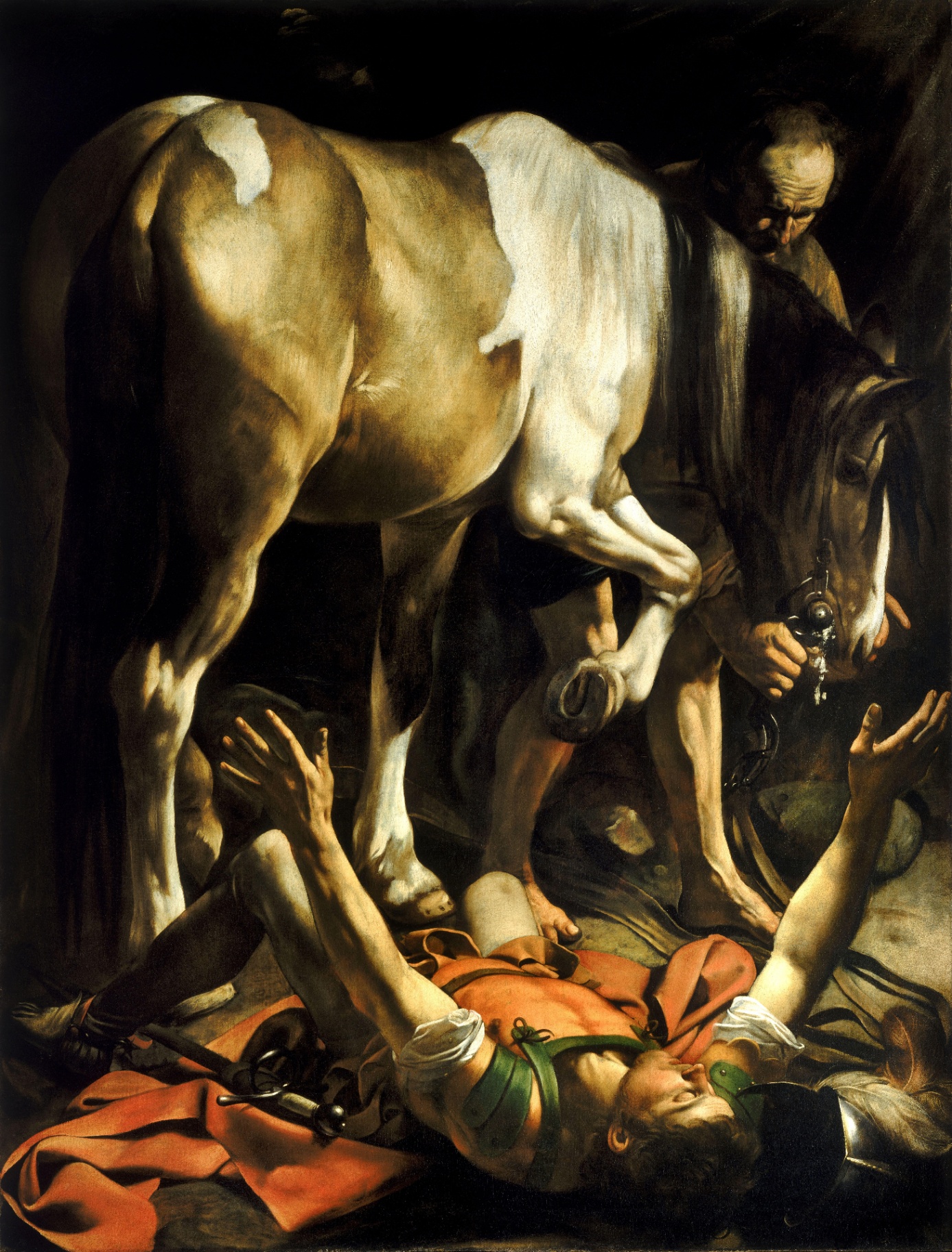
Conversion on the Way to Damascus
Details
Artist
Caravaggio · Baroque
About
The most audacious composition in Baroque painting: the largest figure is the horse. Saul is on his back on the ground, arms flung up, blinded by a light that comes from nowhere and everywhere. His elderly servant is calming the horse, oblivious to the miracle happening at his feet. The absence of Christ, the earthy realism of the horse's dappled flank, the compression of the composition into vertical space â all radical.
The full story
Technical details
- Medium
- Oil on canvas
- Dimensions
- 230 × 175 cm
- Date
- 1600–1601
- Commissioned by
- Tiberio Cerasi
- Location
- Cerasi Chapel, Santa Maria del Popolo, Rome
Historical context
In 1600, Monsignor Tiberio Cerasi, Treasurer-General to Pope Clement VIII, acquired a chapel in the Augustinian church of Santa Maria del Popolo. This was a prestigious commission at the dawn of the Roman Baroque, a period when the Catholic Church sought to use grand, emotive art to reaffirm its power during the Counter-Reformation. Cerasi hired the two leading stars of the Roman art world: Annibale Carracci to paint the altarpiece and Michelangelo Merisi da Caravaggio to provide two large canvases for the side walls. At the turn of the 17th century, Rome was a city of intense religious fervor and immense artistic competition. Caravaggio was already famous for his dramatic use of light and his tendency to use common street people as models for saints. For this chapel, he was tasked with depicting the pivotal moment of Saint Paul’s life. The resulting work represents a radical departure from traditional Renaissance iconography, stripping away the heavenly hosts to focus on a raw, interior spiritual awakening.
Symbolism & iconography
- The horse's raised hoof symbolizes the precariousness of human life and the unexpected nature of divine intervention.
- Paul’s closed eyes and outstretched arms represent his transition from physical sight to spiritual vision.
- The discarded sword and helmet on the ground signify his abandonment of his former life as a persecutor of Christians.
- The darkness of the background represents the 'dark night of the soul' or the spiritual blindness that preceded Paul's conversion.
What to look for in person
- Step to the far left of the chapel rail to see how the perspective snaps into place; the painting was designed to be viewed from an angle.
- Look closely at the horse’s leg; Caravaggio painted a vein bulging under the skin, a testament to his obsessive anatomical realism.
- Notice the contrast between this earthy, dark scene and Carracci’s bright, classical altarpiece directly in front of you—this was a deliberate 'battle of styles' in the 17th century.
- Observe the lack of a halo on Paul; Caravaggio often omitted traditional symbols of sainthood to emphasize the humanity of his subjects.
Fun facts
- This is actually Caravaggio's second version of the scene; his first version on wood was rejected by the patron and is now held in a private collection.
- Critics of the time mockingly called it 'the accident in the stable' because the horse's backside takes up more space than the saint.
- The dramatic foreshortening of Paul’s body was a revolutionary technique designed to make him appear to be falling out of the painting and toward the viewer.
- Unlike many other religious paintings of the era, the light source is invisible and psychological, representing the 'inner light' of faith.
Rating
Notes
Loading…