Masterpiece
The Creation of Adam
Details
About
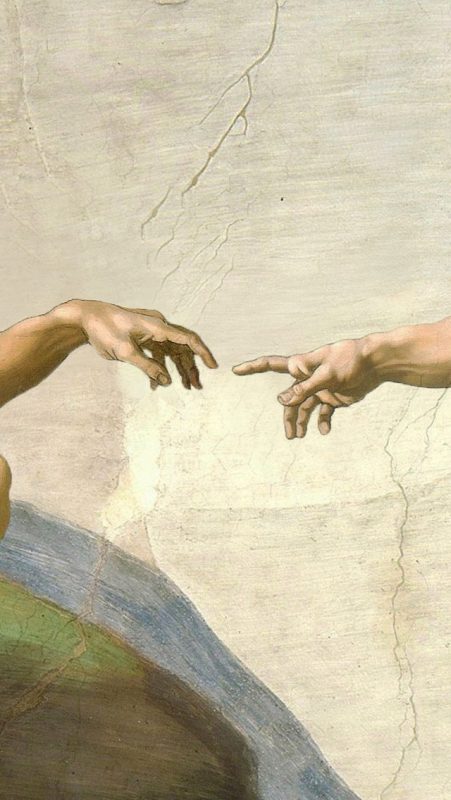
The most reproduced image in Western art â and the gap between the fingers is the point. Adam is a heavy, languid nude, energy about to enter him; God rushes in on a cloak of writhing figures, index finger extended, on the verge of contact. The cloak has been convincingly read as a cross-section of the human brain â anatomically accurate down to the pituitary stalk. Whether Michelangelo, a serious student of dissection, meant it as a secret metaphor is still argued.
The full story
Technical details
- Medium
- Fresco
- Dimensions
- 280 × 570 cm
- Date
- 1511–1512
- Commissioned by
- Pope Julius II
- Location
- Central Vault, Sistine Chapel, Vatican Museums
Historical context
In 1508, Pope Julius II, a man of volcanic ambition known as the "Warrior Pope," summoned Michelangelo Buonarroti back to Rome to paint the ceiling of the Sistine Chapel. Originally, the space featured a simple star-speckled blue sky, but Julius wanted something grander to reflect the prestige of the papacy and the holiness of the private chapel where the College of Cardinals met. Michelangelo, who considered himself a sculptor rather than a painter, initially resisted the commission, even signing his letters "Michelangelo, Sculptor" to protest the task. The era was the height of the High Renaissance, a period defined by a renewed obsession with Classical antiquity and the belief that the human body was the ultimate vessel for divine expression. While Michelangelo toiled on the scaffold between 1508 and 1512, Rome was a city in flux—a center of humanistic learning and papal power, but also a place of political tension as the Protestant Reformation began to stir in the north. The "Creation of Adam" serves as the central crowning jewel of this massive theological narrative, capturing the exact moment God breathes life, and by extension, the intellect, into humanity.
Symbolism & iconography
- The Divine Mantle: Many neuroanatomists believe the red cloak surrounding God is a perfect anatomical cross-section of the human brain, symbolizing God imparting intelligence to man.
- The Green Scarf: A thin green sash trailing from the divine group is thought by some to represent the umbilical cord, signifying the birth of humanity.
- The Mysterious Woman: The figure tucked under God's left arm is often identified as Eve, waiting in the divine mind to be created, or Sophia, the personification of Wisdom.
- The Finger of God: The straight, commanding finger of the Creator contrasts with the limp, curved finger of Adam, symbolizing the difference between divine will and human frailty.
What to look for in person
- Look at the work from the far end of the chapel (near the Last Judgment) to appreciate how Michelangelo adjusted the proportions to compensate for the extreme height of the ceiling.
- Observe the 'giornate' lines—faint seams in the plaster—which show exactly how much Michelangelo could paint in a single day before the lime dried.
- Directly after viewing the 'Creation,' look at the smaller panels nearby to see how Michelangelo’s style evolved from crowded, small figures to the massive, heroic scale seen in Adam.
Fun facts
- During the 1980s restoration, technicians discovered that the 'bridge of the nose' on Adam had actually fallen off in a structural collapse centuries ago and was poorly repainted; they left the repair visible to maintain historical integrity.
- Michelangelo painted the entire ceiling, including Adam, while standing up and leaning back, not lying on his back as popular legends suggest.
- The figure of God was originally painted with more modest robes, but Michelangelo’s obsession with anatomy led him to paint the muscular legs of the Creator with startling realism.
- The fresco was completed in just a few 'giornate' (days' work of fresh plaster), showing Michelangelo's incredible speed and confidence as he neared the end of the four-year project.
Rating
Notes
Loading…