Masterpiece
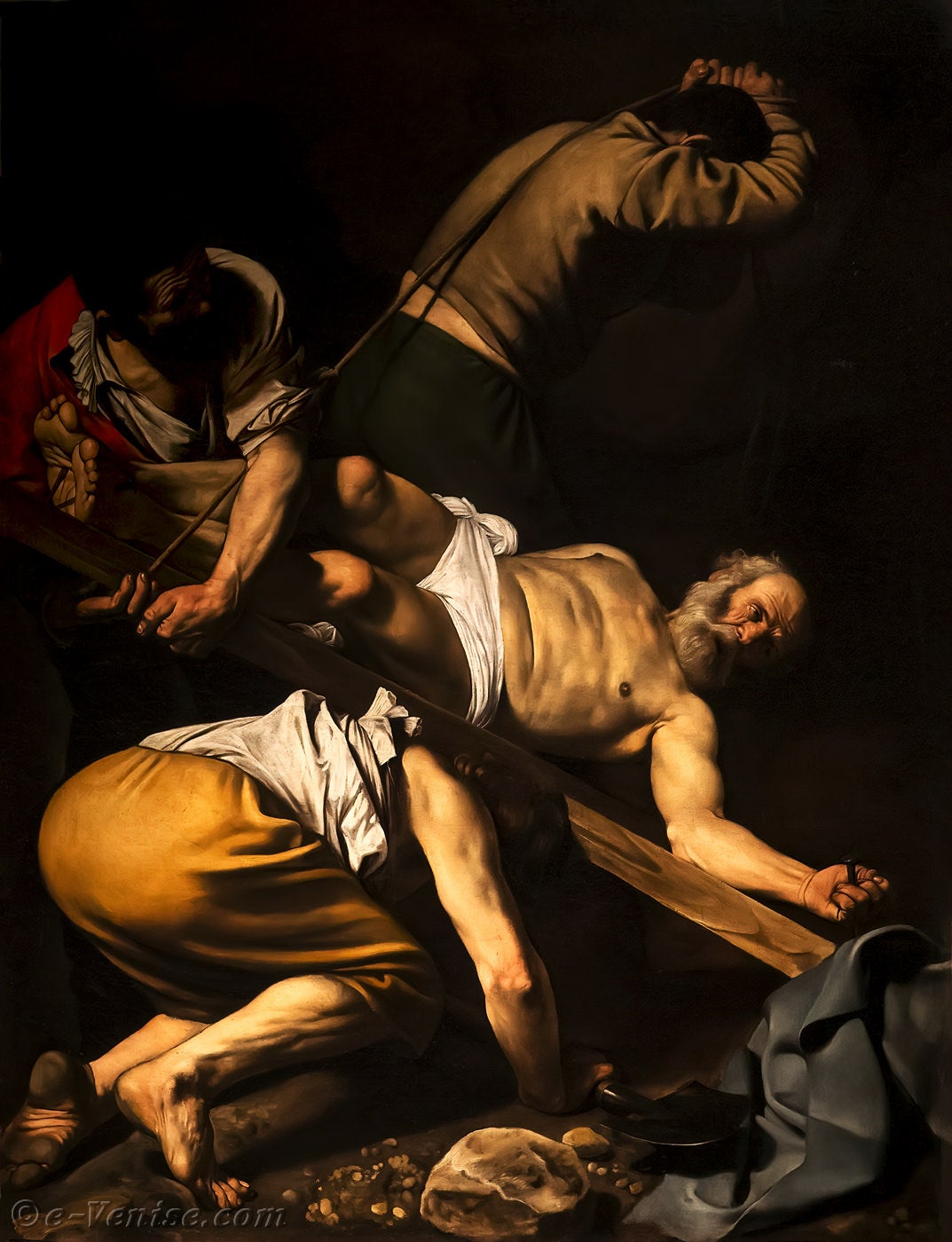
Crucifixion of St. Peter
Details
About
Peter is being crucified upside down (he refused to die like his master). Three anonymous laborers strain to hoist the cross â one shoves with his back, another pulls a rope with dirt-caked feet in our face. Peter is heavy, old, and heartbreakingly alive: he lifts his head to look at the nail in his own hand. No angels, no glory â just physical labor and pain. Paired directly opposite the Conversion of Paul.
The full story
Technical details
- Medium
- Oil on canvas
- Dimensions
- 230 × 175 cm
- Date
- 1600–1601
- Commissioned by
- Monsignor Tiberio Cerasi
- Location
- Cerasi Chapel, Santa Maria del Popolo, Rome
Historical context
In 1600, Monsignor Tiberio Cerasi, Treasurer-General to Pope Clement VIII, acquired a chapel in the Augustinian church of Santa Maria del Popolo. Rome was in the midst of the Counter-Reformation, a period when the Catholic Church sought to use powerful, direct, and emotionally resonant art to reassert its dogma against Protestant critiques. Cerasi commissioned the two leading stars of the Roman art world to decorate his chapel: Annibale Carracci for the altarpiece and Michelangelo Merisi da Caravaggio for the side walls. The contract was signed in September 1600, a time when Rome was flooded with pilgrims for the Jubilee year. Caravaggio was tasked with depicting the conversion of St. Paul and the crucifixion of St. Peter—the two pillars of the Roman Church. The artist was working in a city of extreme contrasts: the opulent wealth of the papal court and the gritty, often violent reality of the Roman streets. This tension is perfectly captured in his work for the Cerasi Chapel, which turned away from the idealized Mannerism of the previous century toward a startling, almost confrontational naturalism.
Symbolism & iconography
- The Upside-Down Cross: Symbolizes Peter's humility and his specific requested manner of martyrdom to distinguish his death from Christ's.
- The Large Stone: Situated in the foreground, it represents 'The Rock' of the Church, a direct reference to Matthew 16:18.
- The Shovel: Tossed on the ground, it indicates the hole is already dug, signaling the finality and imminent completion of the execution.
- The Nails: Driven through the hands and feet, they are painted with a cold, metallic realism that emphasizes the physical reality of the saint's suffering.
- The Darkness: Represents the spiritual void of the world without the light of the Gospel, which Peter is helping to bring through his sacrifice.
What to look for in person
- Stand slightly to the right of the painting to best appreciate the diagonal perspective Caravaggio intended for people entering the chapel.
- Note the contrast between the rough, dirty feet of the executioner and the pale, luminous skin of the Saint.
- Look at the painting from the altar rail; the composition is designed to make the cross feel like it is tilting directly into the chapel's physical space.
- The chapel is often dark; bring a few 1-Euro coins to operate the light box for a better view of the details in the shadows.
Fun facts
- Caravaggio actually painted two versions of this scene; the first version (on wood) was rejected or kept by a collector, and this second version on canvas was what finally graced the chapel.
- The executioner in the yellow jacket is crouching in such a way that his rear end is one of the closest things to the viewer, a typical bit of Caravaggio’s street-level cheekiness.
- The stone at the bottom left is a visual pun: Peter’s name in Greek (Petros) means 'rock,' signifying him as the foundation upon which the Church was built.
- Recent cleanings have revealed that the dirt on the executioners' feet is so meticulously painted that it suggests Caravaggio used actual Roman laborers as his models.
Rating
Notes
Loading…