Masterpiece
Danaë
Details
About
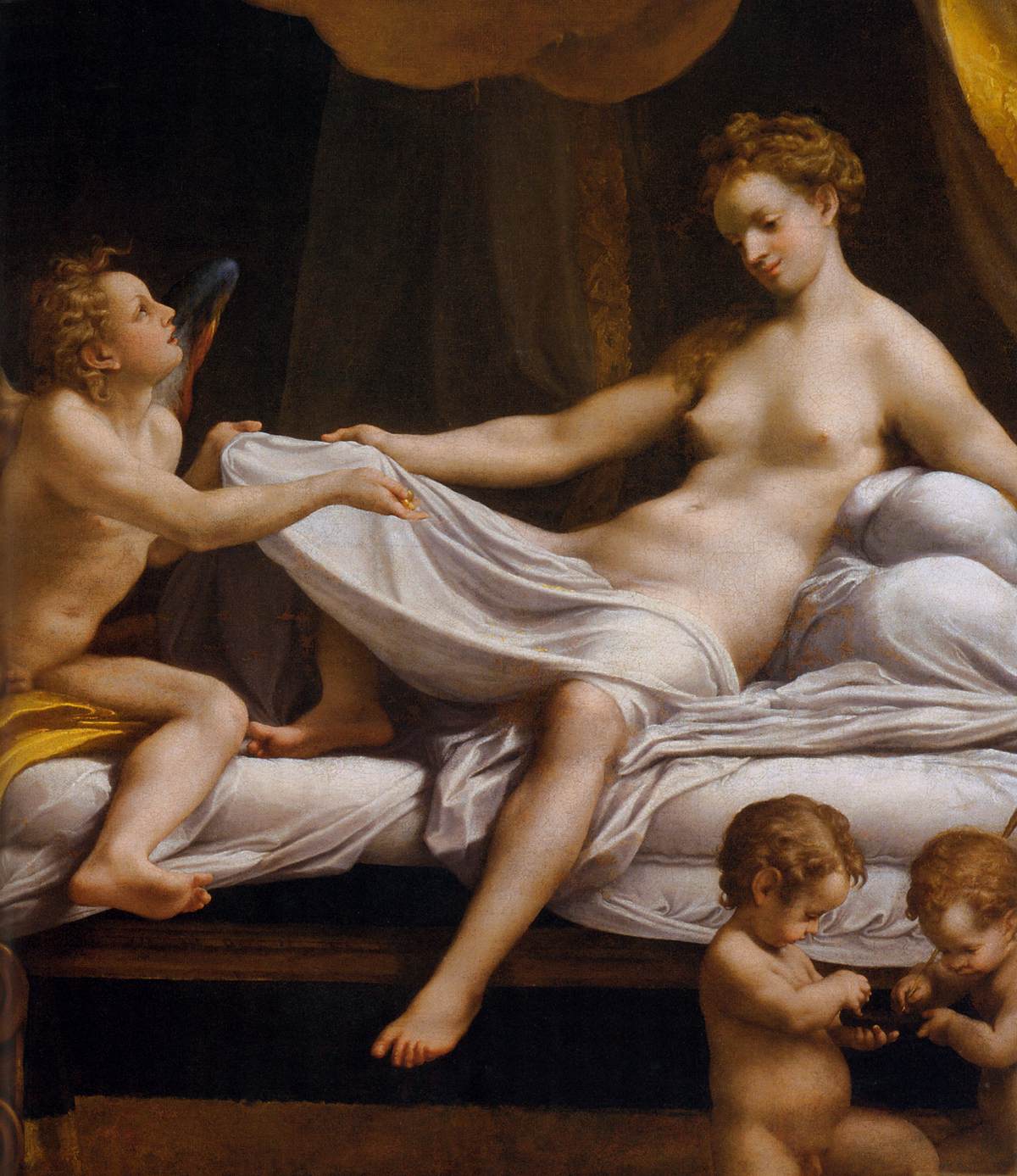
Zeus descends as a shower of gold onto the reclining Danaë â Correggio paints the gold as literal coins falling into her lap while Cupid holds back the sheet. The tenderness is startling: no violence, no drama, just soft light and complicit smiles. One of the four 'Loves of Jupiter' Correggio painted for the Duke of Mantua.
The full story
Technical details
- Medium
- Tempera on panel
- Dimensions
- 161 × 193 cm
- Date
- c. 1531
- Commissioned by
- Federico II Gonzaga, Duke of Mantua
- Location
- Room XX (The Room of the Psychological Portraits), Galleria Borghese
Historical context
Commissioned around 1530-1531 by Federico II Gonzaga, the Duke of Mantua, this painting was part of a prestigious series intended as a gift for Emperor Charles V. The suite, collectively known as 'The Loves of Jupiter,' focused on the various disguises the king of the gods assumed to seduce mortal women. At the time of its creation, Northern Italy was a vibrant hub of High Renaissance innovation, where artists like Correggio were pushing the boundaries of naturalism and sensuality. The work was produced during a period of intense diplomatic maneuvering. Federico Gonzaga sought to curry favor with the Holy Roman Emperor, and what better way to do so than with a series of high-end mythologies that celebrated power, beauty, and the physical delights of the Olympian gods. This was an era where the private rooms of princes were becoming galleries of 'poesie'—painted poems that prioritized visual pleasure and emotional atmosphere over moralizing lessons. When the painting eventually migrated to Rome, it became a cornerstone of the Borghese collection, reflecting the family's taste for refined, luminous Northern Italian masterpieces.
Symbolism & iconography
- The Golden Rain: Represents Jupiter's divine intervention and the 'seed' of the hero Perseus, who would be born from this union.
- The Touchstone: The dark stone the cupids use to test their arrows symbolizes the testing of true love versus fleeting passion.
- The Winged Hymen: Unlike the traditional old nurse, the presence of Hymen (god of marriage) legitimizes the union and adds a sense of grace.
- The Open Window: A standard Renaissance trope for the transition between the earthly, domestic sphere and the divine or natural world beyond.
What to look for in person
- The painting is best viewed from a slight distance first to appreciate the diagonal 'S-curve' of Danaë’s body, which provides the work’s underlying structure.
- Get closer to the bottom right corner to see the incredible detail in the cupids' wings; Correggio uses tiny, feathered brushstrokes to create a sense of genuine softness.
- Look at the shadow cast by the winged youth onto the bedsheets; notice how it is a 'soft' shadow with blue and grey tones rather than a flat black.
- Check the smile on Danaë's face from different angles; like the Mona Lisa, her expression seems to shift slightly depending on where you stand.
Fun facts
- The painting traveled more than most Renaissance masterpieces, moving from Mantua to Spain, then to Prague, Sweden, London, and Paris, before finally being purchased for the Borghese collection in 1827.
- Queen Christina of Sweden, a famous previous owner, reportedly loved the painting so much she took it with her into exile in Rome.
- The painting was once cut down in size on its left side during its many travels, meaning we lost a small portion of the original architectural background.
- Early critics were scandalized by the two cupids, suggesting they represented 'sacred' and 'profane' love, though they are more likely just a playful nod to the preparation for a romantic encounter.
Rating
Notes
Loading…