Masterpiece
David
Details
About
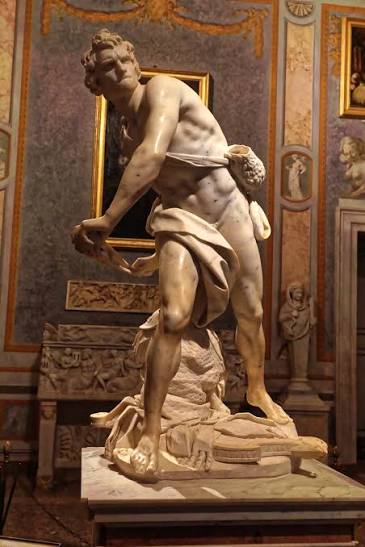
Not the serene Michelangelo David contemplating the fight â Bernini's David is mid-throw, muscles coiled, brow furrowed, lips pressed against clenched teeth. The face is Bernini's own self-portrait, checked in a mirror held by Cardinal Barberini (who would later become Pope Urban VIII). Goliath is invisible but implied â David is aiming at you. Stand where the sling is pointing and you become the giant.
The full story
Technical details
- Medium
- Marble
- Dimensions
- H. 170 cm
- Date
- 1623–1624
- Commissioned by
- Cardinal Scipione Borghese
- Location
- Room II (Sala del David), Galleria Borghese, Rome
Historical context
In 1623, Gian Lorenzo Bernini was the rising star of the Roman Baroque, a favorite of the Borghese family who possessed an uncanny ability to breathe life into stone. This life-sized 'David' was commissioned by Cardinal Scipione Borghese, the nephew of Pope Paul V and a voracious collector of both antiquity and modern masterpieces. At the time, Rome was the center of the Counter-Reformation, a period where the Catholic Church sought to use art to inspire awe and direct emotional engagement with scripture. Unlike the static masterpieces of the High Renaissance, the Baroque demanded action, drama, and a sense of physical theater. This work was the final of four monumental commissions Bernini executed for Scipione's villa, marking the moment where the sculptor transitioned from a prodigious talent to the undisputed master of his age, permanently redefining the boundaries of what marble could achieve.
Symbolism & iconography
- The Harp: Located at David’s feet, the harp is decorated with a griffin's head, symbolizing David's future role as a psalmist and king.
- Abandoned Armor: The plate armor belonging to King Saul signifies that true strength comes from divine faith rather than man-made protection.
- The Five Smooth Stones: In his shepherd’s bag, Bernini meticulously carved the reserve stones mentioned in the Book of Samuel, reinforcing biblical accuracy.</a>,
What to look for in person
- Walk toward the sculpture from the side to witness how the tension in the torso seems to increase as you move into David's line of sight.
- Look closely at the lips; Bernini captured the specific way a person bites their lip when performing a feat of immense physical strength.
- Examine the base to see the contrast between the rough-hewn 'ground' and the highly polished surface of King Saul's discarded breastplate.
- Observe the sculpture from the perspective of Goliath—directly in front of David's gaze—to feel the full psychological impact of the 'activated' space.
Fun facts
- The face of David is a self-portrait; Bernini carved his own features while his patron, the future Pope Urban VIII, reportedly held the mirror.
- The sculpture was originally positioned against a wall to force the viewer to see the action from a specific, high-velocity angle, though it is now displayed in the center of the room.
- Bernini was only 24 years old when he began this commission, completing it in a remarkable seven months.
- Unlike Michelangelo's David, who is nude to emulate Greek heroes, Bernini’s David is partially draped, adhering to the stricter modesty codes of the Counter-Reformation.
Rating
Notes
Loading…