Masterpiece
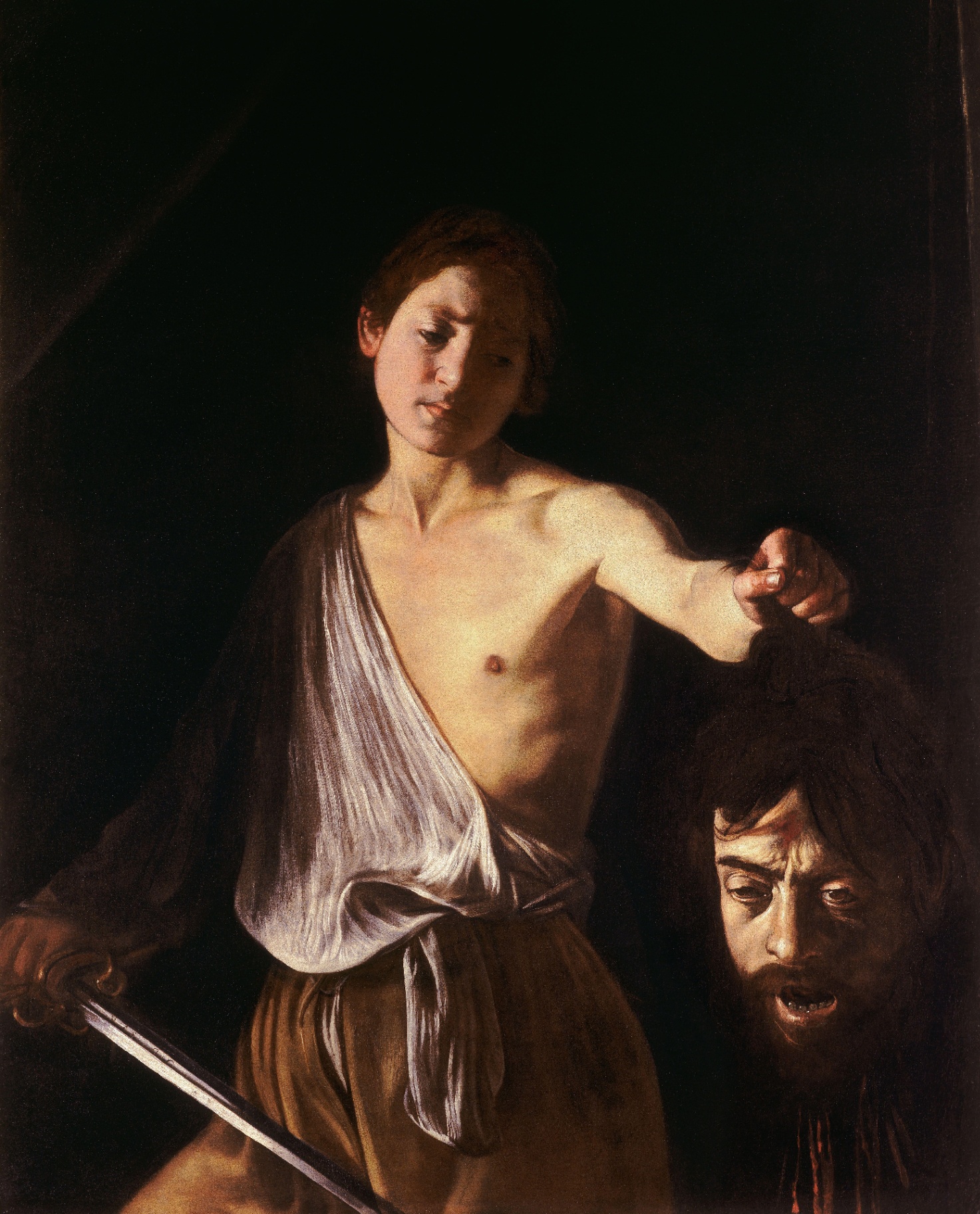
David with the Head of Goliath
Details
About
Painted in Caravaggio's final year, on the run for murder and hoping this canvas would win him a papal pardon. The head of Goliath is Caravaggio's own self-portrait â mouth open, eyes half-alive, blood still dripping. David looks not triumphant but sorrowful, as if pitying his victim. It's an autobiographical confession: the painter is the monster, and he's asking to be beheaded.
The full story
Technical details
- Medium
- Oil on canvas
- Dimensions
- 125 × 101 cm
- Date
- 1610
- Commissioned by
- Uncommissioned (Gift for Cardinal Scipione Borghese)
- Location
- Room VIII (Room of the Silenus), Galleria Borghese
Historical context
In 1610, Caravaggio was a man on the run, living in exile after murdering Ranuccio Tomassoni in a street brawl four years earlier. Desperate to return to his beloved Rome, the artist lived under a constant cloud of fear, frequently moving between Naples, Malta, and Sicily. During this period, the Roman art world was transitioning from the rigid structures of the High Renaissance into the emotional turbulence of the Baroque, a shift Caravaggio himself pioneered. This painting was created as a strategic plea for mercy. It was intended as a gift for Cardinal Scipione Borghese, the nephew of Pope Paul V and a powerful patron who possessed the authority to grant Caravaggio a formal pardon. The work is a psychological self-portrait, sent ahead of the artist as he traveled back toward Rome—a journey that would ultimately end in his mysterious death at Porto Ercole before the pardon could be realized. It stands as a haunting testament to a man who knew his time was short and his sins were many.
Symbolism & iconography
- The severed head: A brutal self-portrait representing the artist's 'sinful' self, literally offering his head to the Pope to pay for his crimes.
- The sword inscription: 'H-AS OS' (Humilitas occidit superbiam) confirms the theme of the painting as the victory of Christian humility over the sin of pride.
- The David's expression: Unlike typical depictions of victory, this David shows pity and remorse, symbolizing Caravaggio's hope for divine and legal mercy.
- The Darkness: The heavy use of shadows (chiaroscuro) symbolizes the moral vacuum and the 'dark night of the soul' Caravaggio was experiencing while in exile.
What to look for in person
- Look closely at Goliath's forehead; the artist painted the wound from the stone with such realism you can see the indented bone.
- Step back to appreciate the 'tenebrism'—the way the figures seem to project three-dimensionally out of the flat black background.
- Examine the hilt of the sword to find the faint 'H-AS OS' inscription, which is easily missed if you don't look for the white flecks of paint.
- Pay attention to David's dirty fingernails and the coarse texture of his shirt; Caravaggio was famous for including these 'ugly' realistic details in sacred scenes.
Fun facts
- Caravaggio was actually carrying this painting with him on the boat when he died, intending to hand-deliver it to the Borghese family.
- The model for David is widely believed to be 'Cecco del Caravaggio,' the artist's assistant and rumored lover, who appears in several of his works.
- X-ray analysis shows that Caravaggio originally painted David’s face at a different angle before settling on this more somber, downward-looking expression.
- The sword in David's hand is a 'cinquedea,' a type of short sword common in Renaissance Italy, often heavily engraved.
Rating
Notes
Loading…