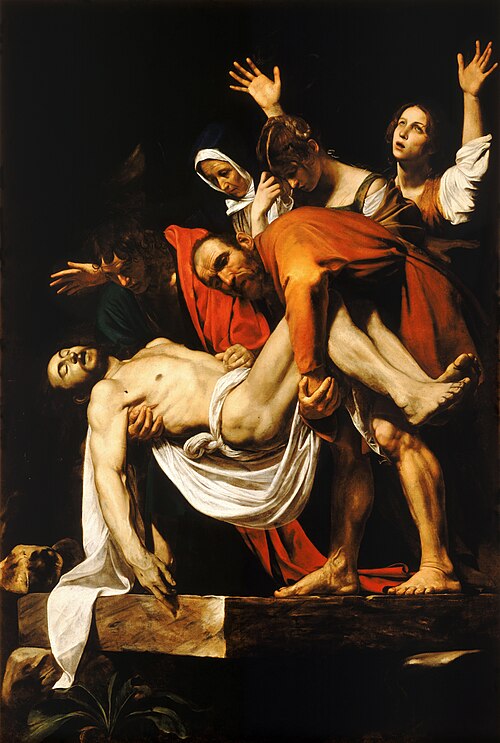
Masterpiece
The Entombment of Christ
Details
About
Caravaggio's most publicly acclaimed altarpiece â even Rubens copied it. Christ's dead weight pulls the entire composition downward, his hanging arm brushing the stone of the tomb. Nicodemus stares out at us, implicating the viewer in the burial. The diagonal from the raised hand of Mary of Cleopas down to Christ's dragging shroud is one of the most muscular compositions in Baroque painting. The stone slab in the foreground juts into our space â the tomb is where we stand.
The full story
Technical details
- Medium
- Oil on canvas
- Dimensions
- 300 × 203 cm
- Date
- 1602–1603
- Commissioned by
- Girolamo Vittrice
- Location
- Room XII, Vatican Pinacoteca, Vatican Museums
Historical context
Commissioned by Girolamo Vittrice for his family chapel in the Oratorian church of Santa Maria in Vallicella (the Chiesa Nuova), this masterpiece was created during the height of the Counter-Reformation. Rome at the turn of the 17th century was a city of intense religious fervor. The Oratorians, founded by Saint Philip Neri, emphasized a direct, humble, and emotionally resonant connection to the divine. Caravaggio’s art was the perfect vehicle for this mission, stripping away Mannerist artifice in favor of gritty, tactile humanity. The work was completed in 1603, a period when Caravaggio was the most famous and controversial painter in Rome. While many of his altarpieces were rejected for being "too vulgar," this painting was immediately hailed as a triumph. It remained in the Chiesa Nuova until 1797, when it was looted by Napoleon’s troops and taken to Paris. Following the Treaty of Paris in 1815, it was returned to Italy and eventually entered the Vatican collection, where it remains the centerpiece of the Pinacoteca’s Baroque gallery.
Symbolism & iconography
- The Stone of Unction: The sharp corner pointing at the viewer symbolizes Christ as the 'Cornerstone' of the Church.
- The Dropped Arm: Christ’s limp arm and touching of the stone signify the 'Word made Flesh' and the reality of the Incarnation.
- The Mullein Plant: The small green plant in the bottom left, Verbascum thapsus, was believed to have medicinal properties and symbolizes the hope of resurrection and healing.
- The Three Marys: They represent three distinct stages of female grief: the silent prayer of the Virgin, the weeping of Mary Magdalene, and the primal scream of Mary of Clopas.
What to look for in person
- Look at the painting from a slightly crouched position. Because it was designed for an altar, the perspective is optimized to be seen from below, making the stone slab seem to pop out in 3D.
- Examine the skin tones: note the contrast between the deathly, greenish-white of Christ’s torso and the sun-reddened, weathered skin of Nicodemus’s legs.
- Notice the fingers of John the Evangelist; they are pressed into the spear-wound in Christ’s side, a gritty detail that emphasizes the physical reality of the sacrifice.
Fun facts
- The painting was so admired by other artists that it is one of the most copied works in history, with versions painted by Rubens, Fragonard, and Géricault.
- The figure of Nicodemus is often thought to be a portrait of Michelangelo, or perhaps a nod to the sculptor's own late, unfinished Pietà.
- When Napoleon's officials selected works to take to the Louvre, this was one of the first paintings they seized due to its immense reputation.
- The 'Stone of Unction' depicted at the bottom is a specific reference to the slab where Christ's body was said to be washed and anointed before burial.
Rating
Notes
Loading…