Masterpiece
The Deposition
Details
About
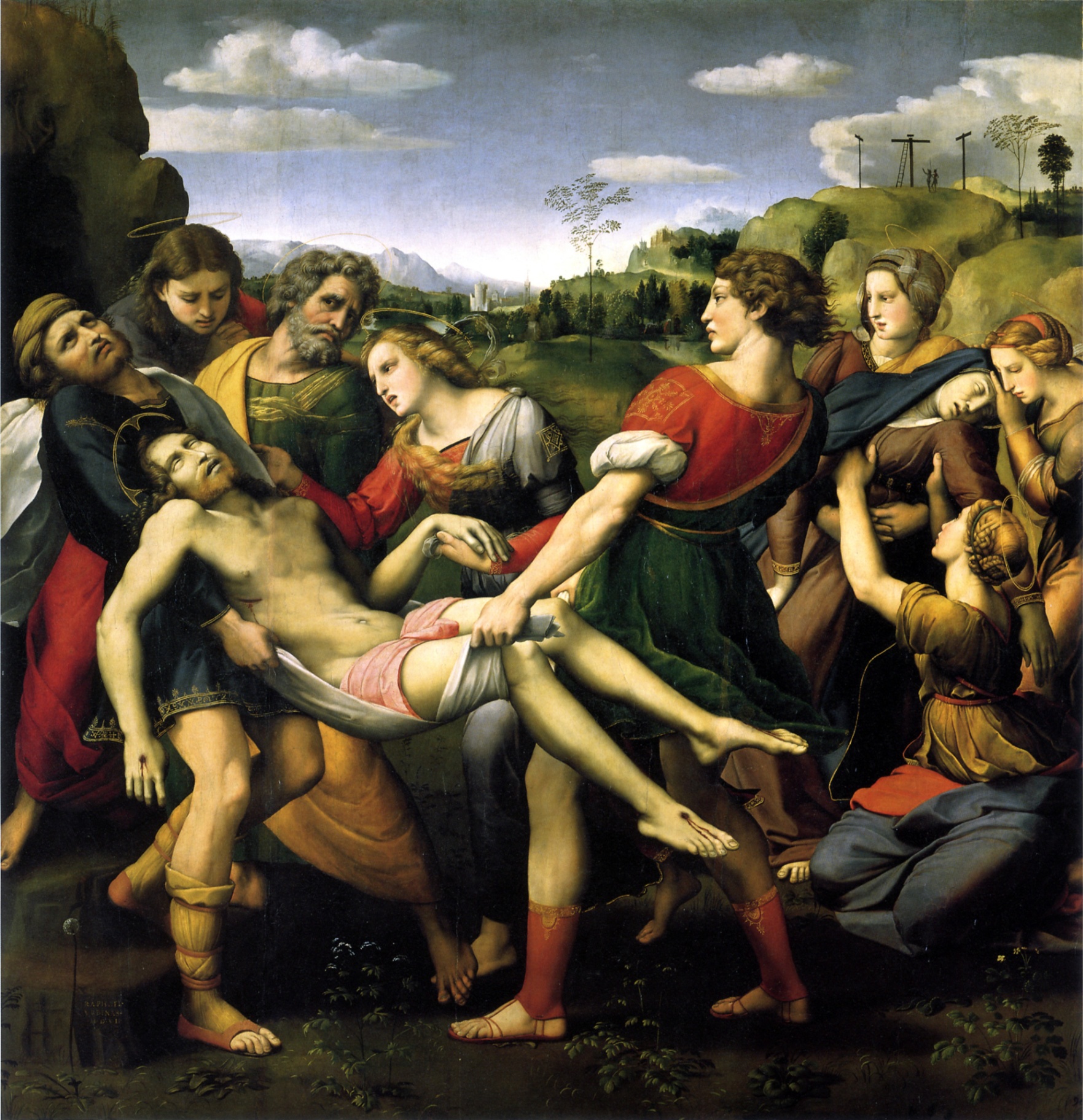
Raphael at 24, commissioned by Atalanta Baglioni in memory of her murdered son Grifonetto. The composition is a homage to Michelangelo â the twisted bearer at left echoes the Sistine ignudi â but the emotional current is Raphael's own. The Virgin faints on the right in a pyramid of grief; Christ's body is a diagonal of dead weight. Look at the bearer's braced legs and the strain in every neck: this is a body genuinely heavy to carry.
The full story
Technical details
- Medium
- Oil on wood panel
- Dimensions
- 184 × 176 cm
- Date
- 1507
- Commissioned by
- Atalanta Baglioni
- Location
- Room IX (The Silenus Room), Galleria Borghese, Rome
Historical context
The "Deposition" (also known as the "Borghese Entombment") was commissioned by Atalanta Baglioni, a noblewoman from Perugia, to commemorate her son Grifonetto Baglioni. Grifonetto had been murdered in 1500 during a bloody family feud for control of the city—a dark episode known as the 'Red Wedding' of Perugia. This work was Raphael's most ambitious undertaking before his move to Rome, serving as both a private memorial and a public declaration of his artistic maturity. At the turn of the 16th century, the High Renaissance was reaching its zenith. Raphael, still in his early twenties, was working in the shadow of Leonardo da Vinci and Michelangelo. In this commission, he sought to prove he could synthesize Leonardo’s emotional depth with Michelangelo’s muscularity. For nearly a century, the painting hung in the San Francesco al Prato in Perugia, until it was clandestinely removed in 1608 by agents of Cardinal Scipione Borghese, who coveted it so fiercely that he had it smuggled to Rome under the cover of night.
Symbolism & iconography
- The Sweetbriar/Thorns: Small thorny plants in the foreground subtly reference the Crown of Thorns and the physical pain of the Passion.
- The Cave: The dark, yawning entrance to the tomb on the left symbolizes the transition from the physical world to the unknown.
- The Swoon of the Virgin: Mary’s physical collapse (Spasimo) was a theological point of the era, emphasizing her status as a 'Co-Redemptrix' who suffered alongside her son.
- The Green Tunic: The carrier in the center wears a vibrant green, a color often used in the Renaissance to represent hope and the promise of the Resurrection.
What to look for in person
- Look at the grasping hand of the woman on the far right; her fingers are pressing into the Virgin's flesh, a detail of realism that demonstrates Raphael’s study of human anatomy.
- Step to the side of the painting to appreciate the 'cradling'—the wooden support structure on the back—which has helped keep this massive panel from warping for over 500 years.
- Observe the landscape in the upper left; notice how Raphael uses 'atmospheric perspective,' making the distant hills bluer and hazier to create a sense of vast depth.
Fun facts
- Cardinal Scipione Borghese liked the painting so much he had it stolen from a church at night; even after the citizens of Perugia rioted, the Pope (the Cardinal's uncle) issued a decree declaring it a gift.
- The figure of the young man carrying Christ's legs is widely considered to be a 'crypto-portrait' of Grifonetto Baglioni, the patron's murdered son.
- If you look at the horizon, you can see the three crosses of Golgotha in the far distance, providing a clear narrative timeline from the background to the foreground.
- The painting was originally part of a larger altarpiece; parts of the predella (the bottom decorative strip) are still in the Vatican Museums today.
Rating
Notes
Loading…