Masterpiece
Disputation of the Holy Sacrament
Details
Artist
Raphael · High Renaissance
About
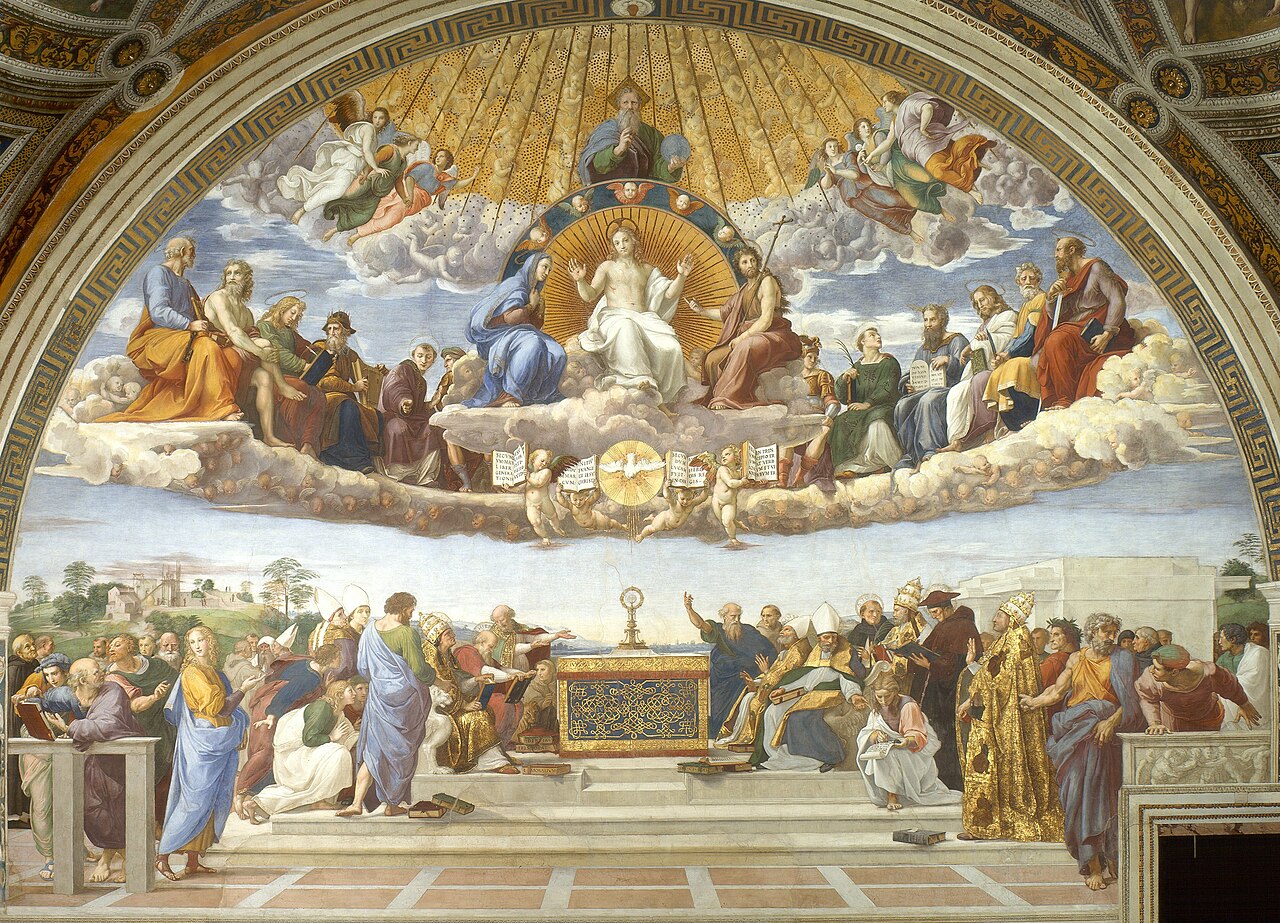
Painted directly across from The School of Athens, this fresco is its theological twin â reason on one wall, revelation on the other. The composition is stacked in tiers: the Eucharist on the altar below, saints and popes debating around it, then Christ enthroned with the Virgin and John the Baptist, and God the Father crowning the whole above. Raphael uses a double semicircle â one earthly, one heavenly â that echoes the curve of the wall itself, so the room becomes part of the painting. Look for Dante in profile among the theologians (right side, laurel-crowned).
The full story
Technical details
- Medium
- Fresco with gold leaf additions
- Dimensions
- 500 × 770 cm
- Date
- 1509–1510
- Commissioned by
- Pope Julius II
- Location
- Stanza della Segnatura, Vatican Museums
Historical context
The 'Disputation of the Holy Sacrament' was the first fresco Raphael painted for the Stanza della Segnatura, the private library and study of Pope Julius II. Commissioned around 1509, it represents a pivotal moment in the High Renaissance, when the papacy sought to reconcile classical antiquity with Christian theology. At this time, Rome was undergoing a massive urban and artistic transformation as Julius II—the 'Warrior Pope'—aimed to restore the city to its ancient imperial glory, using the brilliance of artists like Raphael and Michelangelo to assert the intellectual and spiritual supremacy of the Roman Catholic Church. The room itself was designed to house the Pope's personal collection of books, and the frescoes on the four walls represent the four pillars of human knowledge: Theology, Philosophy, Poetry, and Jurisprudence. Facing the 'School of Athens' across the room, the 'Disputation' serves as the ultimate expression of Theology. It illustrates the 'Disputatio,' not in the sense of an angry argument, but as a formal theological inquiry into the mystery of the Eucharist, where the truth is revealed through both divine revelation and the intellectual rigor of the Church Fathers.
Symbolism & iconography
- The Monstrance on the altar contains the Consecrated Host, serving as the central link between the earthly and heavenly realms.
- The Four Gospels are carried by cherubs appearing below Christ, symbolizing the spread of the Word to the four corners of the earth.
- The Holy Spirit is depicted as a dove flanked by four angels holding the books of the Gospels, emphasizing divine inspiration in scripture.
- Dante Alighieri, seen on the right with a laurel wreath, represents the inclusion of poetry and literature as valid paths to divine truth.
- The unfinished building on the left represents the ongoing construction of the new St. Peter’s Basilica, a project Julius II had just begun.
What to look for in person
- Follow the vertical line: start at the very top with God the Father and move your eyes straight down to the Host on the altar to understand the theological hierarchy.
- Look at the floor tiles: the perspective lines (orthogonals) are designed to make the room feel larger if you stand in the center of the Stanza.
- Compare the clouds: the clouds in the upper register are populated by tiny, ghostly heads of cherubim painted in 'monochrome' to suggest they are made of light.
- Notice the 'transparency' of the figures near the edges; Raphael uses softer, more blurred outlines (sfumato) to create a sense of atmospheric depth.
Fun facts
- The figure of Pope Julius II’s uncle, Pope Sixtus IV, appears on the right side of the altar wearing a gold-and-blue cape.
- Raphael included himself in the crowd; keep an eye out for a young man with a dark cap looking directly at the viewer near the far left railing.
- During the Sack of Rome in 1527, German mercenaries carved graffiti into the lower portions of the fresco; some of these 'Landsknecht' names were visible before modern restorations.
- The gold rays emanating from Christ are not just paint; Raphael applied actual gold leaf and tiny plaster buttons to the surface to make the light catch the sun.
Rating
Notes
Loading…