Masterpiece
Inspiration of St. Matthew
Details
Artist
Caravaggio · Baroque
About
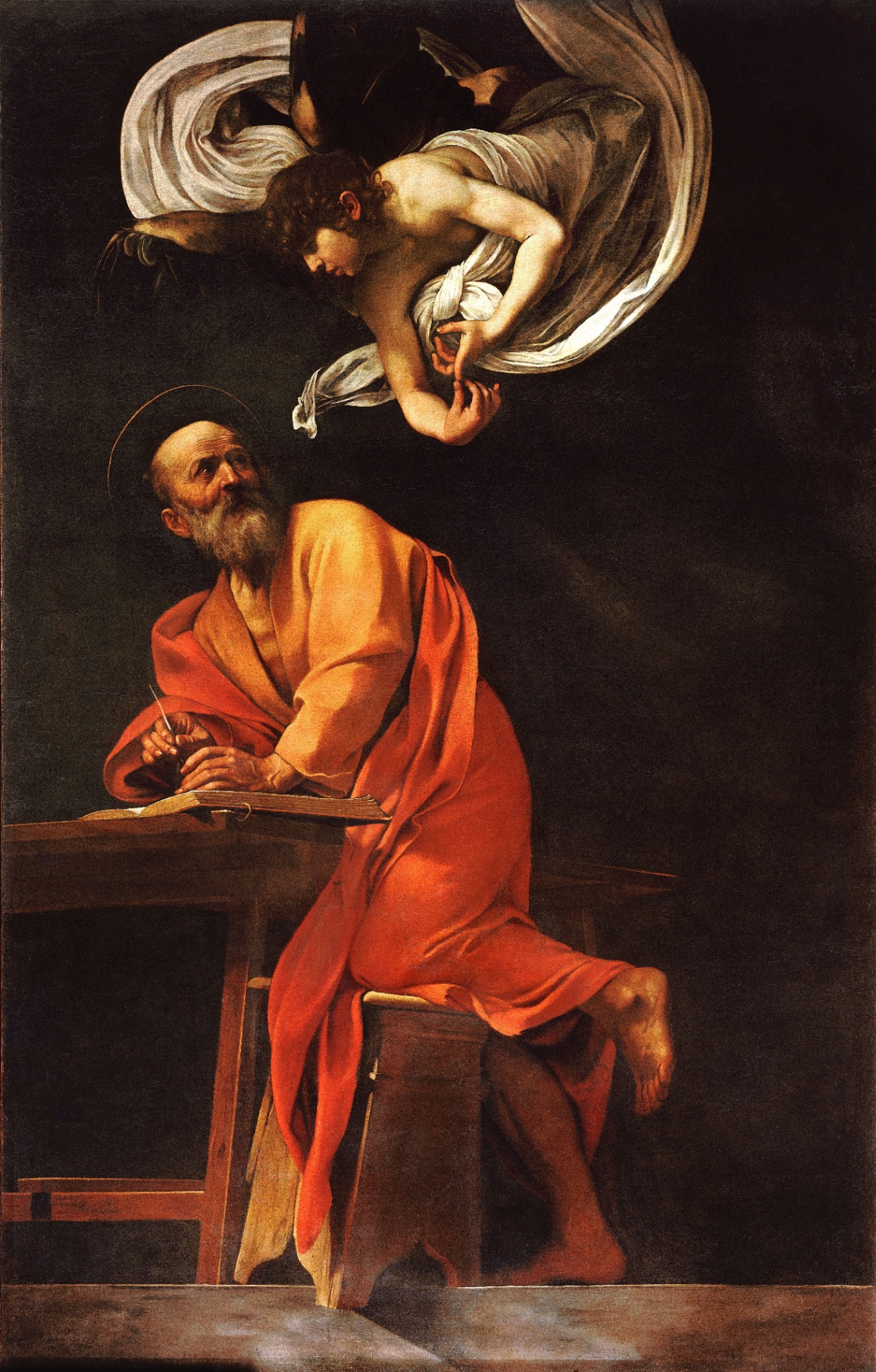
The altarpiece between the Calling and the Martyrdom. Matthew is a grey-bearded working man â his stool tilts precariously over the frame into our space â as an angel counts off the gospel points on his fingers. The first version was rejected as too undignified (Matthew was cross-legged and illiterate); Caravaggio painted this more decorous replacement. The dangling foot is still classic Caravaggio: sacred subject, dirty sole.
The full story
Technical details
- Medium
- Oil on canvas
- Dimensions
- 292 × 186 cm
- Date
- 1602
- Commissioned by
- The executors of Cardinal Matthieu Cointerel
- Location
- Contarelli Chapel, San Luigi dei Francesi, Rome
Historical context
The Inspiration of Saint Matthew (1602) represents the final chapter in Caravaggio’s breakthrough commissions for the Contarelli Chapel in San Luigi dei Francesi. The chapel was funded through the legacy of French Cardinal Matthieu Cointerel, known in Italian as Matteo Contarelli, who had died in 1585 without seeing his namesake chapel completed. By the time Caravaggio was hired to finish the decor, the project had languished for decades. This specific altarpiece was actually the result of a creative crisis: Caravaggio’s first version, known as Saint Matthew and the Angel, was rejected by the church officials for being too crude, as it depicted the saint as an illiterate peasant with dirty feet being physically guided by the hand. At the turn of the 17th century, Rome was the beating heart of the Counter-Reformation. The Catholic Church sought to use art as a weapon of faith, demanding clarity, realism, and emotional resonance to inspire the masses. Caravaggio’s revolutionary naturalism—a departure from the intellectualized, elegant distortions of Mannerism—fit this mandate perfectly, even if his gritty realism often pushed the boundaries of decorum for the clergy of the time.
Symbolism & iconography
- The Angel's counting fingers: Represents the systematic recording of Christ’s lineage, emphasizing the Gospel's role as a historical and theological record.
- The Tilted Stool: A symbol of the 'instability' of the human world when touched by the divine, signaling that the sacred has disrupted the mundane.
- Tenebrism (the dark background): Symbolizes the spiritual 'darkness' or void of the world, highlighting that divine truth is the only source of light.
- The Large Book and Quill: Indicators of Matthew's role as an Evangelist and the human effort required to translate divine wisdom into scripture.
What to look for in person
- Visit in the morning when the natural light in the church is best, but bring a few 1-euro coins to operate the chapel's light box.
- Step back to the center of the nave to see how the vertical lines of the painting align with the chapel's architecture.
- Look closely at the saint's feet; after the scandal of the first version, Caravaggio made sure these were clean, though he still insisted on a realistic, sun-reddened skin tone.
- Observe the angel's swirling white robe; the virtuoso brushwork there is much looser and more 'impressionistic' than the tight detail on Matthew’s face.
Fun facts
- This is actually Caravaggio's second attempt; his first version was rejected for making the saint look too much like an illiterate peasant.
- The original 'rejected' version was purchased by a collector but was unfortunately destroyed in Berlin during the closing days of World War II.
- The wooden stool tilting over the edge of the canvas is a 'trompe l'oeil' trick designed to make the painting appear to enter the viewer's physical space.
- X-rays of the canvas reveal that Caravaggio painted the angel's legs and the saint's robe with minimal underdrawing, working with characteristic speed directly onto the primed surface.
Rating
Notes
Loading…