Masterpiece
Lady with a Unicorn
Details
About
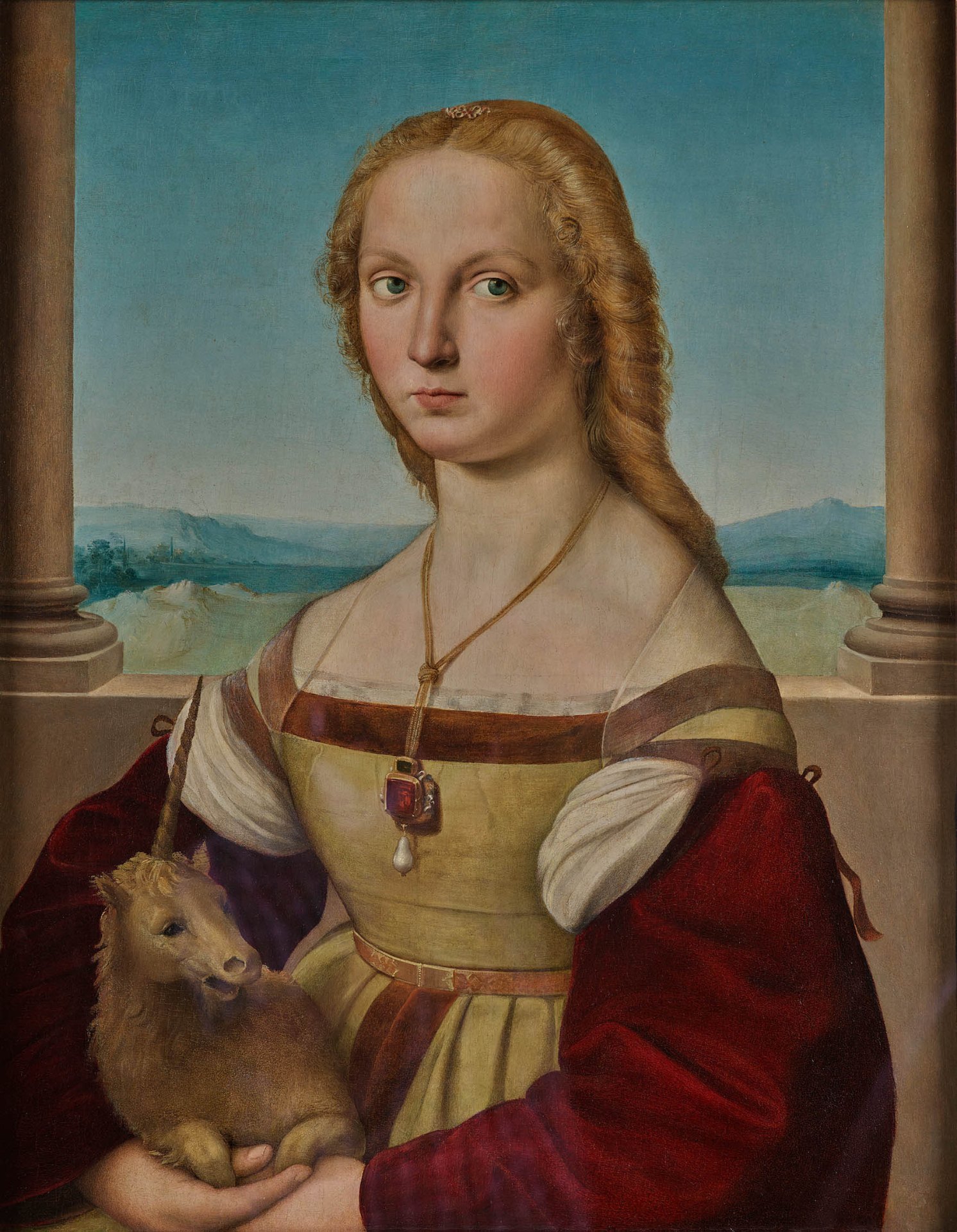
The unicorn is a symbol of chastity â it could only be tamed by a virgin. The sitter's identity has been debated for centuries (Giulia Farnese? Maddalena Strozzi? An unknown Roman bride?). X-rays reveal the picture began as a portrait with a dog, was overpainted with a unicorn, and then further overpainted in the 17th century to turn her into St. Catherine â before conservators returned it to Raphael's second version.
The full story
Technical details
- Medium
- Oil on wood panel transferred to canvas
- Dimensions
- 65 × 51 cm
- Date
- 1505–1506
- Commissioned by
- Likely the Strozzi or Farnese family
- Location
- Room IX, Galleria Borghese, Rome
Historical context
Painted around 1505–1506, this portrait captures Raphael during his pivotal Florentine period. Having moved from his native Urbino to Florence, the young prodigy found himself in the orbit of Leonardo da Vinci. This was a transformative moment in the High Renaissance; Leonardo was working on the 'Mona Lisa', and its influence spread through the artist community like wildfire. While the identity of the sitter remains a point of scholarly debate, she is widely believed to be Maddalena Strozzi, or perhaps a member of the Farnese family. At the time of its creation, Rome and Florence were centers of immense patronage where portraiture served as a vital tool for social status and matrimonial negotiations. This work was likely commissioned to celebrate a wedding, as the unicorn was a potent symbol of virginal purity, a prerequisite for a noble bride in 16th-century Italy. After centuries of being overpainted and misattributed, the painting arrived at the Galleria Borghese, where it stands as one of the museum's most prized gems of the High Renaissance.
Symbolism & iconography
- The Unicorn: A mythical creature symbolizing purity and virginal chastity, indicating the sitter was likely an unmarried or newlywed noblewoman.
- The Ruby and Pearl Pendant: The ruby represents passion and prosperity, while the single large pearl hanging below it symbolizes innocence and spiritual purity.
- The Two Columns: These represent fortitude and stability, framing the sitter as a pillar of her family and household.
- Red Velvet Sleeves: The deep crimson color and expensive fabric signify the immense wealth and high social status of the sitter's family.
What to look for in person
- Look closely at the horizon line; Raphael uses 'aerial perspective,' making the distant hills bluer and fainter to create a sense of deep space.
- Observe the pendant's shadow on her chest; the light source is consistent, coming from the upper left, which gives her body a three-dimensional, 'sculptural' quality.
- Notice the hair; individual fine strands are painted with a single-hair brush, showcasing Raphael's meticulous attention to detail even at a young age.
Fun facts
- For nearly 300 years, this was thought to be a portrait of Saint Catherine because the unicorn had been completely painted over with a spiked wheel and a martyr's palm.
- When scholars first attributed the work to Raphael in the 19th century, they actually thought it was a portrait of the artist's mistress, 'La Fornarina,' before the hidden unicorn was discovered.
- Radiograph tests revealed that Raphael originally painted a small dog—a symbol of marital fidelity—in the woman's lap before changing it to a unicorn.
- This was the first painting in history to be restored using X-ray technology to guide the removal of overpainting.
Rating
Notes
Loading…