Masterpiece
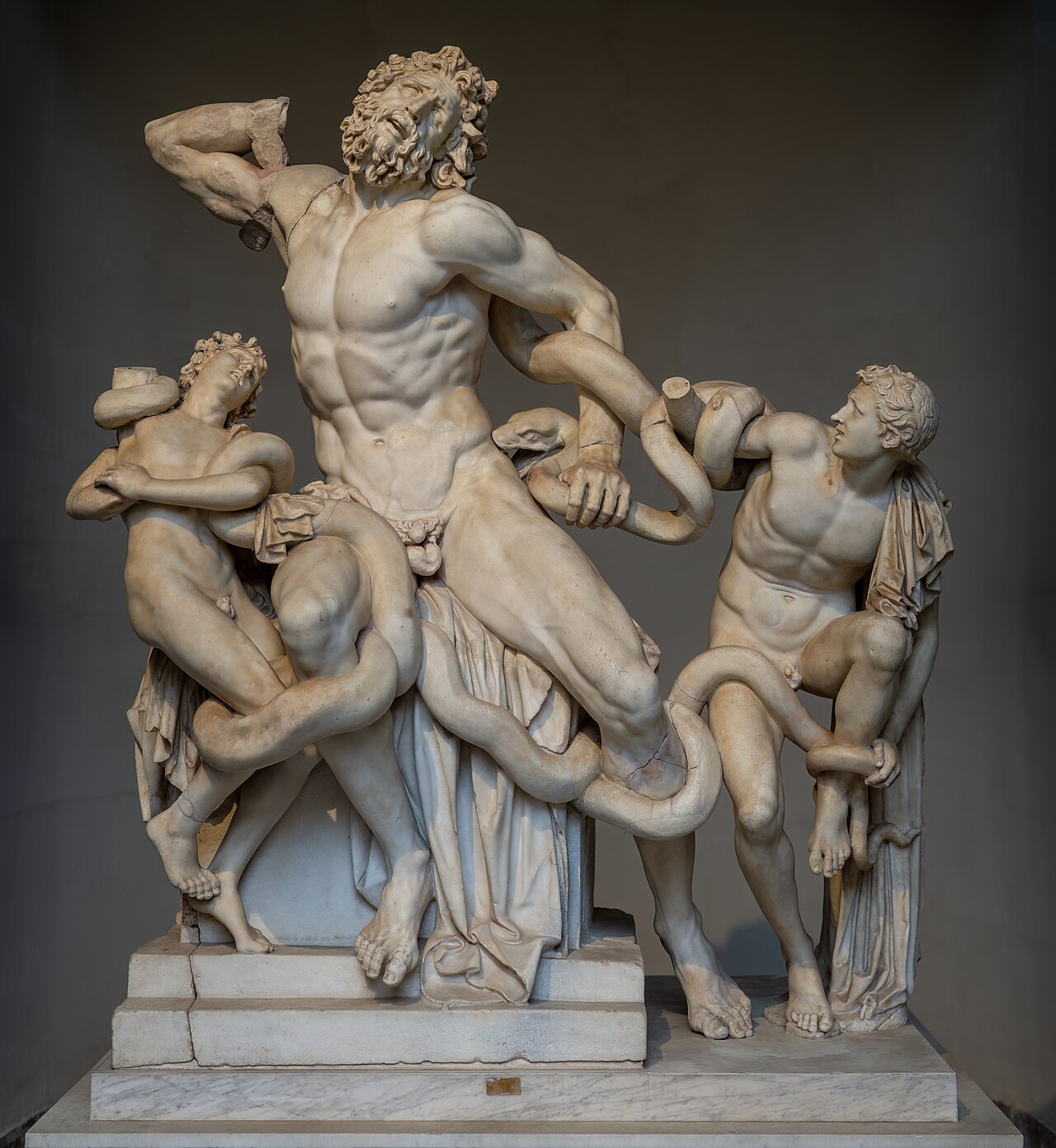
Laocoön and His Sons
Details
About
Dug up in a Roman vineyard in 1506 while Michelangelo was working nearby â he ran to see it, and the influence on the Sistine ceiling was immediate. Laocoön, the Trojan priest who warned against the wooden horse, is being strangled with his sons by sea serpents sent by the gods. The muscular anguish, the diagonals of the coils, the open-mouthed scream â this is the founding statue of Western pathos. Pliny called it 'a work to be preferred to all that the arts of painting and sculpture have produced.'
The full story
Technical details
- Medium
- Marble (White Parian)
- Dimensions
- H. 208 cm (approx. 6 ft 10 in)
- Date
- c. 40–30 BC (or a 1st Century AD Roman copy of a Hellenistic original)
- Commissioned by
- Likely a Roman patron or the Imperial court
- Location
- Octagonal Court (Cortile Ottagono), Pio-Clementine Museum, Vatican Museums
Historical context
The discovery of the Laocoön in 1506 on the Esquiline Hill was an earth-shattering event for the Roman Renaissance. Unearthed near the site of Emperor Nero’s Golden House and the Baths of Titus, the sculpture was immediately identified by the architect Giuliano da Sangallo and Michelangelo as the masterpiece described by the Roman historian Pliny the Elder. Pliny had hailed it as a "work to be preferred to all that the arts of painting and sculpture have produced." At the time of its creation—likely around 40 BC by the Rhodian sculptors Agesander, Athenodoros, and Polydorus—Rome was transitioning from a Republic to an Empire. The sculpture reflects the "Hellenistic Baroque" style, characterized by intense emotionalism and dramatic movement. Its rediscovery fundamentally altered the course of Western art, providing a visceral model of human suffering and muscular tension that would haunt the works of Michelangelo and define the aesthetic of the High Renaissance and the subsequent Baroque era.
Symbolism & iconography
- The Sea Serpents: Sent by Poseidon or Athena, they represent the inescapable will of the gods and the crushing weight of destiny.
- The Altar: The base on which Laocoön sits signifies his role as a priest and emphasizes the sacrilegious nature of his divine punishment.
- The Nudity: Unlike Roman political portraiture, the figures are heroically nude to elevate the scene from a historical event to a universal mythological tragedy.
- The Hair and Beard: The deep, chaotic drilling of the curls signifies turmoil and the loss of social order or control.
What to look for in person
- Move to the far right of the sculpture to see the oldest son’s expression of pity for his father—it is arguably the most heartbreaking detail.
- Look closely at the father's side, where the serpent’s fangs are actually biting into his hip; the marble here is carved with incredible delicacy to show the skin pulling.
- Stand back to appreciate how the sculpture was designed to be viewed from the front; though it is three-dimensional, the composition is almost relief-like in its arrangement.
- Check the lighting; the deep shadows in the eyes and under the muscles are intentional, designed to heightening the 'chiaroscuro' effect of the stone.
Fun facts
- When discovered, the father's right arm was missing; Michelangelo correctly guessed it was bent back over the shoulder, but for centuries, a straight 'reaching' arm was attached instead.
- In 1905, a Czech archaeologist found the original bent arm in a builder's yard in Rome; it was finally reattached to the statue in 1957.
- Pope Julius II purchased the sculpture immediately upon its excavation and had it brought to the Vatican on a wagon covered in laurel leaves.
- Napoleon Bonaparte was so obsessed with the piece that he looted it in 1798 and took it to the Louvre; it was only returned to Rome after his defeat at Waterloo.
Rating
Notes
Loading…