Masterpiece
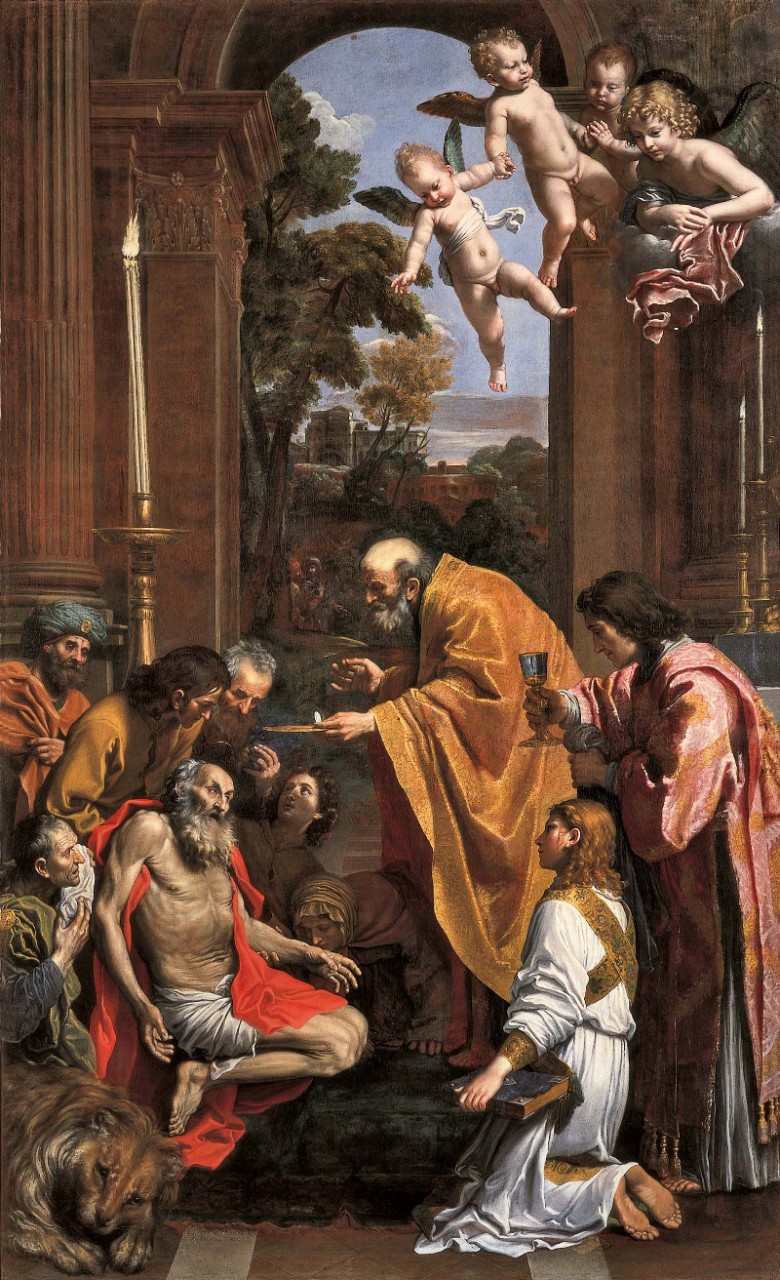
The Last Communion of St. Jerome
Details
About
Domenichino was accused of plagiarizing an older painting by his teacher Agostino Carracci â the case became one of the first plagiarism scandals in art history. Whatever its origins, it's an emotionally exacting picture: Jerome is emaciated, kneeling naked-shouldered before the altar, receiving his final communion. The lion (his desert companion) sleeps at his feet. Poussin considered this one of the greatest paintings in Rome.
The full story
Technical details
- Medium
- Oil on canvas
- Dimensions
- 419 × 256 cm
- Date
- 1614
- Commissioned by
- The Congregation of San Girolamo della Carità
- Location
- Room XII, Pinacoteca, Vatican Museums
Historical context
In 1614, Rome was the beating heart of the Counter-Reformation, a period when the Catholic Church utilized grand, emotional art to reassert its doctrines against Protestant challenges. Domenico Zampieri, known as Domenichino, was a leading light of the Bolognese school, which sought to marry the rigorous draftsmanship of Raphael with the emotional clarity required by the Council of Trent. This massive altarpiece was originally commissioned for the church of San Girolamo della Carità. At this time, Rome was transitioning from the raw, dark naturalism of Caravaggio toward a more disciplined, classical Baroque style. Domenichino, a protégé of Annibale Carracci, became the primary exponent of this "ideal" style. The painting arrived at a moment when the cult of Saint Jerome—a Doctor of the Church who translated the Bible into Latin—was being heavily promoted to emphasize the importance of the sacraments and the continuity of Church tradition. This work was immediately recognized as a masterpiece, though it would soon become the center of one of the most famous plagiarism scandals in art history.
Symbolism & iconography
- The Lion: Traditional attribute of Saint Jerome, representing his time in the desert and his strength of character, here shown in a state of mourning.
- The Skull: A 'memento mori' (reminder of death) sitting near the saint's feet, signaling the transition from the temporal world to the eternal.
- The Scarlet Robe: Referencing Jerome's status as a Cardinal of the Church, though historically the office did not exist in his lifetime.
- The Golden Chalice and Host: These are the focal points of the composition, reinforcing the Catholic doctrine of the Real Presence of Christ in the Eucharist.
- The Architecture: The Roman arches in the background symbolize the triumph of the Church over the ruins of the pagan world.
What to look for in person
- Step back to the center of the room to appreciate how the arch in the painting mimics the real architectural frames of the Pinacoteca's galleries.
- Focus on the hands of the figures; Domenichino uses them to lead your eye in a circular motion around the Host.
- Examine the texture of the priest's golden dalmatic (vestment); the artist used thick impasto and delicate glazing to simulate the look of heavy, woven silk.
- Look through the archway in the background to see the silver-blue tones of the distant hills, a technique called aerial perspective.
Fun facts
- The painting sparked a massive scandal when Giovanni Lanfranco accused Domenichino of plagiarizing a similar work by their teacher, Agostino Carracci; the debate raged for decades before critics realized Domenichino had actually improved upon the original.
- Nicolas Poussin, one of the most famous painters in history, famously declared this work one of the two greatest paintings in existence.
- When the painting was taken to Paris by Napoleon, it was meticulously restored by French experts, which helped preserve its brilliant colors for centuries.
- Domenichino was paid a mere 50 scudi for the work—a pittance for a masterpiece—because the monks who commissioned it were notoriously frugal.
Rating
Notes
Loading…