Masterpiece
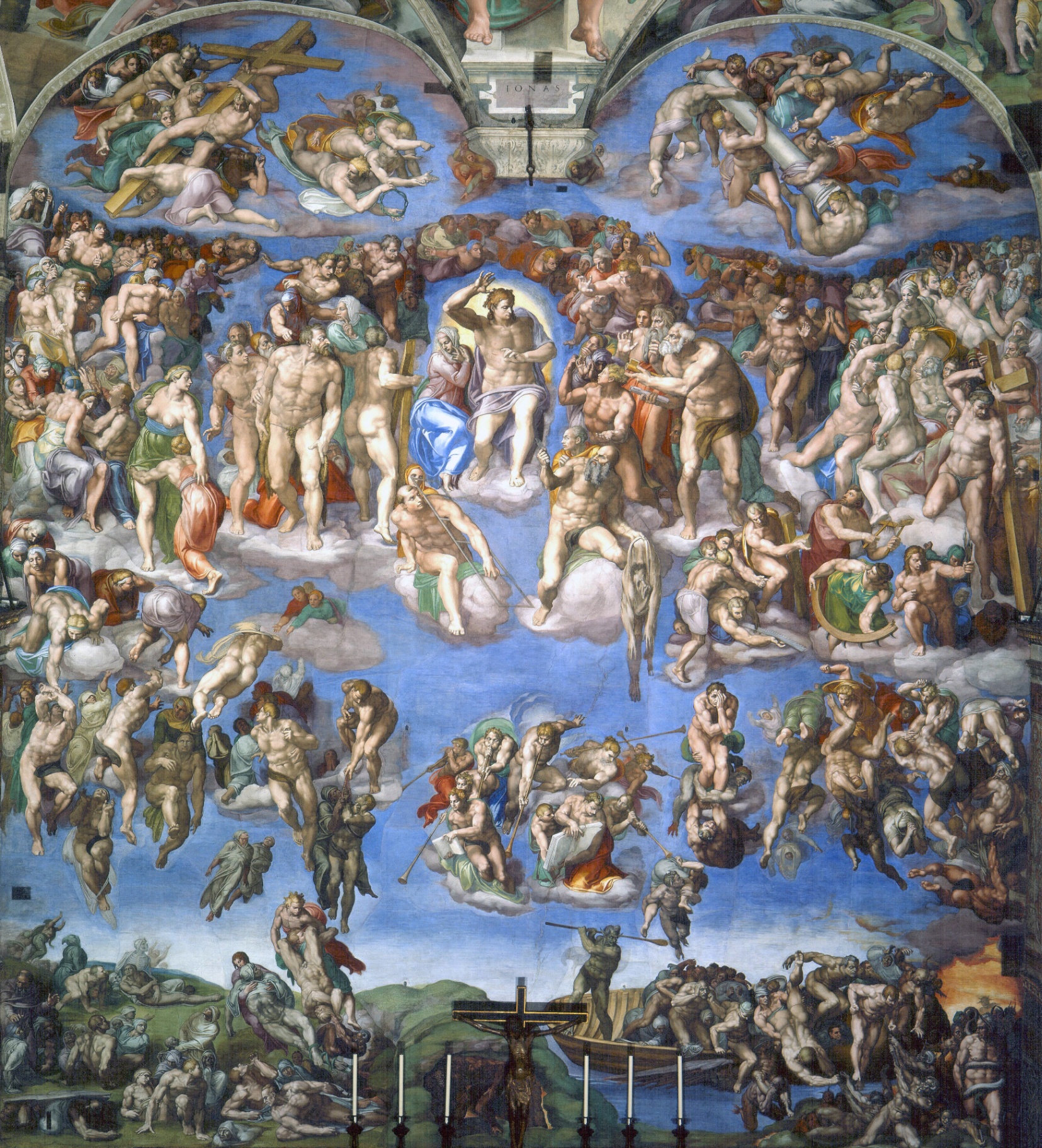
The Last Judgement
Details
About
Painted 25 years after the ceiling, this altar wall is Michelangelo at 66 â angrier, darker, more terrifying. Christ is a beardless, athletic judge whose raised arm sends the damned spiralling down toward Charon's boat. St. Bartholomew holds his own flayed skin, and the face on that skin is Michelangelo's self-portrait: the artist as martyr. The papal master of ceremonies Biagio da Cesena complained about the nudity, and Michelangelo painted him into hell as Minos with donkey ears and a snake biting his groin. Loincloths were added later by 'the breeches-maker' Daniele da Volterra.
The full story
Technical details
- Medium
- Fresco
- Dimensions
- 1,370 × 1,220 cm
- Date
- 1536–1541
- Commissioned by
- Pope Clement VII and Pope Paul III
- Location
- Altar Wall, Sistine Chapel, Vatican Museums
Historical context
Commissioned by Pope Clement VII and confirmed by his successor Paul III Farnese, The Last Judgment was painted between 1536 and 1541, a quarter-century after Michelangelo completed the chapel ceiling. This was a period of profound ecclesiastical crisis; the Protestant Reformation was fracturing Europe, and the Sack of Rome in 1527 had left the city physically and spiritually scarred. The Catholic Church responded with the Counter-Reformation, a movement seeking to reassert papal authority and doctrinal purity. Michelangelo returned to the Sistine Chapel not as the hopeful young man who painted the Creation of Adam, but as a mature artist grappling with his own mortality and a darkening religious climate. To make room for this terrifying vision of the apocalypse, two of his own previous frescoes and several by Perugino were destroyed. The resulting work shocked many for its relentless nudity and departure from traditional iconography, reflecting a Church—and an artist—in the throes of radical transformation.
Symbolism & iconography
- Saint Bartholomew's Flayed Skin: A grotesque self-portrait of Michelangelo, symbolizing his spiritual anguish and desire to be 'reborn.'
- The Rosary: On the left, two souls are pulled up to heaven by a set of prayer beads, emphasizing the Catholic doctrine of salvation through prayer and works.
- Charon and Minos: The inclusion of these mythological figures from Dante’s 'Divine Comedy' bridges the gap between classical antiquity and Christian theology.
- The Instruments of the Passion: In the top lunettes, angels struggle with the Cross, the Crown of Thorns, and the Pillar of Scourging, reminding the viewer that Christ's mercy came through physical sacrifice.
What to look for in person
- Look at the bottom right corner to find the figure of Minos; his face is a caricature of the Pope's Master of Ceremonies who criticized the work.
- Observe the skin of Saint Bartholomew (sitting just below Christ's left foot) to see Michelangelo’s hidden self-portrait.
- Notice the contrast between the ascending 'saved' on the left and the descending 'damned' on the right to feel the cyclical motion of the piece.
- Compare the bright, restored colors of the blue sky to the darker, sootier look it had prior to the major 1980-1994 restoration.
Fun facts
- The fresco was so controversial that a 'Purification' campaign was launched after Michelangelo's death to paint over the genitals of the figures.
- Michelangelo chose to use the most expensive pigment available, lapis lazuli, for the vast blue sky, which was paid for by the Vatican.
- Biagio da Cesena complained to the Pope about his unflattering portrait as Minos, but the Pope jokingly replied that his jurisdiction did not extend into Hell.
- To create a more immersive and imposing effect, Michelangelo tilted the upper part of the wall slightly forward so it 'looms' over the viewer.
Rating
Notes
Loading…