Masterpiece
Madonna of Foligno
Details
About
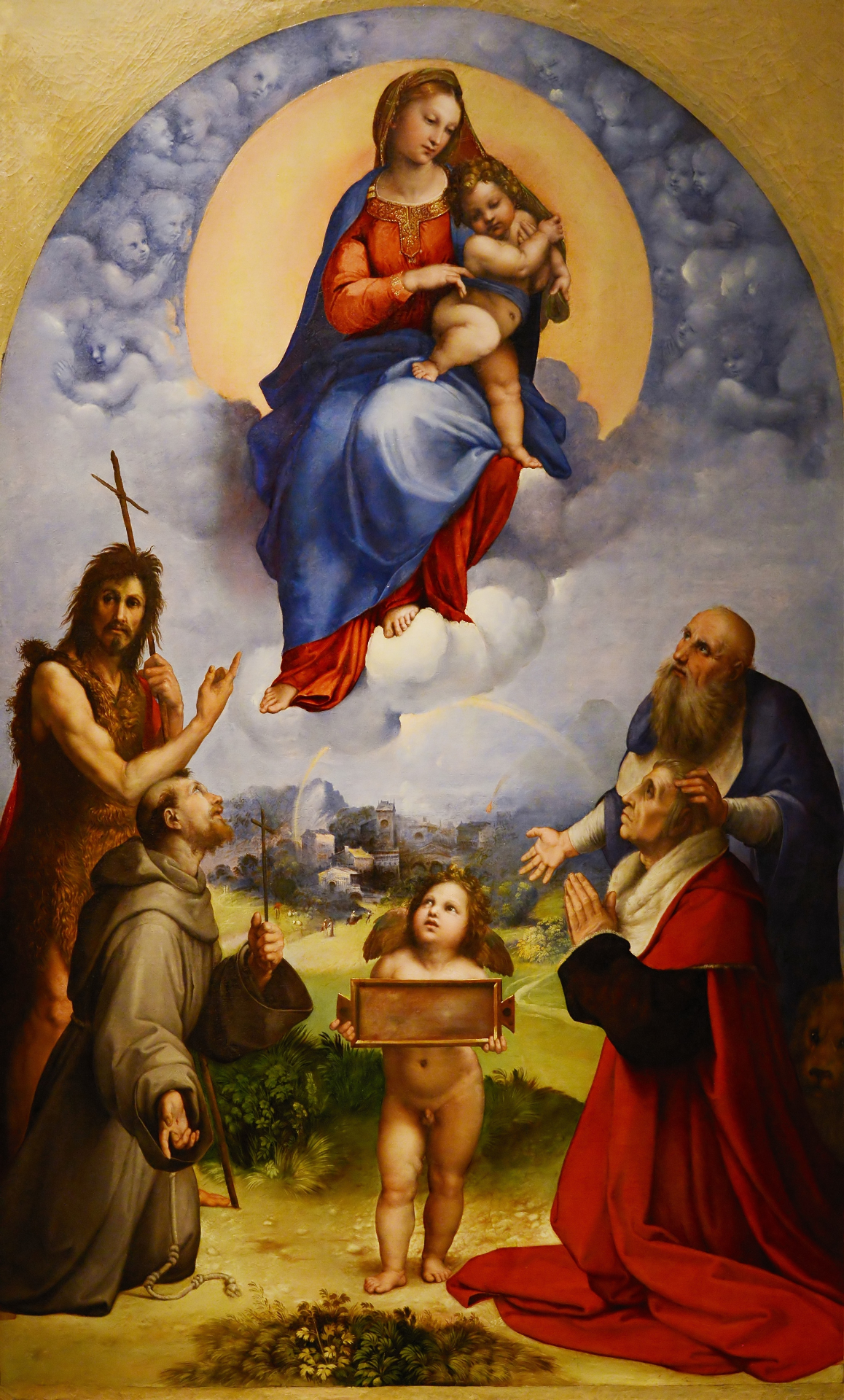
A votive altarpiece: the donor Sigismondo de' Conti kneels at right, thanking the Virgin for surviving a lightning strike (visible in the background, hitting his house in Foligno). A cherub in the center holds a blank tablet â likely the original inscription has been lost. The Virgin sits in a golden mandorla of clouds and cherub-heads; her intimate downward gaze at the donor makes the miracle personal.
The full story
Technical details
- Medium
- Oil on canvas (transferred from wood)
- Dimensions
- 320 × 194 cm
- Date
- 1511–1512
- Commissioned by
- Sigismondo de' Conti
- Location
- Room VIII (The Raphael Room), Pinacoteca, Vatican Museums
Historical context
The early 16th century in Rome was a period of unparalleled artistic fervor under the papacy of Julius II, the "Warrior Pope." Raphael had been in the city for several years, competing with Michelangelo’s Sistine Ceiling while decorating the Vatican Stanze. Amidst this creative explosion, Sigismondo de' Conti, a prominent humanist scholar and court secretary to the Pope, commissioned this altarpiece as an ex-voto, a gesture of gratitude to the Virgin Mary. The immediate catalyst was a terrifying event at de' Conti's home in Foligno. Around 1511, a fireball—variously interpreted as a meteor or a stray projectile from a nearby siege—struck the estate but miraculously left the family and the house unharmed. This work was a public declaration of divine protection, originally intended for the high altar of the Santa Maria in Aracoeli in Rome, where de' Conti was eventually buried. It represents a peak moment in High Renaissance art, where the natural world and the supernatural realm are reconciled through Raphael’s evolving mastery of light and atmosphere.
Symbolism & iconography
- The blue and red of the Virgin's robes represent her roles as Queen of Heaven (blue) and the Mother of the sacrificial Christ (red).
- St. Francis’s presence signifies the commission's link to the Franciscan church of Santa Maria in Aracoeli, where the painting first hung.
- The golden disc behind the Virgin functions as a 'mandorla' or halo, signifying her purity and her status as the 'woman clothed with the sun' from the Book of Revelation.
- The orange-colored clouds beneath the Virgin are actually composed of the faces of 'cherubim,' indicating that the very atmosphere of heaven is formed by divine spirits.
What to look for in person
- Look closely at the clouds around the Virgin's feet to find the faint, ghostly faces of angels emerging from the vapor.
- Observe the landscape of Foligno in the background under high light; the 'fireball' has a distinct glowing trail that shifts from orange to yellow.
- Step to the side to see the texture of the canvas; because it was transferred from wood in the 19th century, the surface has a unique, slightly flattened quality despite the vibrancy of the paint.
- Pay attention to the textures of the clothing, especially the contrast between St. Jerome's heavy silk Cardinal robes and St. Francis's rough, woolen habit.
Fun facts
- The painting was taken to Paris by Napoleon's troops in 1799, where it underwent a risky restoration process that involved transferring the paint layer from the original wood panel to a canvas support.
- Sigismondo de' Conti died in 1512, shortly before the painting was completed, making this a posthumous tribute to his devotion.
- The 'meteor' depicted in the background is a subject of scientific debate; while art historians call it a thunderbolt, some astronomers believe it is one of the earliest accurate depictions of a bolide (a bright meteor) in art.
- The blank plaque held by the putto has never been filled; while some say it was meant for a text that was never finalized, others argue its emptiness represents the 'ineffable' nature of God's grace.
Rating
Notes
Loading…