Masterpiece
Madonna of the Pilgrims
Details
About
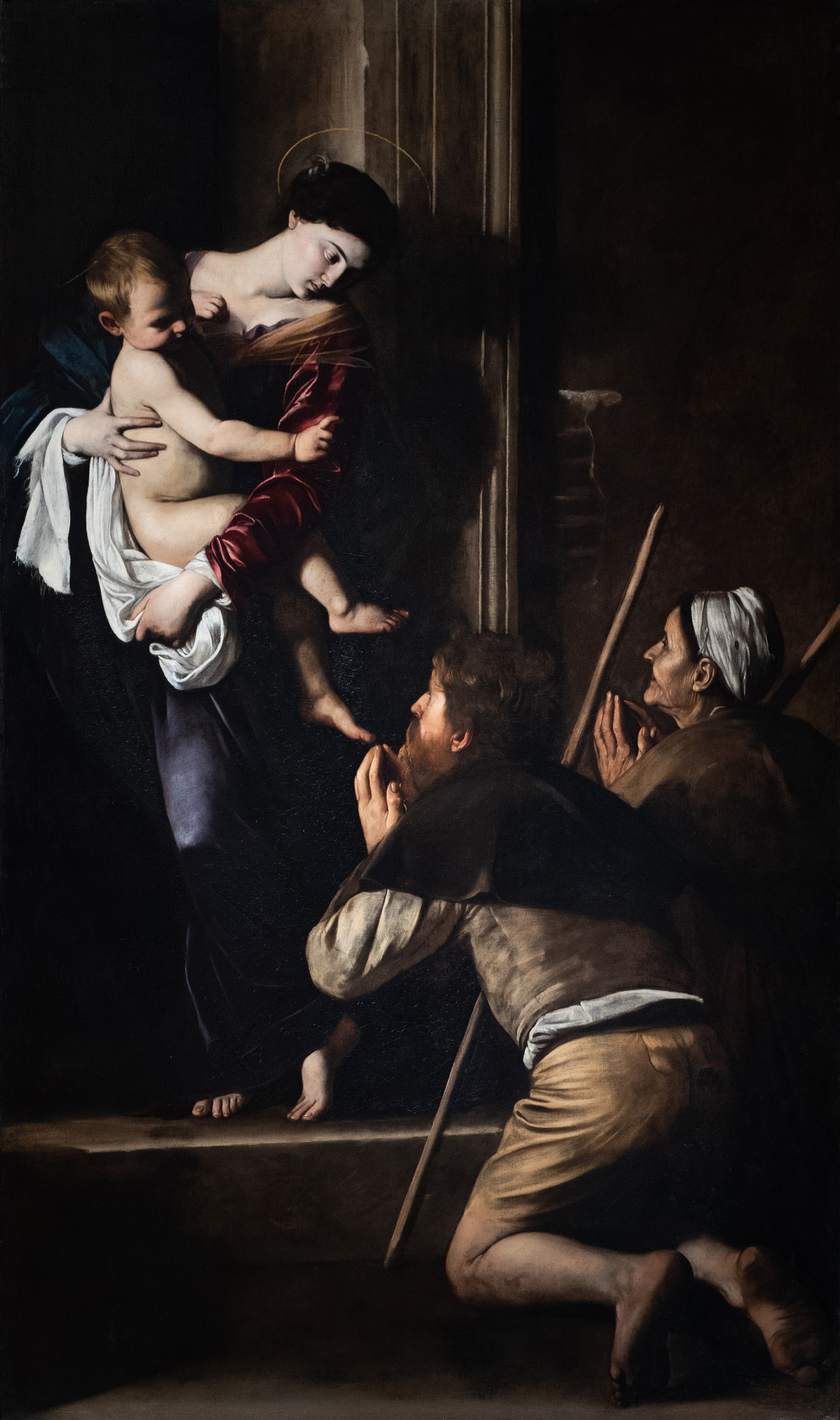
Also called Madonna di Loreto. The Virgin appears at her doorstep to two barefoot pilgrims kneeling in the dirt â soles filthy, clothes travel-worn. Scandalized viewers noted the 'dirty feet' immediately. She stands in a contrapposto lifted straight from classical statuary, holding a Christ Child almost too big for her. The painting is still in its original chapel, which is exactly the point: Caravaggio painted it to feel like the Virgin might step out of the frame and greet you.
The full story
Technical details
- Medium
- Oil on canvas
- Dimensions
- 260 × 150 cm
- Date
- 1604–1606
- Commissioned by
- Ermete Cavalletti (Family Chapel)
- Location
- Cavalletti Chapel, Basilica of Sant'Agostino, Rome
Historical context
Commissioned in 1603 for the Cavalletti family chapel in the Basilica of Sant’Agostino, Caravaggio’s "Madonna of the Pilgrims" (or "Madonna di Loreto") arrived during the height of the Counter-Reformation. This was a period when the Catholic Church sought to reaffirm its connection to the common person while simultaneously defending its core dogmas. The painting took roughly two years to finish, debuting in 1606 to a public that was both scandalized and enthralled by its raw honesty. Rome at the turn of the 17th century was a city of extreme contrasts—divine splendor and crushing poverty. As pilgrims flooded the city for Jubilee years and religious festivals, the Sant’Agostino church, located near the Piazza Navona, became a central hub for the faithful. Caravaggio, living a volatile life of street brawls and artistic brilliance, captured this gritty reality, placing the divine Mother and Child not in a celestial void, but on a crumbling Roman doorstep, directly encountering the weary poor who sought her blessing.
Symbolism & iconography
- The dirty feet represent the 'vita pauperum' (the life of the poor) and the physical reality of the pilgrimage to Loreto.
- The stone step serves as a 'liminal space'—a boundary between the holy interior of the home and the gritty exterior of the world.
- The shadow cast by the Virgin’s foot onto the step symbolizes her entry into the physical world of the viewer.
- The child’s nudity and his size emphasize the 'Word made Flesh,' highlighting his humanity and vulnerability.
What to look for in person
- Look at the painting from the right side of the chapel; Caravaggio adjusted the perspective to account for the viewer’s approach from the church entrance.
- Examine the bottom right corner to see the incredible detail in the male pilgrim’s calloused, sun-darkened skin.
- Notice the halo—it is a thin, almost invisible gold wire, typical of Caravaggio’s move toward naturalism.
- Visit in the morning when the natural light from the high windows of the basilica best mimics the directional light within the painting.
- Observe the Virgin's grip; she holds the heavy child with the practiced ease of a real mother, a departure from more stiff, symbolic poses.
Fun facts
- The painting caused an immediate scandal because of the 'filthy feet' of the pilgrims, which critics felt were too undignified for an altar.
- The model for the Virgin, Lena, was at the center of a legal dispute when a notary claimed Caravaggio attacked him over her honor.
- While most people think the Virgin is standing, she is actually leaning with her weight on one hip, a pose known as 'haughty' or 'plebeian' depending on the critic.
- The brickwork visible through the peeling plaster on the left was a direct reference to the crumbling state of many Roman buildings at the time.
Rating
Notes
Loading…