Masterpiece
Martyrdom of St. Matthew
Details
Artist
Caravaggio · Baroque
About
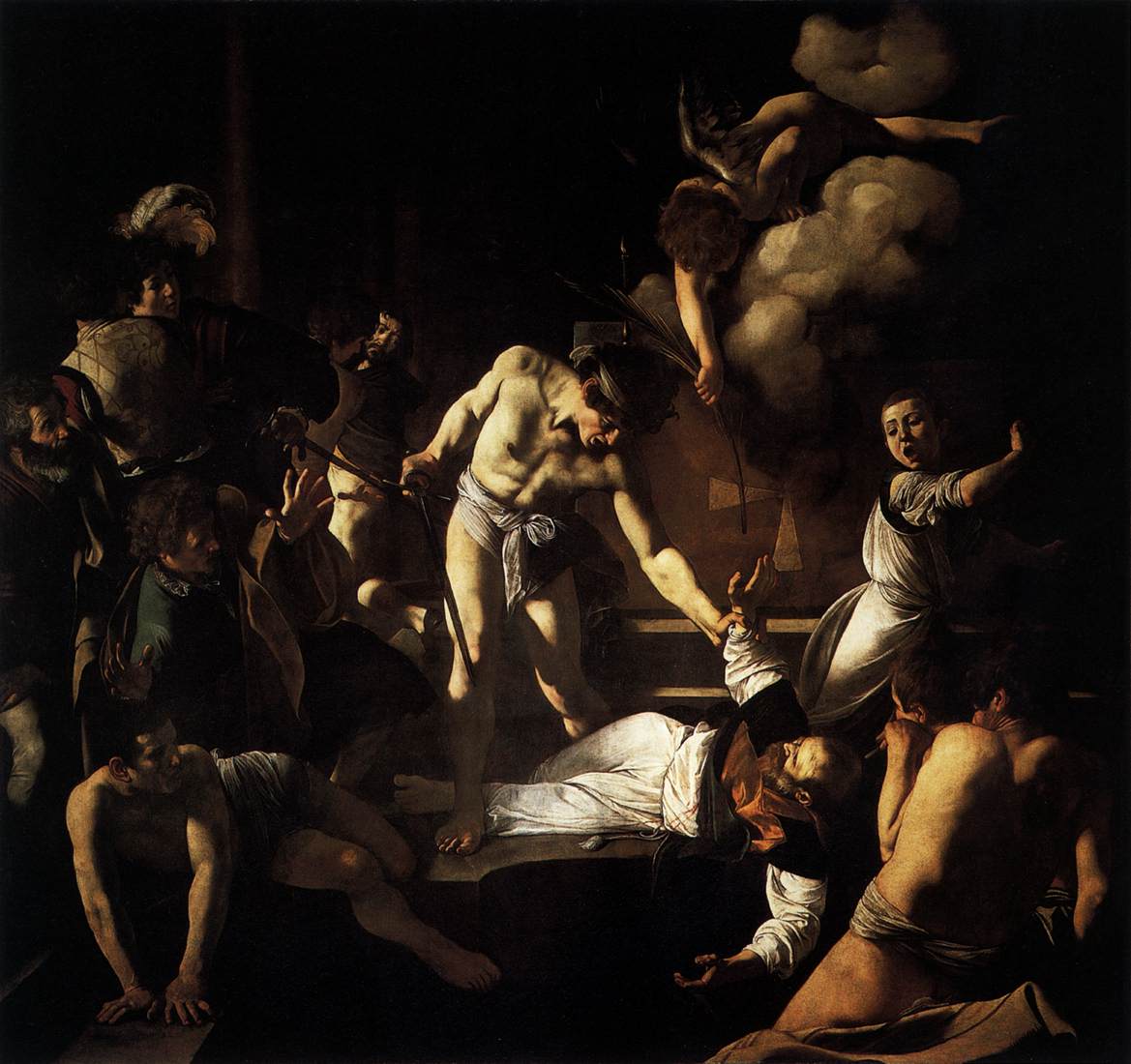
The most chaotic of the three Contarelli paintings â figures scatter in every direction as the near-naked assassin looms over the fallen saint. An angel descends with the palm of martyrdom. In the shadows on the left, a bearded man looks out at us with an expression of grief: that's Caravaggio's self-portrait, watching himself paint a murder. The composition took years of struggle â X-rays show at least two complete underpaintings.
The full story
Technical details
- Medium
- Oil on canvas
- Dimensions
- 323 × 343 cm
- Date
- 1599–1600
- Commissioned by
- Cardinal Francesco Maria del Monte for the estate of Matteo Contarelli
- Location
- Contarelli Chapel, San Luigi dei Francesi, Rome
Historical context
The commissioning of the Contarelli Chapel in San Luigi dei Francesi was a long, fraught process that spanned several decades. Initially entrusted to Girolamo Muziano and later the Cavalier d’Arpino, the project languished until the late 1590s. The estate of the late French Cardinal Matteo Contarelli finally provided the funds to finish the chapel honoring his patron saint. Behind the scenes, the influential Cardinal Francesco Maria del Monte, Caravaggio’s early protector, pulled strings to secure the commission for his young protégé. This moment in Rome marked the height of the Counter-Reformation. The Catholic Church was using art as a weapon of persuasion, demanding clarity, realism, and emotional intensity to move the faithful. Caravaggio arrived on the scene at precisely the right time, replacing the artificial elegance of the Mannerist style with a gritty, street-level naturalism that both shocked and captivated the Roman public. This specific painting, installed alongside 'The Calling of St. Matthew,' signaled the birth of the Roman Baroque.
Symbolism & iconography
- The Palm Frond: Held by the angel above, this is the traditional symbol of a martyr’s victory over death through faith.
- The Baptismal Pool: The water on the floor signifies that Matthew was killed while performing his duties, emphasizing the sanctity of the sacraments.
- The Lighting: The stark light represents divine intervention piercing through the darkness of a sinful, chaotic world.
- The Executioner’s Nakedness: His lack of clothing marks him as a pagan and a figure of raw, unchecked physical violence, contrasting with the Saint’s liturgical robes.
What to look for in person
- Lean in to see the self-portrait of Caravaggio; he is the bearded man in the background, just to the left of the executioner's shoulder.
- Notice how the light in the painting appears to come from the real window high above the altar in the chapel, integrating the work into the physical space.
- Look at the feet of the figures; Caravaggio was famous for painting 'dirty feet' to emphasize the humanity and poverty of his subjects.
- Compare the kinetic, violent energy of this painting with the quiet, frozen moment of 'The Calling' on the opposite wall to see the artist's range.
Fun facts
- X-rays of the canvas show that Caravaggio's first attempt included much smaller figures and a classicized, architectural background that he eventually scrapped.
- The painting was nearly rejected by the church authorities because the executioner is more physically prominent and 'heroically' built than the saint.
- Caravaggio’s self-portrait in the background shows him with a worried expression, perhaps reflecting his own frequent brushes with the law and street violence.
- The boy running away on the right is believed to be the same model used for the 'Boy Bitten by a Lizard.'
Rating
Notes
Loading…