Masterpiece
The Parnassus
Details
About
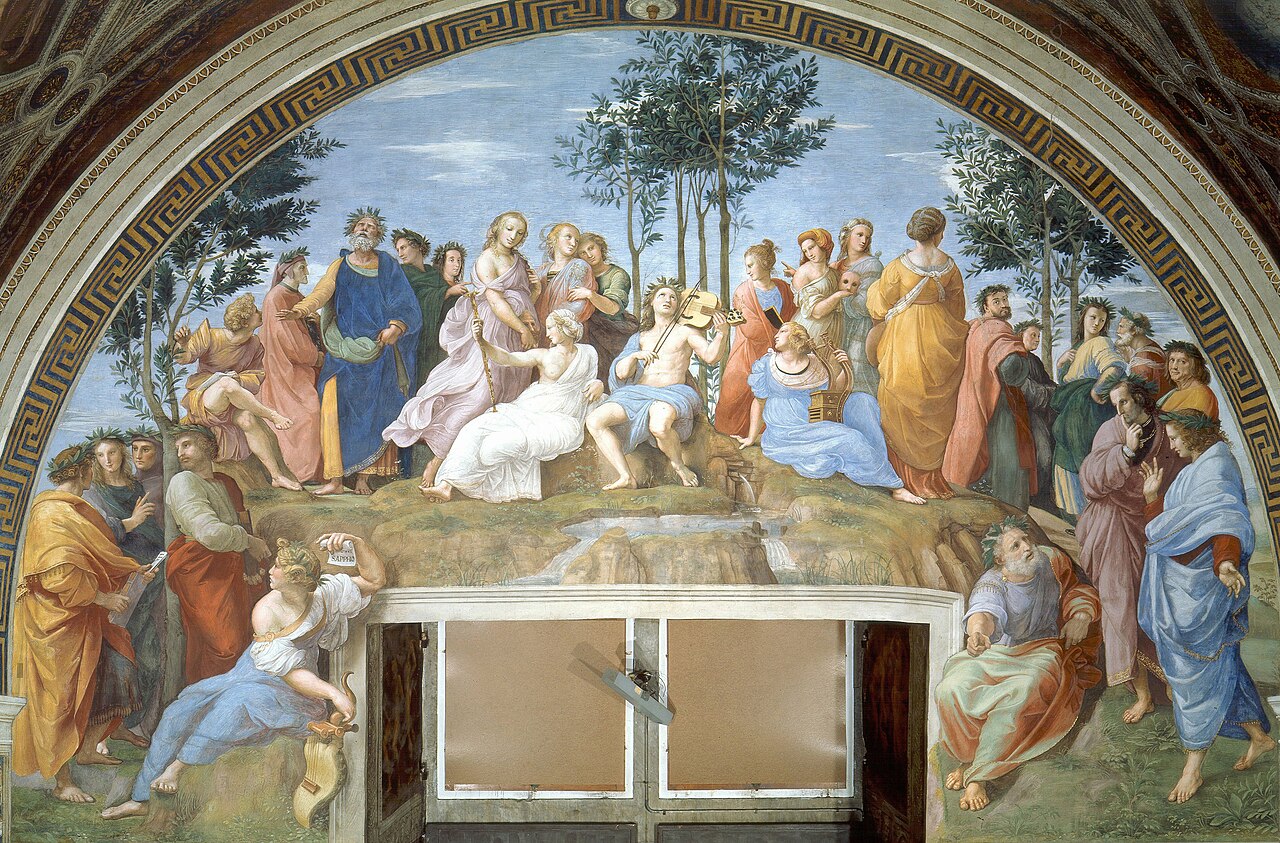
The wall over the window in the Stanza della Segnatura â Apollo plays a lira da braccio (a Renaissance instrument, not an ancient lyre) surrounded by the Muses and the poets of antiquity. Homer sings blind on the left, Dante stands in profile with his laurel wreath and hooked nose, Sappho lounges below with her name on a scroll. Raphael integrates the awkward window into the composition by making Parnassus rise around it â the wall's problem becomes the picture's structure.
The full story
Technical details
- Medium
- Fresco
- Dimensions
- Base width approx. 670 cm
- Date
- 1510–1511
- Commissioned by
- Pope Julius II
- Location
- Stanza della Segnatura, Vatican Museums
Historical context
Commissioned by Pope Julius II, "The Parnassus" is a cornerstone of the High Renaissance, painted during a period when Rome was reclaiming its status as the caput mundi—the center of the world. Between 1509 and 1511, Julius II invited the young Raphael Sanzio to decorate his private library and study, the Stanza della Segnatura. This room was intended to represent the four pillars of human knowledge: Theology, Philosophy, Justice, and Poetry. "The Parnassus" represents the realm of Poetry and the Arts. It was created at a time when Humanism was at its peak, and the Vatican sought to reconcile classical pagan philosophy with Christian doctrine. As Raphael worked on this fresco, Michelangelo was simultaneously painting the Sistine Chapel ceiling just a few yards away. This atmosphere of intense artistic competition and intellectual fervor resulted in a work that does not merely decorate a wall but defines the intellectual elegance of the sixteenth-century Roman court.
Symbolism & iconography
- The Laurel Wreaths: Worn by Apollo and several poets, these signify eternal fame and the triumph of the intellect over time.
- Sappho's Parchment: By clearly labeling her, Raphael highlights the importance of the female voice in the classical canon, a bold move in a papal study.
- The Springs of Castalia: The water flowing from the mountain represents the source of poetic inspiration—to drink from it was to be filled with the spirit of the Muses.
- Twelve Trees: The laurel trees scattered across the hill may represent the twelve signs of the zodiac or the twelve labors of Hercules, symbolizing the cosmic order.
What to look for in person
- Stand slightly to the left of the window to get the best angle on Homer’s upward-turned face; the natural light emphasizes his expression of divine trance.
- Look closely at the transition between the painted mountain and the stone window frame—Raphael deliberately blurred the edges to make the hill seem to 'grow' out of the architecture.
- Compare the heavy, muscular limbs of the Muses here to the figures in 'The School of Athens' on the opposite wall; you can see Raphael's style becoming more 'monumental' as he studied Michelangelo's work.
- Check the bottom left corner for the inscription of Sappho’s name on her scroll—it is one of the few explicit labels in the entire room.
Fun facts
- The 'lira da braccio' played by Apollo has seven strings, which likely corresponds to the seven planets known at the time or the seven tones of the musical scale.
- Scholars believe the face of the Muse to the immediate left of Apollo may be a portrait of Vittoria Colonna, a famous poet and close friend of Michelangelo.
- In the original 16th-century layout, the window below the fresco looked out toward the Mons Vaticanus, which was once considered a site sacred to Apollo, creating a direct link between the painting and the Roman landscape.
- While most figures are identified, the identity of the poet looking directly at the viewer on the far right remains a mystery, though some believe it is a self-portrait or a tribute to a contemporary friend of Raphael.
Rating
Notes
Loading…