Masterpiece
Pietà
Details
About
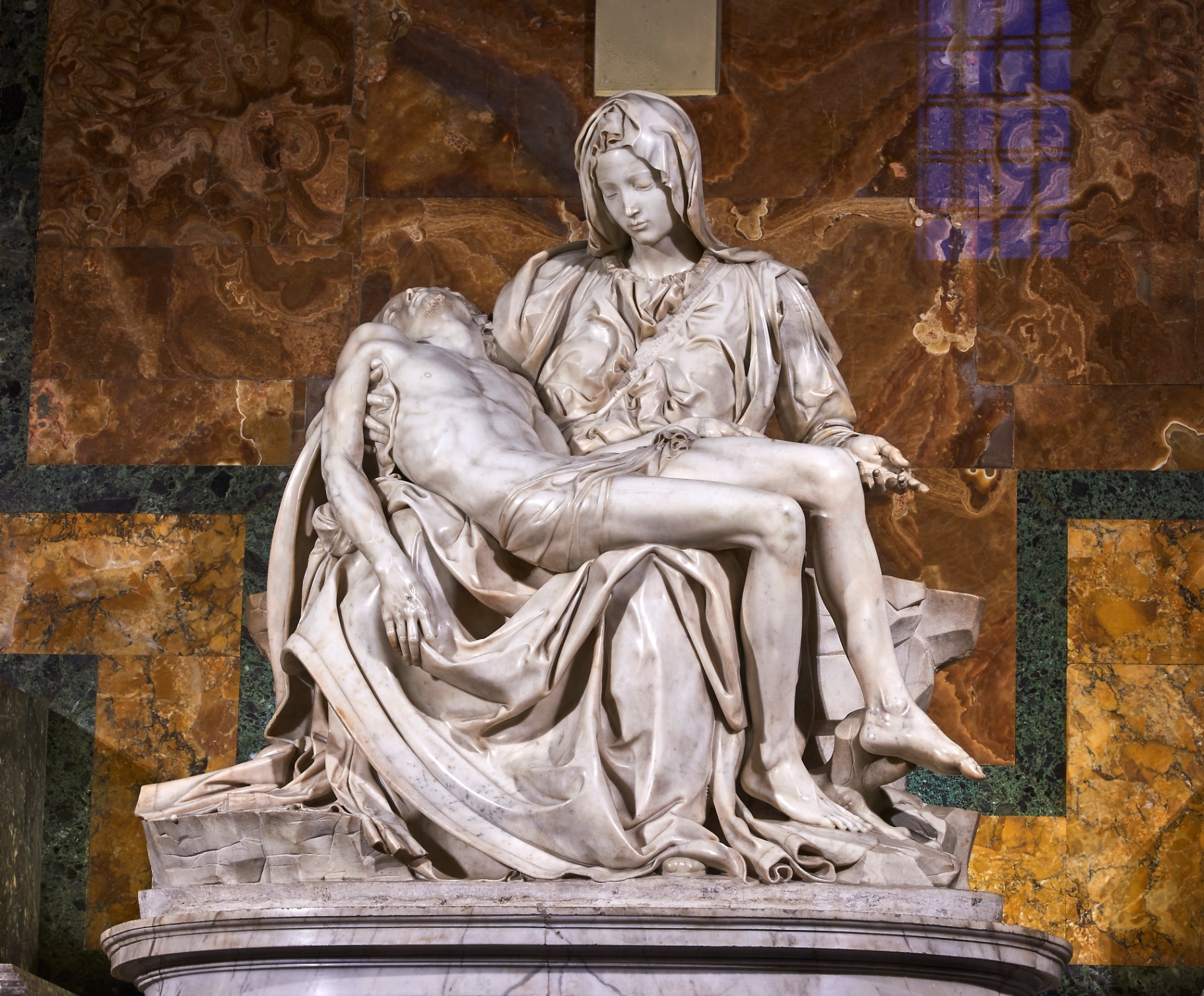
Michelangelo was 24. The Virgin appears impossibly young (younger than her dead son) â Michelangelo said her purity had preserved her. Christ's body drapes across her lap with a horizontal weight that pulls the whole pyramid downward; her left hand is turned palm-up in a gesture of open, unanswerable grief. It's the only work Michelangelo ever signed â the sash across her chest, added after he overheard someone credit the sculpture to a rival. Behind bulletproof glass since 1972.
The full story
Technical details
- Medium
- Carrara Marble
- Dimensions
- 174 × 195 cm
- Date
- 1498–1499
- Commissioned by
- Cardinal Jean de Bilhères-Lagrave
- Location
- First chapel on the right (North Aisle), St. Peter's Basilica, Vatican City
Historical context
At the close of the 15th century, Rome was a city undergoing a monumental rebirth under the papacy of Alexander VI. While the High Renaissance was beginning to bloom in Florence, it was the French Cardinal Jean de Bilhères-Lagrave who provided the spark for this particular masterpiece. Serving as the French ambassador to the Holy See, the Cardinal commissioned a twenty-four-year-old Michelangelo Buonarroti to create 'the most beautiful work of marble in Rome' to adorn his funeral chapel in the old St. Peter's Basilica. The contract was signed in 1498, a time of relative political volatility as the Borgia family tightened their grip on the Italian peninsula. Michelangelo, still a young man eager to surpass the masters of antiquity, spent nine months in the quarries of Carrara selecting a single, flawless block of marble. The resulting statue was not only a technical triumph but a pivotal moment in art history, transitioning the stiff, evocative Northern European 'Vesperbild' tradition into the harmonious, idealized grace of the Italian High Renaissance.
Symbolism & iconography
- The youthful face of Mary symbolizes her 'immaculate' nature and perpetual purity, which Michelangelo believed halted the aging process.
- The open left palm of the Virgin is a gesture of 'Ecce Homo' or 'Behold the Man,' offering her son as a sacrifice for the redemption of humanity.
- The heavy, swirling drapery represents the burden of grief and the physical weight of the sacrifice Mary must carry.
- The signature on the sash is written in the imperfect tense (faciebat), a humble nod to ancient Greek artists implying the work is perpetually 'in progress' or never truly finished in the eyes of God.
What to look for in person
- Observe the statue from the far right to see how the angle of Christ's head aligns perfectly with the folds of Mary's garment.
- Notice the subtle indentation in Christ's side; Michelangelo chose to keep the wound from the spear very small and clean to maintain the figure's beauty.
- Look at the base of the statue, which Michelangelo carved to resemble the craggy rocks of Mount Calvary.
- Since the 1972 attack, you cannot get close, so bring a pair of small binoculars to see the incredible detail of the fingernails and the veins in Christ's arm.
Fun facts
- In 1972, a geologist named Laszlo Toth attacked the statue with a hammer while shouting 'I am Jesus Christ!', breaking Mary's arm and nose.
- During the restoration after the 1972 attack, researchers found a secret 'M' carved into the palm of Mary's left hand, believed to be a subtle second signature.
- The statue was moved from its original location in the Chapel of Santa Petronilla to several spots within the Basilica before reaching its current home in the 18th century.
- To protect it from potential damage, the work is now displayed behind a massive wall of bulletproof acrylic glass.
Rating
Notes
Loading…