Masterpiece
The Rape of Proserpina
Details
About
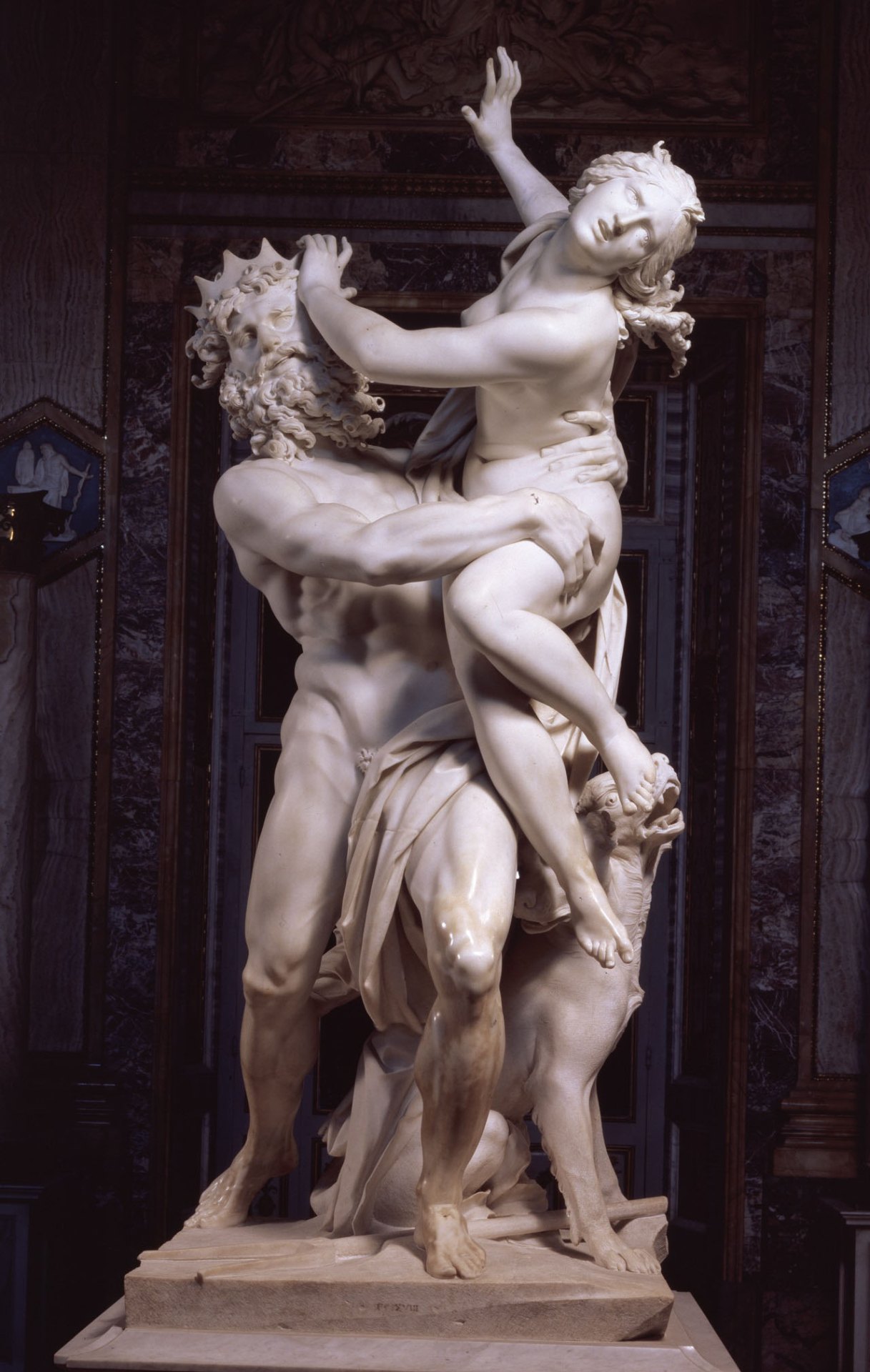
Bernini at 23, and already the most virtuosic marble carver in Europe. Look at Pluto's fingers pressing into Proserpina's thigh â the flesh actually dimples under the grip. Her tears are single drops of stone; his beard is deep-cut, almost lace. The three-headed Cerberus barks at their feet. Walk around it: from the left you see the abduction, from the front the struggle, from the right her outstretched hand pleading to the world she's leaving. This is theater in stone.
The full story
Technical details
- Medium
- Carrara marble
- Dimensions
- H. 255 cm (original pedestal not included)
- Date
- 1621–1622
- Commissioned by
- Cardinal Scipione Borghese
- Location
- Room IV (The Emperor's Room), Galleria Borghese, Rome
Historical context
In 1621, Cardinal Scipione Borghese, the most ambitious and voracious art collector in 17th-century Rome, commissioned the twenty-three-year-old Gian Lorenzo Bernini to create a series of monumental sculptures for his villa on the Pincian Hill. This was a period of intense artistic renewal in Rome; the austerity of the late Renaissance was giving way to the theatricality and emotional fervor of the Baroque. Scipione was the nephew of Pope Paul V, and his patronage allowed Bernini to experiment with a level of daring that would redefine the medium of marble forever. 'The Rape of Proserpina' was intended to serve as a centerpiece for the Cardinal’s social gatherings, where guests would admire the young artist's ability to translate the poetic violence of Ovid’s 'Metamorphoses' into stone. Ironically, shortly after its completion, Scipione gifted the statue to Cardinal Ludovico Ludovisi to curry political favor. It remained in the Ludovisi collection for centuries before being returned to its intended home in the Galleria Borghese in 1908. This work represents the moment the Baroque style truly announced its arrival, breaking free from the static, front-facing constraints of earlier sculpture.
Symbolism & iconography
- The three-headed dog, Cerberus, stands at the base to guard the gates of the Underworld and signifies that Proserpina is crossing the threshold into the realm of the dead.
- Pluto's crown and scepter denote his absolute sovereignty over the dead, contrasting his royal authority with his lawless act of abduction.
- The falling drapery represents the suddenness of the attack; its chaotic folds mirror the internal turmoil and loss of control Proserpina is experiencing.
- Proserpina's tears, carved directly into the marble, symbolize her shift from a goddess of spring and life to a victim of the dark underworld.
What to look for in person
- Circle the statue slowly in a counter-clockwise direction to see how the narrative of the struggle unfolds from different angles.
- Look closely at the back of the sculpture to see the tension in Proserpina's toes as she tries to find purchase in the air.
- Observe the sculpture at eye level with Pluto’s hand on Proserpina's thigh to appreciate the 'softness' Bernini achieved in the stone.
- Notice the shadows cast by the deep undercutting of the marble, which Bernini used to create a painterly 'chiaroscuro' effect in 3D.
Fun facts
- Despite his extraordinary talent, Bernini was known for his legendary temper and once nearly killed his brother in a fit of rage over a mistress.
- The sculpture was gifted away by Cardinal Scipione Borghese just one year after he received it, likely as a strategic political bribe to the nephew of the newly elected Pope Gregory XV.
- During the 19th century, the statue was considered so provocative and 'indecent' by some critics that it was occasionally screened off from sensitive viewers.
- To achieve the realistic texture of the skin, Bernini used various grades of abrasives and even acidic washes to soften the appearance of the polished marble.
Rating
Notes
Loading…