Masterpiece
Raphael's Tomb
Details
About
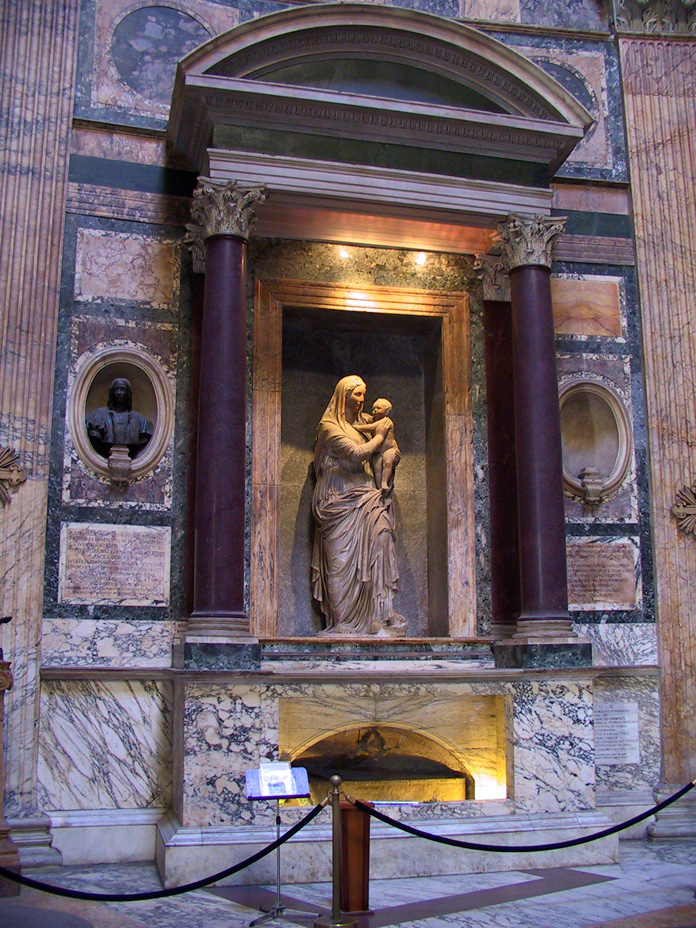
Raphael asked to be buried in the Pantheon â he loved the building and wanted to be laid to rest inside a work of architectural perfection. The tomb is a Roman sarcophagus in a niche below a Madonna del Sasso by Lorenzetto. The epitaph, by Cardinal Bembo, translates: 'Here lies Raphael, by whom nature herself feared to be conquered while he lived, and when he was dying, feared herself to die.' He was 37.
The full story
Technical details
- Medium
- Marble sarcophagus, stone masonry, and bronze bust addition
- Dimensions
- Total height of niche approx. 600 cm
- Date
- 1520 (Interment); 1833 (Current sarcophagus installation)
- Commissioned by
- Raphael (self-commissioned his burial and the Madonna statue)
- Location
- Third chapel on the left, The Pantheon, Rome
Historical context
In 1520, the High Renaissance reached a sudden, mournful crescendo with the death of Raffaello Sanzio da Urbino—known to the world simply as Raphael. At just 37 years old, he was the 'Prince of Painters,' a man so beloved for his grace and talent that he was treated like royalty in the papal court of Leo X. His death on Good Friday sent shockwaves through Rome, a city then at the height of its creative and political power, yet teetering on the edge of the religious upheavals of the Reformation. Raphael had requested burial in the Pantheon, the greatest surviving temple of antiquity, which had been converted into the church of Santa Maria ad Martyres. This was a profound statement of his artistic identity. By choosing this site, Raphael inextricably linked the 'modern' Renaissance to the Roman past he had spent his final years documenting and protecting as the Prefect of Antiquities. His tomb became a site of pilgrimage almost immediately, signaling the transition of an artist from a mere craftsman to a divine figure of cultural history.
Symbolism & iconography
- The Madonna del Sasso: Commissioned by Raphael himself, the statue represents the 'Rock' (Sasso) of the Church, reflecting his deep, if courtly, piety.
- The Latin Epitaph: Created by Pietro Bembo, the text symbolizes the Humanist belief that art could challenge and even defeat the cycle of natural decay.
- The Roman Sarcophagus: By using an ancient stone casket, the tomb symbolizes the 'rebirth' (Renaissance) of antiquity through the body of the artist.
- The Dove: Often seen in the surroundings, it represents the Holy Spirit, but also the grace ('grazia') that was the defining characteristic of Raphael’s personal style.
What to look for in person
- Look at the inscription on the right side of the niche; it honors Maria Bibbiena, the niece of a powerful Cardinal to whom Raphael was engaged.
- Notice the 19th-century bronze bust to the left of the sarcophagus—it is based on his famous self-portrait, though it lacks the 'softness' of his painted skin tones.
- Visit on a sunny day between 11:00 AM and 1:00 PM; as the sun moves, the light from the oculus reflects off the floor and provides a soft, indirect glow to the marble tomb.
- Peer closely at the base of the Madonna del Sasso above the tomb to see the fine tool marks of Lorenzetto, who finished the work Raphael had envisioned.
Fun facts
- During the 1833 exhumation, a plaster cast was made of Raphael’s skull to settle a dispute with an art society in Urbino that claimed to own his remains.
- Raphael’s fiancée, Maria Bibbiena, who died before they could marry, is also buried nearby in the same chapel.
- The tomb was originally much more crowded with other monuments; it was simplified in the 19th century to give the 'Prince of Painters' more visual breathing room.
- Legend once suggested Raphael died of 'amorous excesses,' though modern historians believe it was a misdiagnosed pulmonary infection exacerbated by bloodletting.
Rating
Notes
Loading…