Masterpiece
Sacred and Profane Love
Details
About
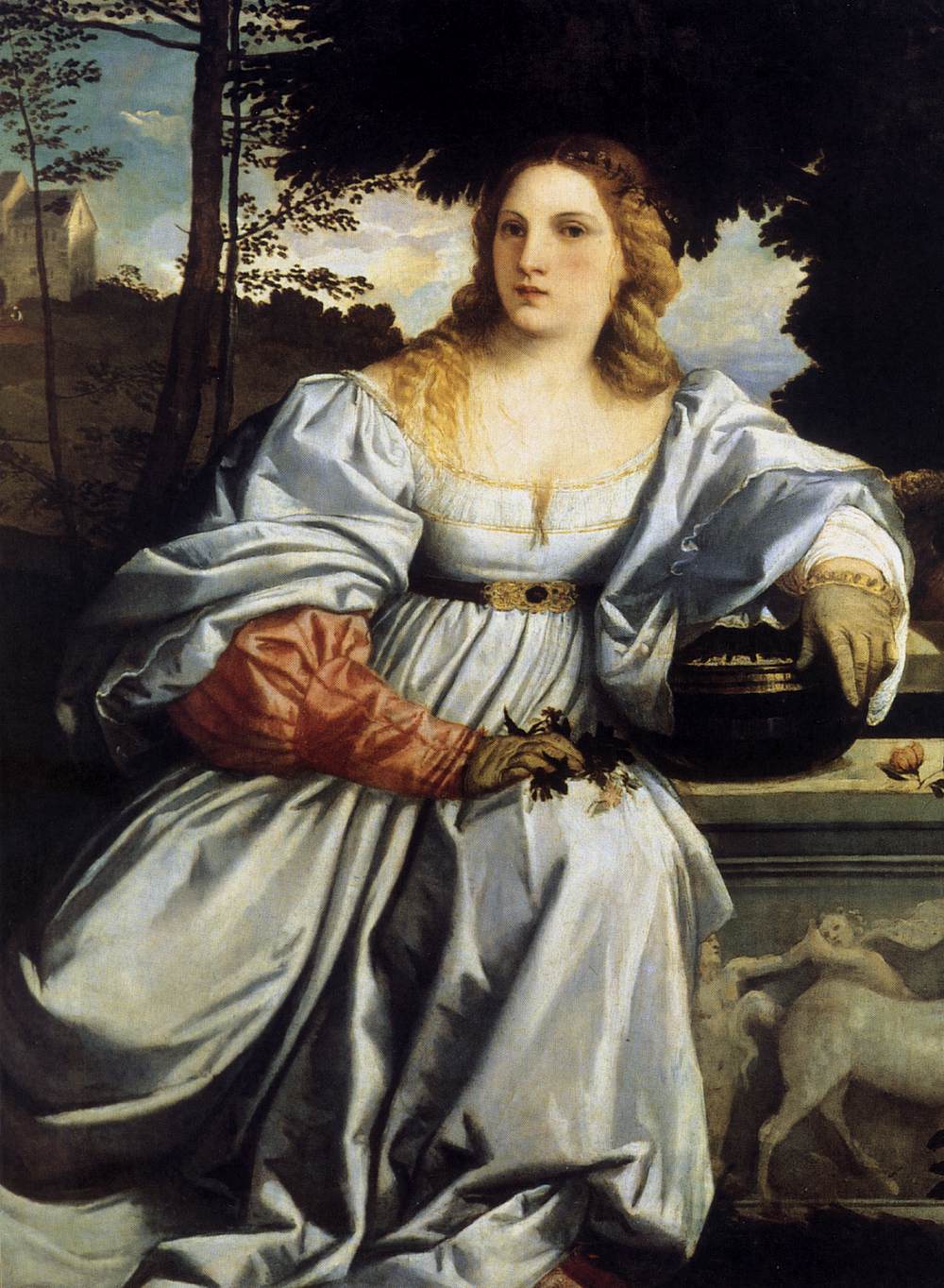
Titian at 25. Two women flank a Roman sarcophagus turned into a fountain: one clothed and worldly, one nude and divine â but which is which? Iconographers still argue. The nude, holding a lamp of heavenly love, is probably the 'sacred' one; the clothed woman with earthly jewels is 'profane'. The landscape behind each mirrors their nature â a fortified castle for the earthly, a shepherd's pastoral for the divine. Painted for a wedding, it's a Neoplatonic meditation on the two Venuses.
The full story
Technical details
- Medium
- Oil on canvas
- Dimensions
- 118 × 279 cm
- Date
- 1514
- Commissioned by
- Niccolò Aurelio
- Location
- Room XX, Galleria Borghese
Historical context
Commissioned around 1514, this masterpiece was a marriage gift from Niccolò Aurelio, the Secretary to the Venetian Council of Ten, to his bride, the young widow Laura Bagarotto. The timing was deeply poignant and political; Laura’s father had been executed by the Venetian state just years prior for treason, and this marriage served as a formal reconciliation between her family and the Republic. Titian, barely in his mid-twenties but already the rising star of the Venetian school, was tasked with creating an allegory that celebrated the legal and spiritual union of a couple in a city undergoing a visual revolution. The painting was created during the High Renaissance, specifically within the Venetian 'Cinque-cento,' a period where artists moved away from the rigid lines of Florence toward 'colorito'—the use of color and light to define form. It was eventually purchased by Cardinal Scipione Borghese in 1608, becoming a cornerstone of the Borghese Collection. While the title 'Sacred and Profane Love' was not Titian's—it was first recorded in a 1693 inventory—it has since become the definitive lens through which we view this complex meditation on womanhood and virtue.
Symbolism & iconography
- The Sarcophagus: By turning a tomb into a fountain, Titian symbolizes life and love springing from death, a metaphor for the transformative power of marriage.
- The Red Cloak: Worn by the nude figure, the vibrant red represents the heat of divine passion and spiritual fervor, contrasting with the cool white of the bride's purity.
- Rabbits: Tucked into the landscape behind the bride, these are traditional symbols of fecundity and the hope for many children in the new marriage.
- Stirring Cupid: Cupid’s act of mixing the water represents the tempering of passion with reason, creating a balanced and harmonious union.
- The Burning Lamp: Held aloft by the nude figure, it represents the light of God and the intellectual search for truth that transcends the physical body.
What to look for in person
- Stand back to appreciate the 'atmospheric perspective'—notice how the distant hills transition from green to a hazy, pale blue to create a sense of depth.
- Look closely at the marble relief on the fountain; it depicts scenes of violence and chastisement, which serve as a warning against uncontrolled lust.
- Move to the side of the painting to see how Titian built up the 'impasto'—the thick application of paint—on the white sleeves of the bride to make the fabric catch the light.
- Observe the reflection of the light in the silver bowl on the fountain's edge; it demonstrates Titian's obsession with how different surfaces interact with light.
Fun facts
- In 1899, the Rothschild family offered the Italian government 4 million lire for the painting—a sum higher than the entire value of the Borghese palace—but the offer was rejected to keep the masterpiece in Rome.
- X-ray analysis reveals that the bride was originally painted wearing a different dress and a more elaborate hairstyle, showing Titian’s process of simplifying the composition for greater impact.
- The coat of arms visible on the marble fountain belongs to Niccolò Aurelio, while the coat of arms inside the silver bowl belongs to his bride, Laura Bagarotto.
- Despite its fame, Titian left no record of what he actually called the painting; the current title stuck simply because 17th-century viewers found the contrast of the two women so striking.
Rating
Notes
Loading…