Masterpiece
The School of Athens
Details
About
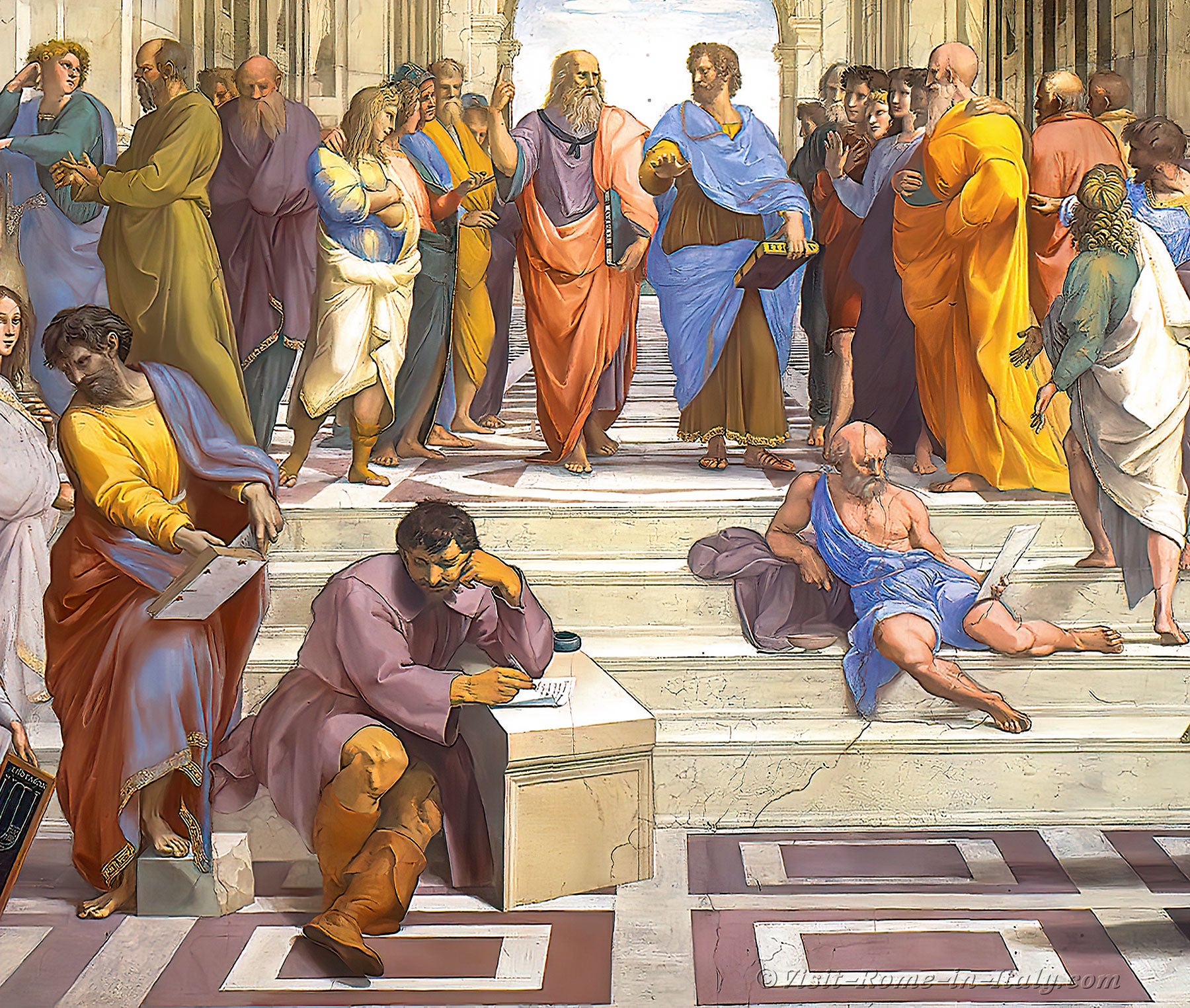
Raphael's fresco is the visual manifesto of the High Renaissance: the great philosophers of antiquity assembled beneath a soaring Bramante-inspired barrel vault. Plato points to the heavens holding the Timaeus, Aristotle gestures to the earth with the Ethics â the entire debate between metaphysics and empiricism captured in two hands. Look for the cast: Heraclitus in the foreground has Michelangelo's face (a late addition, added after Raphael saw the Sistine ceiling), Euclid bending with a compass is Bramante, and Raphael himself peers out from the far right in a black cap. The perspective is mathematically flawless â every arch and floor tile converges on the point between Plato and Aristotle. Stand back to feel the depth, then step close to see how loosely the drapery is actually painted.
The full story
Technical details
- Medium
- Fresco
- Dimensions
- 500 × 770 cm
- Date
- 1509–1511
- Commissioned by
- Pope Julius II
- Location
- Stanza della Segnatura, Vatican Museums
Historical context
Commissioned by Pope Julius II, Raphael’s 'The School of Athens' was painted at a pivotal moment in the High Renaissance, when Rome was reclaiming its status as the center of the intellectual and artistic world. Julius II, a warrior-pope with a passion for grandeur, sought to transform his private library (the Stanza della Segnatura) into a visual testament to his own wisdom and the harmony between classical philosophy and Christian doctrine. At the same time Raphael was working on these walls, Michelangelo was just steps away, laboring on the Sistine Chapel ceiling. This was an era of intense competition and staggering creative output, driven by the rediscovery of long-lost Greek texts and Roman ruins. The fresco represents the pinnacle of humanism, celebrating the triumph of reason and the continuity of knowledge from the pagan ancients to the Renaissance Church. It was designed to function not just as a decoration, but as a mental gymnasium for the Pope and his advisors.
Symbolism & iconography
- Plato's Upward Finger: Represents his 'Theory of Forms,' suggesting that the true reality exists in a higher, spiritual realm rather than the physical world.
- Aristotle’s Open Palm: Signifies his 'Empiricism,' the belief that knowledge comes from sensory experience and the study of the natural world.
- The Celestial and Terrestrial Globes: Held by Zoroaster and Ptolemy, these represent the study of the heavens (astronomy) and the study of the earth (geography).
- The Inkwell and Pen of Pythagoras: Symbolizes the transcription of oral wisdom into permanent, mathematical law.
- The Toga Colors: Plato wears red (fire/spirit) and purple (air/intellect), while Aristotle wears blue (water) and brown (earth), further reinforcing their philosophical orientations.
What to look for in person
- Stand in the center of the room to experience the 'vanishing point,' which leads your eye directly to the space between Plato and Aristotle's heads.
- Look closely at the floor tiles; their receding pattern is the primary tool Raphael uses to create the illusion of deep 3D space on a flat wall.
- Observe the contrast between the left and right sides: the left is dominated by philosophers of the 'invisible' (math, music, spirit), while the right is dedicated to the 'visible' (geometry, astronomy, biology).
- Check the bottom left corner for the white-robed figure of Hypatia (often identified as Francesco Maria della Rovere), whose gaze is the only one directed directly and piercingly at the viewer.
Fun facts
- The figure of Heraclitus (Michelangelo) was not in the original preparatory drawings; Raphael added him later, likely as a nod of respect after seeing the first half of the Sistine Chapel disclosed in 1511.
- Raphael painted himself into the far right corner, wearing a black beret, standing next to the painter Sodoma and the astronomer Ptolemy.
- The 'school' is actually a temple of knowledge; the architecture was heavily influenced by Bramante’s designs for the new St. Peter's Basilica, which was a construction site at the time.
- Diogenes the Cynic is the sprawled-out figure on the stairs; his casual, isolated position reflects his philosophical rejection of social norms and material possessions.
Rating
Notes
Loading…