Masterpiece
Sistine Chapel Ceiling
Details
About
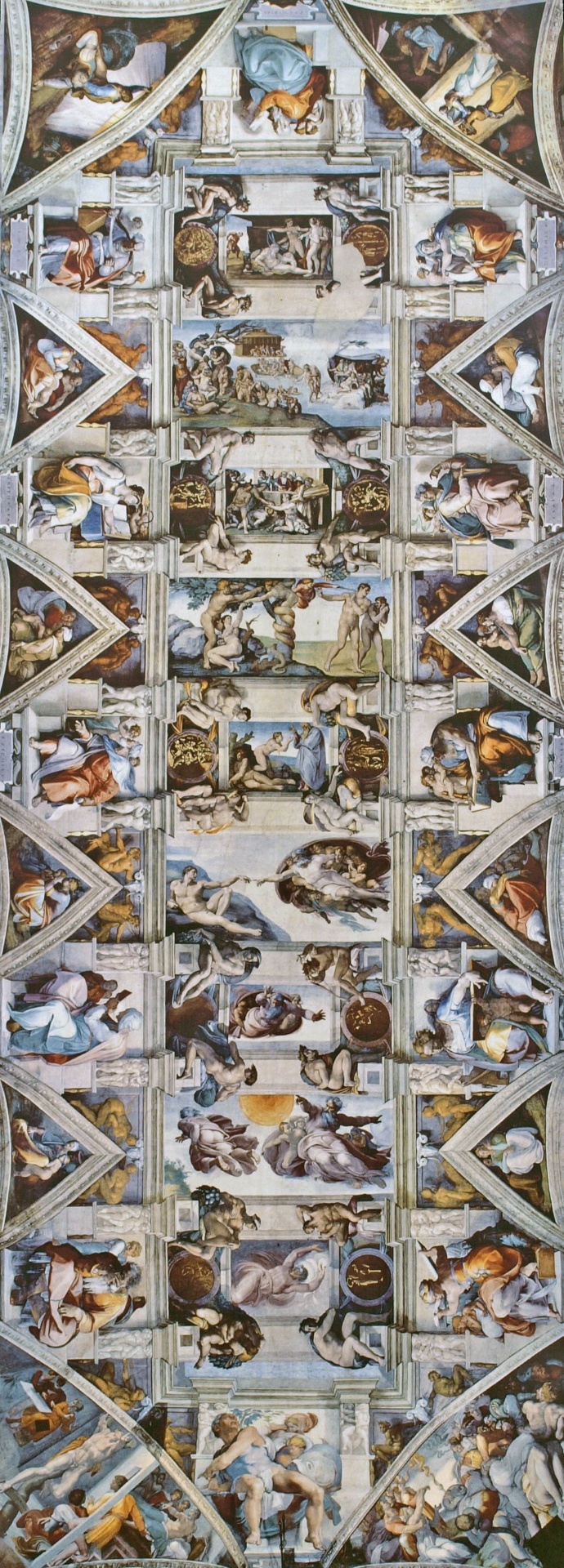
Four years, largely alone, mostly standing on scaffolding with paint dripping into his eyes. Michelangelo â who insisted he was a sculptor, not a painter â reshaped what fresco could do. Nine scenes from Genesis run down the spine, framed by prophets, sibyls, and the ignudi (nude youths) whose anatomy is a study in itself. The chronology runs backwards toward the altar: you enter through the end of Noah's story and walk toward the Creation. Bring binoculars, and look for the Prophet Jonah above the altar â impossibly foreshortened, twisting up out of the wall as if physically escaping the ceiling.
The full story
Technical details
- Medium
- Fresco
- Dimensions
- 40.9 × 13.4 meters (134 × 44 feet)
- Date
- 1508–1512
- Commissioned by
- Pope Julius II (Giuliano della Rovere)
- Location
- Sistine Chapel, Vatican Museums
Historical context
By 1508, Pope Julius II—the "Warrior Pope"—was fixated on consolidating the temporal and spiritual power of the Papacy. The Sistine Chapel, built by his uncle Sixtus IV, was the most important liturgical space in Rome, but the ceiling was a simple blue vault with gold stars. Julius initially envisioned a series of the Twelve Apostles, but the restless, ambitious Michelangelo Buonarroti convinced the Pope to allow for a far more complex scheme. This commission occurred during the height of the High Renaissance, a period defined by the fusion of classical humanism with Christian theology. While Michelangelo was working on the ceiling, the Protestant Reformation was just beginning to simmer in Northern Europe, and Raphael was simultaneously painting the papal apartments next door. The project was grueling; Michelangelo spent four years on high scaffolding, enduring physical strain and constant conflict with the Pope, but the result transformed the chapel from a private papal sanctuary into the epicenter of Western art history.
Symbolism & iconography
- The Oak Leaves and Acorns: Found scattered throughout the decorative borders, these are symbols of the della Rovere family (Pope Julius II’s family name means 'of the oak').
- The Ignudi: These twenty nude figures represent the idealized human form and serve as a bridge between the physical world and the divine narrative.
- The Serpent in the Garden: Michelangelo depicts the serpent with a human torso and legs, a common Renaissance trope that mirrors the 'temptress' nature of the Fall.
- The Brazen Serpent: Located in a corner spandrel, this scene of Israelites being healed symbolizes the future salvation of humanity through Christ’s sacrifice.
What to look for in person
- Look at the figure of Jonah directly above the altar; while the ceiling curves toward you, Michelangelo used foreshortening to make the figure look as if he is leaning dramatically backward.
- Check the 'Creation of Adam' early; the crowds tend to cluster there, but the best light often hits the Sibyls on the sides during the morning.
- Bring a small pair of binoculars; at 20 meters high, the incredible detail in the faces of the Ancestors of Christ in the lunettes is hard to see with the naked eye.
- Observe the transition in style: the scenes near the entrance (painted first) have smaller figures, while those near the altar (painted later) are much larger and more powerful.
Fun facts
- Michelangelo designed his own scaffolding system involving brackets built into the walls, which allowed him to work while the chapel remained in use for services below.
- Contrary to the popular myth that he painted lying on his back, Michelangelo actually painted standing up, leaning his head back at an agonizing angle for hours on end.
- In the 'Separation of Light from Darkness,' Michelangelo completed the entire panel in just one 'giornata' (one day's work of wet plaster).
- The figure of the Prophet Jeremiah is widely considered a self-portrait; he is depicted in a pose of deep, brooding melancholy, mirroring Michelangelo’s own personality.
Rating
Notes
Loading…