Masterpiece
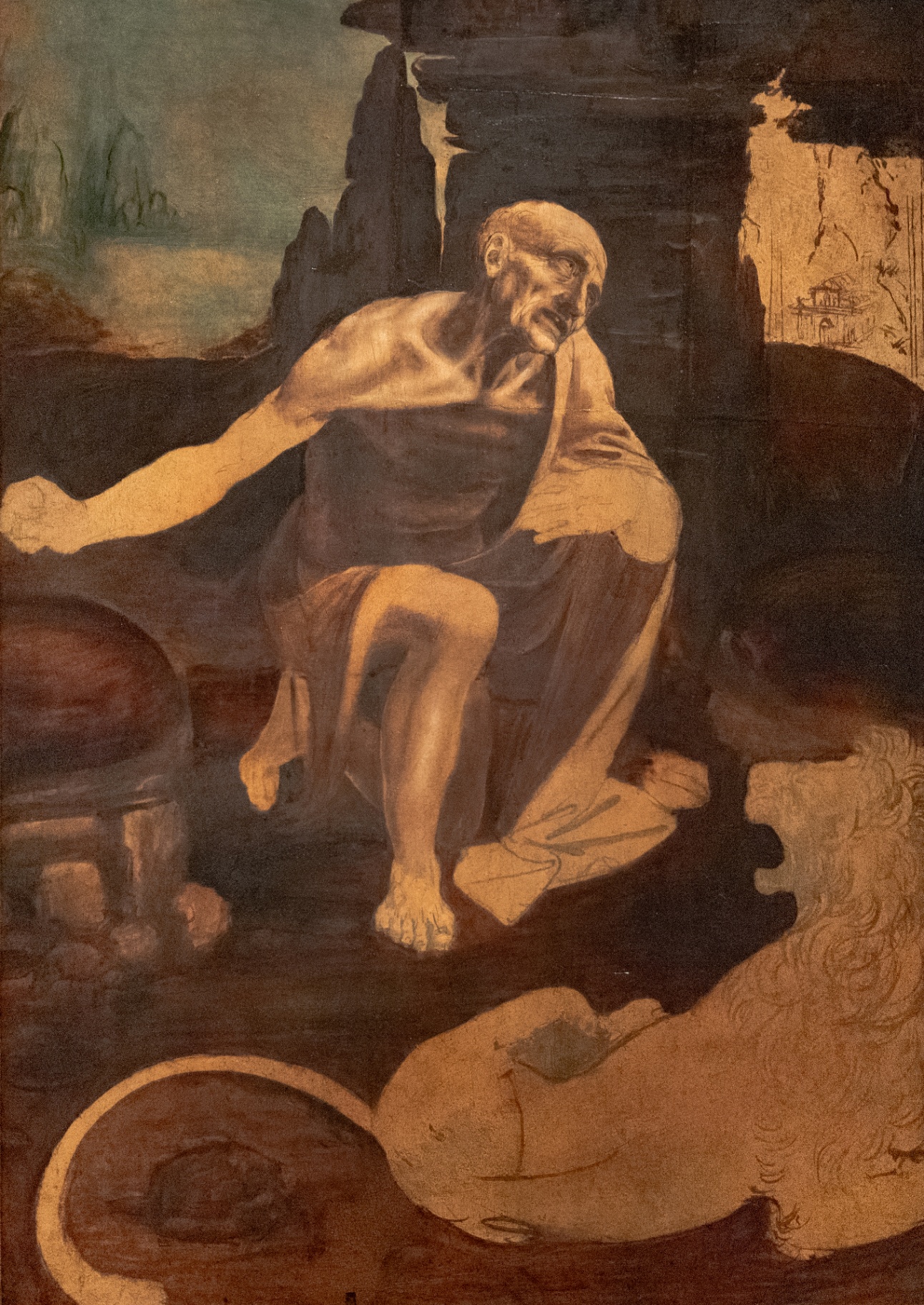
St. Jerome in the Wilderness
Details
About
An unfinished Leonardo â and that is precisely why it's a revelation. You see the underpainting: the skull-like anatomy of Jerome's shoulder, the muscular twist of the neck (Leonardo dissected corpses to get it right), the lion barely sketched at the saint's feet. The face is finished enough to feel the psychological weight of penance. The painting was famously cut into pieces, one used as a stool cover in a shoemaker's shop, before being reassembled in the 19th century â you can still see the seam.
The full story
Technical details
- Medium
- Oil and tempera on walnut panel
- Dimensions
- 103 × 75 cm
- Date
- c. 1480–1482
- Commissioned by
- Unknown (likely a private commission or personal study)
- Location
- Room IX, Pinacoteca, Vatican Museums
Historical context
Created around 1480, this unfinished masterpiece dates to Leonardo’s first Florentine period, just before he departed for Milan. At this time, the Medici family shaped the intellectual landscape of Florence, fostering a blend of Christian devotion and Neoplatonic philosophy. Saint Jerome, the 4th-century scholar who translated the Bible into Latin, was a popular subject for Humanist thinkers who admired his intellect, and for penitents who identified with his self-imposed exile. The painting’s raw, unfinished state provides a rare window into Leonardo’s experimental process. Rome at the time was beginning its ascent as a Renaissance powerhouse under Pope Sixtus IV, yet this panel remained in Leonardo’s possession, likely traveling with him through his various commissions. It is a work of extreme psychological intensity, reflecting the artist’s growing obsession with human anatomy and the 'movements of the soul'—the belief that physical gestures must reveal internal emotional states.
Symbolism & iconography
- The Stone: Held in Jerome's right hand, it represents his rejection of worldly comfort and his physical self-mortification to atone for sin.
- The Lion: According to legend, Jerome pulled a thorn from the lion's paw; here, its loyal presence symbolizes the taming of the wild through Christian mercy.
- The Cave: Represents the darkness of the world and the 'womb' of spiritual rebirth, a common motif in Leonardo’s works like the Virgin of the Rocks.
- The Cross: Though barely visible in the sketch, it is the focal point of the saint's gaze, representing the goal of his journey and his source of strength.
What to look for in person
- Look closely at the saint's neck; you can see the precise anatomical rendering of the tendons and muscles that Leonardo studied through dissection.
- Shift your gaze to the background on the right to see the ghostly outline of a church, which Leonardo likely planned to paint over the rocky terrain.
- Step to the side to see the grain of the walnut panel, which is more visible here than in most finished Renaissance paintings.
- Examine the line separating the head from the body; you can still see the joins where the panel was cut and later restored.
Fun facts
- The painting was famously rediscovered by Napoleon’s uncle, Cardinal Joseph Fesch, who found the two halves of the panel years apart in different shops.
- Close inspection under infrared light reveals Leonardo’s fingerprints in the sky and the background, left as he used his hands to smear the pigment.
- Despite being an early work, it was never completed, possibly because Leonardo was prone to distraction or because he felt he had solved the 'intellectual problem' of the piece.
- The lion is surprisingly realistic for the time, suggesting Leonardo may have observed caged lions in Florence’s 'serraglio' near the Palazzo Vecchio.
Rating
Notes
Loading…