Masterpiece
St. Jerome Writing
Details
About
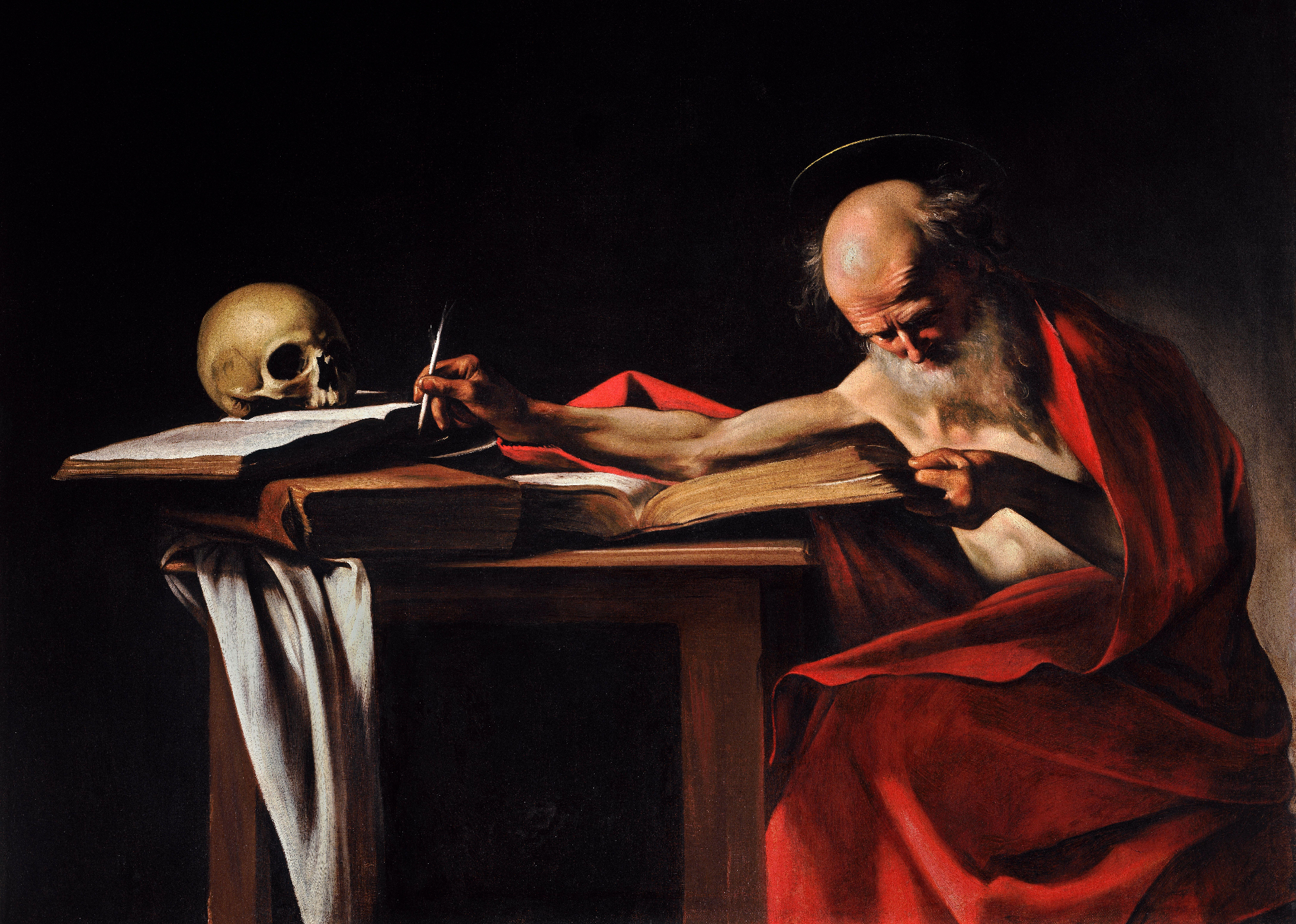
Jerome, translating the Bible into Latin, extends his arm across the composition â the horizontal of the arm answered by the horizontal of the skull on the table. Bald, thin, wrapped in red, he's a scholar reduced to essentials: book, quill, memento mori. Painted for Scipione Borghese.
The full story
Technical details
- Medium
- Oil on canvas
- Dimensions
- 112 x 157 cm
- Date
- 1605–1606
- Commissioned by
- Cardinal Scipione Borghese
- Location
- Galleria Borghese, Room VIII
Historical context
Painted around 1605–1606, this work captures Caravaggio at the height of his Roman fame, just before his life spiraled into the chaos of exile. It was commissioned by Cardinal Scipione Borghese, the nephew of Pope Paul V and a rapacious collector who leveraged his political power to amass one of the world’s greatest art galleries. At the time, Rome was the heart of the Counter-Reformation, a period when the Catholic Church sought to reaffirm its doctrines against Protestant challenges. The figure of Saint Jerome was central to this theological battle. As the scholar who translated the Bible into the Latin Vulgate, Jerome represented the bridge between ancient scripture and the authority of the Church. By commissioning this work, Borghese was not merely acquiring a masterpiece; he was aligning his intellectual and spiritual identity with the rigorous, ascetic traditions of the faith. The painting reflects a Rome that was simultaneously obsessed with opulent power and a somber, almost violent return to spiritual fundamentals.
Symbolism & iconography
- The Skull: A classic 'memento mori' (remember you will die), placed directly opposite the saint to contrast human knowledge with the finality of death.
- The Quill and Inkwell: These represent the Saint's role as the translator of the Vulgate, turning the physical labor of writing into a sacred act.
- The Stone: Resting on the edge of the table, it refers to Jerome's practice of hitting his chest with a rock as an act of penance in the desert.
- The Red Robe: Signifies both the martyrdom of the early saints and Jerome's traditional (though anachronistic) status as a Cardinal of the Church.
- The Closed Book vs. Open Book: Represents the transition from the old laws to the revealed truths of the scriptures being translated.
What to look for in person
- Step to the side to see how the white highlights on the pages of the books seem to project off the canvas into the room.
- Look for the faint 'pentimenti' or changes made by the artist—specifically around the saint's left arm, where you can see how Caravaggio adjusted the position for better balance.
- Observe the texture of the beard; Caravaggio used extremely thin, rapid brushstrokes to create the individual hairs, making them look translucent against the skin.
- Notice the 'hidden' corner of the table in the shadows; it is painted with just enough light to suggest three-dimensional space without distracting from the central figures.
Fun facts
- The painting was once stolen from the oratory of the Cathedral of St. John in Valletta, Malta, before being recovered and eventually finding its way into the Borghese collection.
- The model for Saint Jerome is believed to be the same man Caravaggio used for his 'Abraham' in the 'Sacrifice of Isaac,' chosen for his distinctive weathered features.
- Scientific analysis shows that Caravaggio did not do preliminary sketches on the canvas but instead used the backend of his brush to score the wet primer, marking out the composition before painting.
- Cardinal Scipione Borghese was so obsessed with this painting that it remained one of the few works he never traded or sold, keeping it as a centerpiece of his 'Villa Suburbana.'
Rating
Notes
Loading…