Masterpiece
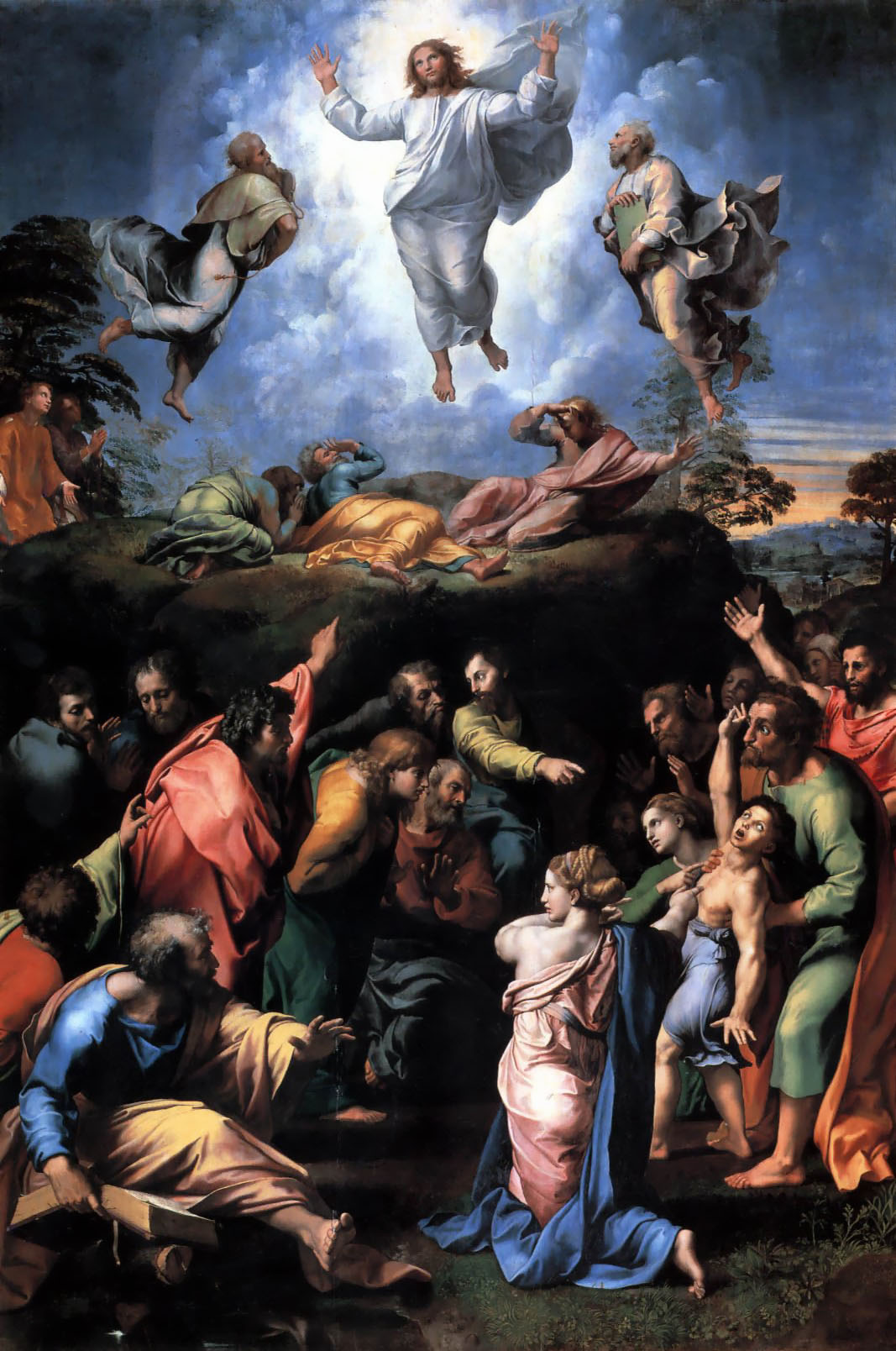
The Transfiguration
Details
About
Raphael's final painting, unfinished at his death aged 37 and carried in his funeral procession. Two scenes collide vertically: the radiant Christ levitating on Mount Tabor above, and the chaotic, shadowed scene below where the apostles fail to heal a possessed boy. The contrast â divine light versus human helplessness â was revolutionary and became a template for the Baroque. The lower half was likely finished by Giulio Romano from Raphael's drawings; you can see a rougher, more anxious hand. This is the painting that convinced Vasari the age of Raphael had ended.
The full story
Technical details
- Medium
- Tempera on wood (transferred to canvas during the Napoleonic era, then restored to panel)
- Dimensions
- 410 × 279 cm
- Date
- 1516–1520
- Commissioned by
- Cardinal Giulio de' Medici (future Pope Clement VII)
- Location
- Room XII, Pinacoteca, Vatican Museums
Historical context
Commissioned in 1516 by Cardinal Giulio de' Medici (the future Pope Clement VII), *The Transfiguration* was intended for the Narbonne Cathedral in France. However, it never left Rome. At the time of its creation, Raphael was the unchallenged prince of painters, juggling massive architectural projects and the decoration of the Vatican Stanze. This work was born from a fierce rivalry; the Cardinal had simultaneously commissioned Sebastiano del Piombo to paint the *Raising of Lazarus*, with Michelangelo secretly providing the drawings to ensure Raphael would be outshone. Raphael, sensitive to the threat, poured his entire artistic inventory into this panel. The Italy of 1520 was a place of high-stakes religious tension and artistic peak. The Reformation was brewing in the north, and in Rome, the High Renaissance was reaching its fever pitch. This painting serves as a bridge between two eras. It was completed just days before Raphael’s sudden death at the age of 37 on Good Friday. Legend tells us that as he lay in state in his studio, this very painting was hung at the head of his bed, its wet oils still glistening as the city mourned the man who had brought the divine down to earth.
Symbolism & iconography
- The possessed boy represents the fallen state of humanity, unable to be cured by human agency (the apostles) alone.
- The kneeling woman in the foreground is often interpreted as the personification of Faith, her classical profile contrasting with the agitated apostles.
- Moses holding the tablets and Elijah represent the Law and the Prophets, testifying that Christ is the fulfillment of Jewish scripture.
- The contrast between the bright, airy top and the dark, shadowy bottom symbolizes the divide between the Kingdom of Heaven and the material world.
- The pool of shadow in the center of the apostles creates a void that can only be filled by the light emanating from Christ above.
What to look for in person
- Look at the eyes of the possessed boy; Raphael painted them with one pupil dilated and the other constricted to heighten the sense of neurological distress.
- Step to the side to see how the light from Christ’s aura illuminates the edges of the apostles' robes in the lower half of the painting.
- Observe the hands: almost every figure is pointing or gesturing, creating a hidden map of movement that directs your gaze to the floating figure of Christ.
- Notice the sharp contrast in 'chiaroscuro' (light and dark) in the lower right; this dramatic lighting was revolutionary for its time and influenced the entire Baroque movement.
Fun facts
- The painting was so highly regarded that it stayed in Rome at the Church of San Pietro in Montorio for nearly 300 years instead of going to France as planned.
- Napoleon Bonaparte was so obsessed with this work that he seized it in 1797 and took it to the Louvre, though it was returned to the Vatican in 1815 after his downfall.
- Recent restorations using infrared reflectography have confirmed that Raphael painted almost the entire work himself, debunking the old theory that his pupils finished the bottom half.
- Raphael died on his 37th birthday, and the 'Transfiguration' was placed at the head of his funeral bier in the Pantheon.
Rating
Notes
Loading…