Masterpiece
Venus Blindfolding Cupid
Details
About
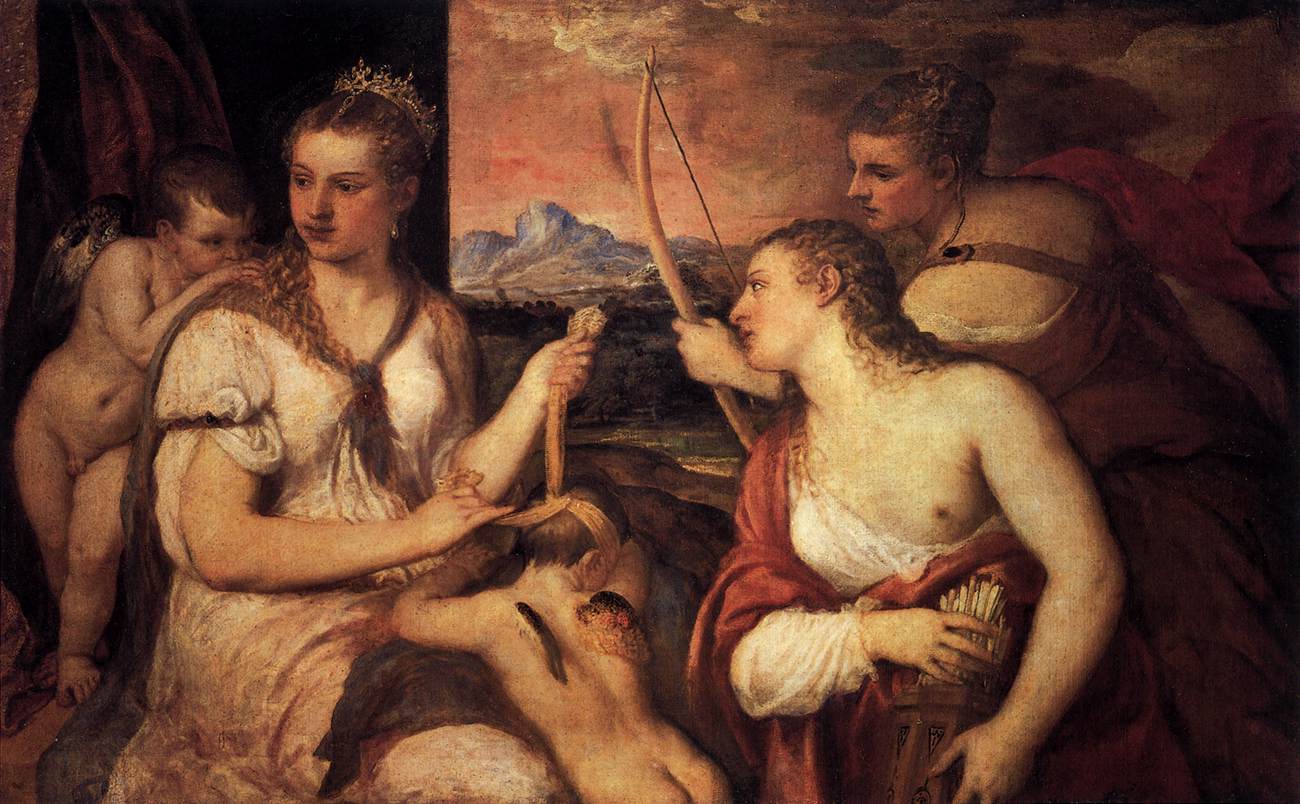
Late Titian â the paint loose, the flesh warm and almost dissolving. Venus binds a scarf over Cupid's eyes while another cupid watches, and two nymphs bring the bow and quiver. Painted in his late seventies, this is Titian's mature style: form emerging from color, edges blurring, the atmosphere doing the drawing.
The full story
Technical details
- Medium
- Oil on canvas
- Dimensions
- 116 × 184 cm
- Date
- c. 1565
- Commissioned by
- Likely the Cornaro family of Venice
- Location
- Room XX (The Room of the Venetians), Galleria Borghese, Rome
Historical context
Titian painted 'Venus Blindfolding Cupid' around 1565, during the final, most experimental decade of his long and illustrious career. At this stage, the Venetian master was no longer interested in the crisp lines of his youth, choosing instead to focus on 'pittura di macchia'—painting with patches of color and visible, tactile brushwork. This was a time when Venice was the artistic rival to Rome; while Rome prioritized 'disegno' (drawing), Titian championed 'colore'. The work entered the prestigious Borghese collection in 1608 when Cardinal Scipione Borghese, the nephew of Pope Paul V and a voracious collector of Renaissance masterpieces, purchased it from the Cornaro family. It represents a mature meditation on the complexities of love, likely created for a private domestic setting where its nuanced allegories on matrimonial duty and the dangers of blind passion could be contemplated at leisure. Amidst the Counter-Reformation's tightening of moral codes, Titian used the guise of classical mythology to explore the psychological layers of human desire.
Symbolism & iconography
- The Blindfold: Represents 'Amor Caecus' or blind passion, the impulsive love that acts without considering consequences.
- The Unmasked Cupid: Symbolizes 'Anteros,' or mutual and rational love, which sees clearly and leads to virtue.
- The Bow and Arrows: Classic attributes of Cupid, here being 'confiscated' or prepared, suggesting the management and control of desire.
- The Red Drapery: A traditional symbol of passion and power, it frames Venus and emphasizes her status as the sovereign of the heart.
- The Dolomite Mountains: The rugged blue peaks in the background are a nostalgic reference to Titian’s home in Pieve di Cadore.
What to look for in person
- Lean in (but not too close!) to see the 'broken' brushwork on the nymphs' sleeves; what looks like solid fabric from afar dissolves into frantic, beautiful marks up close.
- Pay attention to the skin tones of the three different figures; Titian uses distinct palettes for the goddess, the nymphs, and the children to create a sense of varying vitality.
- Look at the distant landscape on the right; the transition from the warm, golden foreground to the ice-blue mountains is a masterclass in atmospheric perspective.
- Observe the painting from the far left of the room to see how the light from the actual windows in the gallery interacts with the painted 'sunset' light within the frame.
Fun facts
- Titian reportedly used his fingers to apply the final glazes of paint in this work, leaving actual fingerprints in the surface of the nymphs' clothing.
- The painting was once thought to represent 'The Three Graces,' but the presence of the two Cupids confirms it as an allegory of Venus.
- X-ray analysis reveals that Titian significantly changed the composition as he worked, originally painting Venus facing the opposite direction.
- Cardinal Scipione Borghese was so determined to own Venetian works like this that he often used his papal connections to pressure families into selling.
Rating
Notes
Loading…