Masterpiece
Cardinal and Theological Virtues
Details
About
The lunette above the Jurisprudence wall â three seated women embody Fortitude (with a lion), Prudence (with a mirror, two-faced), and Temperance (with reins). Above them putti hold the theological Virtues: Faith, Hope, Charity. It's the smallest of the Stanza della Segnatura frescoes and the easiest to overlook â but the drapery and the tender interplay of the three figures rank with anything Raphael painted.
The full story
Technical details
- Medium
- Fresco
- Dimensions
- Width at base approx. 660 cm
- Date
- 1511
- Commissioned by
- Pope Julius II
- Location
- Stanza della Segnatura, Vatican Museums
Historical context
Commissioned by Pope Julius II, the 'Stanza della Segnatura' was originally the Pope’s private library and study. The room's decorative program explores the four pillars of human intellect: Theology, Philosophy, Poetry, and Law. The 'Cardinal and Theological Virtues' occupies the wall dedicated to Jurisprudence, completing the intellectual cycle by showcasing the moral qualities necessary for the administration of justice. Rome in 1511 was at the height of the High Renaissance, a feverish moment of artistic competition where Raphael was working just doors away from Michelangelo, who was simultaneously painting the Sistine Chapel ceiling. This specific wall serves as a bridge between the divine and the secular; while the other walls focus on academic disciplines, this fresco addresses the practical application of right and wrong through the lens of both Church Law (Canon Law) and Civil Law. At a time when the Papacy was asserting its temporal and spiritual authority across Europe, these images served as a monumental reminder of the Pope's role as the supreme arbiter of justice.
Symbolism & iconography
- The Oak Branch: A double symbol representing the virtue of Fortitude (strength) and the Della Rovere family crest of Pope Julius II.
- The Two-Faced Figure: Prudence's young and old faces represent the necessity of looking to the past to make wise decisions for the future.
- The Reins: Held by Temperance, they signify the control of human impulses and the 'bridling' of the soul's lower desires.
- The Lion: Seated next to Fortitude, it symbolizes both physical power and the courage required to uphold the law.
- The Torch and the Fruit: The putti hold these to represent Hope (the light of the future) and Charity (the fruit of good works).
What to look for in person
- Stand directly in the center of the room to see how the lunette aligns perfectly with the window below, framing the light of the room as if it were part of the painting.
- Look closely at the figure of Prudence; try to spot the second, elderly face hidden on the back of her head.
- Observe the transition in style between the 'School of Athens' and this wall; you can see Raphael's figures becoming more 'monumental' and statuesque as he studied Michelangelo's work.
- Check the lighting: early morning light in the Vatican Museums often hits this wall in a way that emphasizes the three-dimensional modeling of the Virtues' limbs.
Fun facts
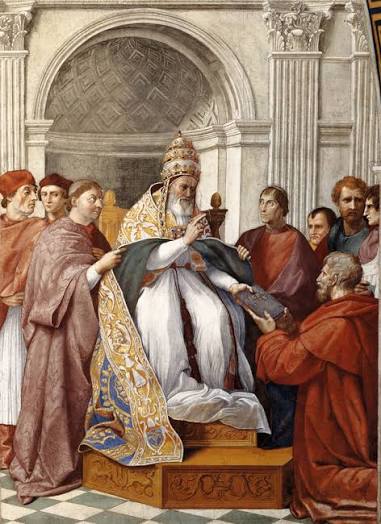
- The face of Pope Gregory IX in the lower right scene is actually a portrait of Pope Julius II, who grew a beard during this period as a vow until the French were expelled from Italy.
- Scholars believe the seated figure of Fortitude was heavily influenced by Michelangelo’s ‘Isaiah’ from the Sistine Chapel, which Raphael likely saw while it was still under construction.
- The figure of Prudence holds a mirror, but if you look closely at the glass, it is not showing a reflection of her face, but rather a symbolic light, representing the 'light of truth'.
- The two scenes at the bottom were likely completed by Raphael's assistants, Gianfrancesco Penni and Giulio Romano, under his close supervision, due to the artist's massive workload in the Vatican.
Rating
Notes
Loading…