Masterpiece
Young Sick Bacchus
Details
About
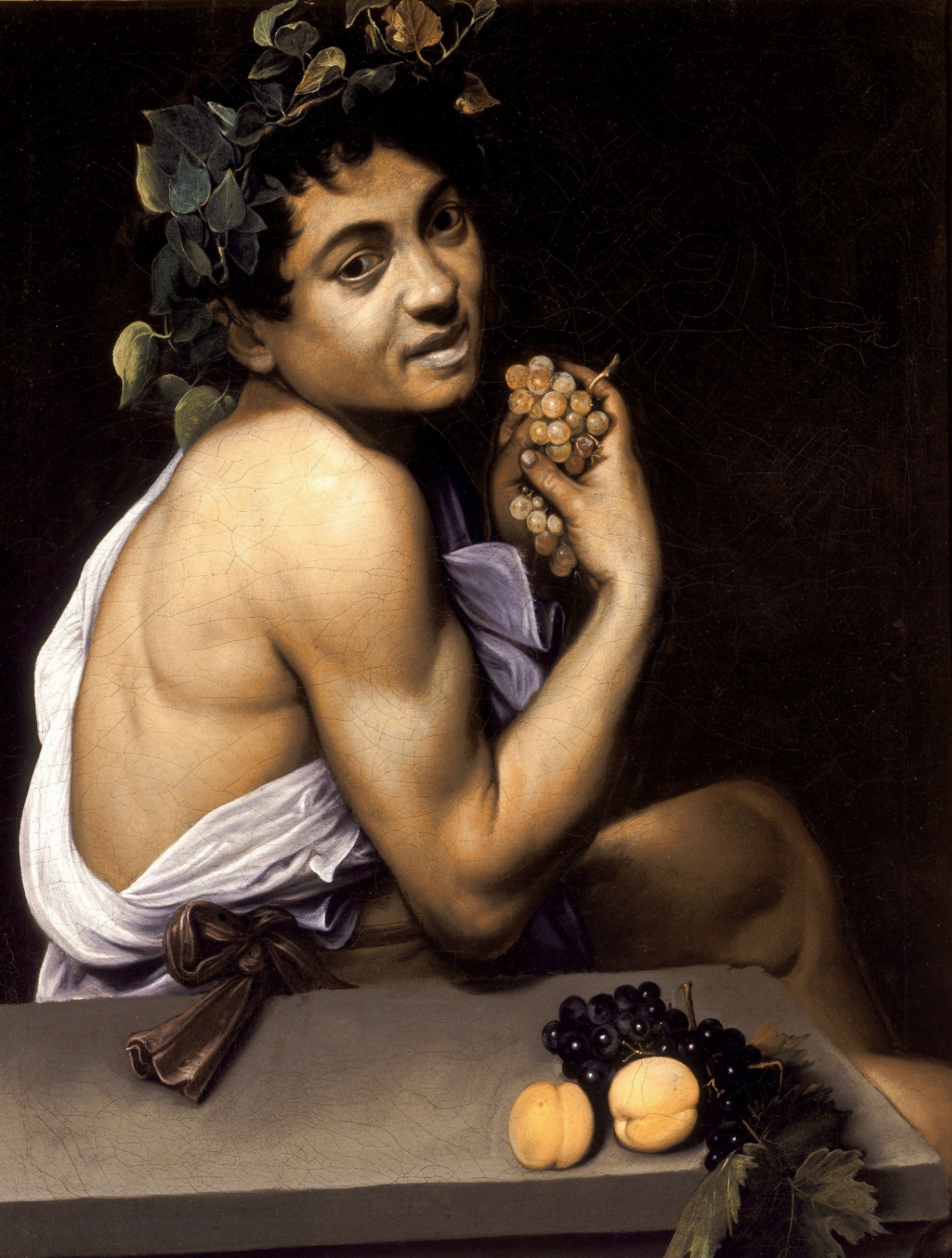
A self-portrait painted while Caravaggio was recovering from malaria in the Ospedale della Consolazione â hence the greenish skin, the jaundiced lips, the sallow shoulder. Bacchus offers us grapes; the fingernails are dirty. This is the moment realism entered mythology through a hospital ward.
The full story
Technical details
- Medium
- Oil on canvas
- Dimensions
- 67 × 53 cm
- Date
- 1593–1594
- Commissioned by
- Uncommissioned (painted for himself or for the open market)
- Location
- Room VIII (The Silenus Room), Galleria Borghese
Historical context
Painted around 1593, this self-portrait marks a pivotal moment in the early Roman career of Michelangelo Merisi da Caravaggio. Having recently arrived from Milan, the young artist found work in the studio of the Cavaliere d'Arpino, the favorite painter of Pope Clement VIII. This was a time of intense competition and struggle for Caravaggio; he was penniless, lacked powerful patrons, and had recently suffered a serious illness or injury—likely malaria or a kick from a horse—that left him hospitalized for months at the Hospital of Santa Maria della Consolazione. The 'Young Sick Bacchus' was produced during or immediately following this convalescence. It reflects a Rome caught between the waning elegance of Mannerism and the burgeoning birth of the Baroque. When Caravaggio’s employer, d'Arpino, later had his collection confiscated by the papal authorities, the painting entered the collection of Cardinal Scipione Borghese. It remains a testament to the artist’s early determination to reject idealized beauty in favor of a gritty, observed reality that would eventually revolutionize European art.
Symbolism & iconography
- The Grapes: In a Christian context, grapes symbolize the Eucharist (the blood of Christ), suggesting a parallel between the suffering of the sick artist and the Passion.
- The Stone Slab: The cold, grey surface in the foreground functions as a 'memento mori,' or a reminder of death, resembling a tombstone or an altar.
- The Pale Skin and Blue Lips: These are literal depictions of illness, subverting the traditional 'divine' nature of the subject to emphasize human frailty.
- The White Tunic: Draped over one shoulder, it references the classical 'exomis' worn by ancient Greek workers and slaves, grounding the god in a lower-class reality.
What to look for in person
- Step to the side of the painting to notice how the forward-thrusting shoulder seems to project out into your space.
- Examine the two grapes resting on the stone table; notice the tiny, meticulous highlights that give them a three-dimensional weight.
- Look closely at the artist's fingernails; Caravaggio purposefully included dirt beneath them to maintain a sense of gritty realism.
- Observe the transition of light on the neck; the subtle use of shadow (chiaroscuro) there creates a sense of depth that was revolutionary for the 1590s.
Fun facts
- Caravaggio painted this using a mirror, which explains why the figure’s right arm is hidden and the left is used to hold the grapes—the reverse of a typical right-handed pose.
- The painting was seized from the studio of the Cavaliere d'Arpino in 1607 by tax authorities acting on behalf of Cardinal Scipione Borghese, who was notorious for 'forcefully' acquiring art he liked.
- The distinctive greenish-yellow skin tone has led modern doctors to diagnose the artist with sub-icterus, a symptom of jaundice or malaria, which was rampant in 16th-century Rome.
- The ivy crown Bacchus wears is slightly wilted, diverging from the traditional evergreen ivy that usually symbolizes the god’s immortality.
Rating
Notes
Loading…