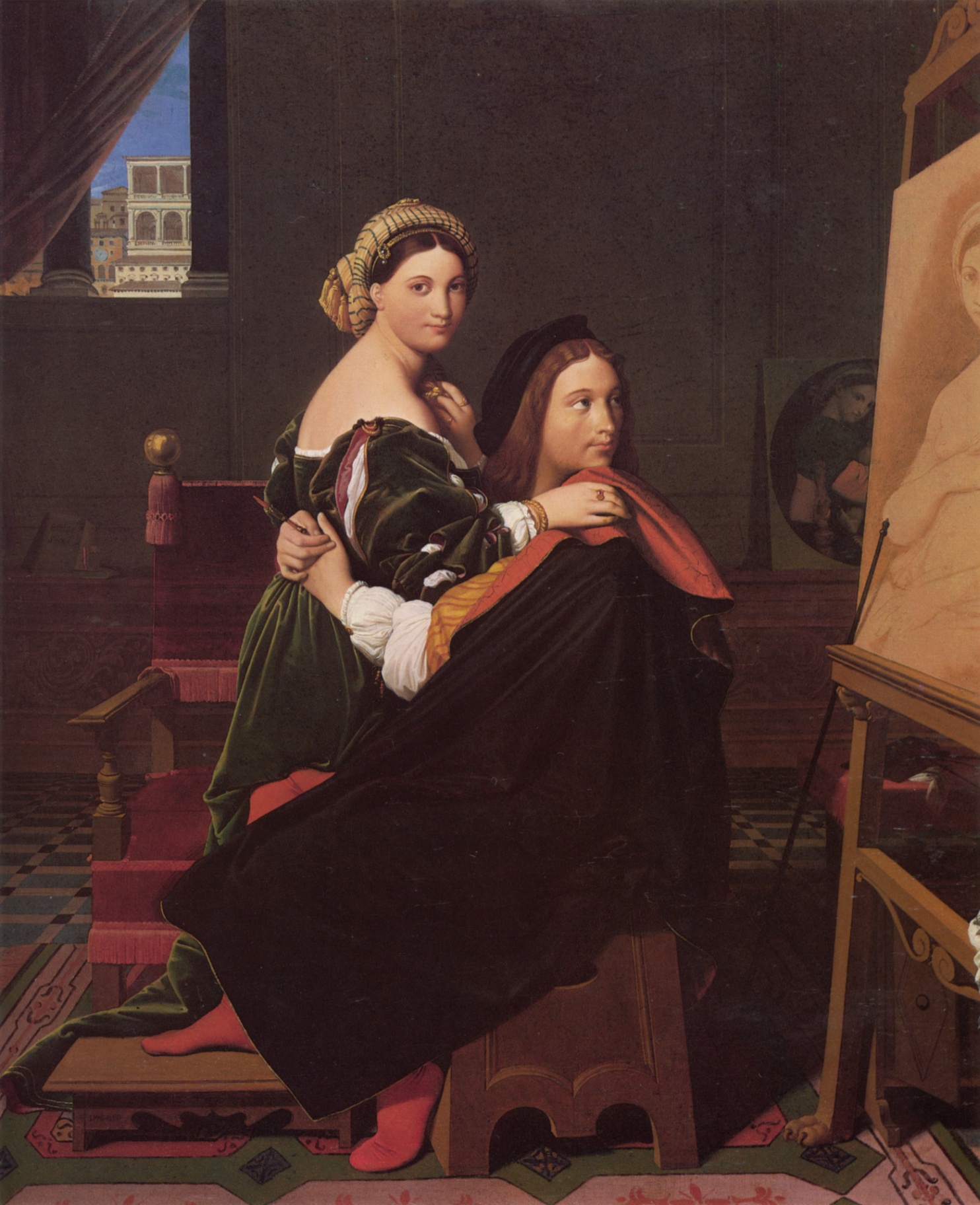
Almost certainly Raphael's mistress Margherita Luti, daughter of a Trastevere baker (fornarina = baker's girl). The armband bears Raphael's signature â a Renaissance equivalent of writing his name on her. She wears a red garnet (a symbol of love) and a myrtle in her hair (Venus). X-rays revealed a ruby ring on her finger, painted out â probably by Giulio Romano after Raphael's death to erase evidence of a secret marriage.
The full story
Stepping before La Fornarina is a startlingly intimate experience, as if we have walked into Raphael’s private quarters and interrupted a moment of quiet, shared recognition. The woman looks directly at us with a gaze that is neither shy nor provocative, but undeniably familiar. She is Margherita Luti, known as the 'Fornarina' or the baker's daughter, and legend suggests she was the great love of Raphael’s life. The painting is a radical departure from the period’s standard aristocratic portraiture; rather than being draped in heavy velvets or stiff brocades to signal status, she is partially nude, her torso veiled only by a transparent wisp of silk that she holds against her breast. This gesture, known as the 'Venus Pudica' or modest Venus, ironically draws the eye exactly to what it purports to hide, blending the divine beauty of classical antiquity with a very real, breathing woman of 16th-century Rome.
Technically, the work is a masterclass in the representation of flesh and texture. Raphael uses a delicate sfumato to soften the transitions between light and shadow, giving her skin a luminous, tactile quality that seems to radiate from within. Notice the contrast between the cool, pale tones of her skin and the deep, saturated blue of her turban, which is woven with gold thread. The background is a dense thicket of myrtle and laurel—plants traditionally associated with Venus, the goddess of love, and Daphne, the symbol of poetic inspiration. By placing her against this dark, leafy backdrop, Raphael pushes her figure forward, making her presence feel three-dimensional and immediate. The light falls from the left, highlighting the softness of her shoulders and the gentle swell of her stomach, creating a sense of physical weight and volume that defined the High Renaissance ideal.
What truly sets this painting apart is its sense of ownership and identity. Bound tightly around her left bicep is a blue enamel band inscribed with the words 'RAPHAEL URBINAS.' This isn't just a signature; it is a brand. It marks her as his, a bold statement of possession in an era where Raphael’s public reputation relied on his perceived celibacy and his impending marriage to a Cardinal’s niece. Some historians suggest that the painting may have even been a 'marriage' portrait of a secret, spiritual nature. X-ray analysis has revealed that she originally wore a ring on her finger, which was later painted over—likely by Raphael’s assistants after his death to protect his reputation from the scandal of a low-born mistress.
La Fornarina matters because it represents the moment art became deeply personal. It is not a commission for a church or an altarpiece for a duke; it is a love letter in oil. Despite the formal excellence and the nods to classical sculpture, it feels modern in its psychological depth. Unlike the idealized Madonnas Raphael painted by the dozen, Margherita here has specific, individual features: the slight asymmetry of the eyes, the fullness of the jaw, and a look of quiet intelligence. When Raphael died suddenly at the age of 37, this painting was found in his studio. It reminds us that behind the 'Prince of Painters' who defined the visual language of the Church was a man who found his greatest inspiration in the simple, earthly beauty of a woman he could never officially claim.
Technical details
Medium
Oil on wood panel
Dimensions
85 × 60 cm
Date
1518–1520
Commissioned by
Uncommissioned (Personal work)
Location
Palazzo Barberini, Rome
Historical context
Painted in the final year of Raphael’s life, La Fornarina emerged during the height of the Roman High Renaissance, a period when Raphael was the most sought-after artist in the world. While he was managing massive projects for Pope Leo X, including the Vatican Stanze and the tapestries for the Sistine Chapel, he found the time to create this intensely private, almost scandalous portrait. Rome at this time was a city of immense wealth and intellectual fervor, but it was also a city of secrets. Raphael was officially engaged to Maria Bibbiena, the niece of a powerful Cardinal, yet he delayed the marriage for years. Scholars believe the pressures of his public life and his high-stakes social climbing were perfectly counterbalanced by his private obsession with the woman in this painting—a baker’s daughter from Trastevere who represented a realm of genuine passion far removed from the ecclesiastical politics of the papal court.
Symbolism & iconography
The blue armband inscribed 'Raphael Urbinas' serves as a lover’s brand, claiming the sitter as the artist’s own.
The myrtle bush in the background is a plant sacred to Venus, symbolizing eternal love and desire.
The large pearl hanging from her turban is a pun on her name; 'Margherita' translates to 'pearl' in Greek/Latin.
The 'Venus Pudica' pose (covering the breast) links the baker’s daughter to the classical statues of the goddess of love, elevating her to a divine status.
What to look for in person
Lean in to see the 'Raphael Urbinas' signature on the blue band; the gold lettering is exceptionally fine.
Observe the 'cangante' (color-changing) effect on the silk veil, where the light shifts from white to a translucent yellow.
Compare the skin tones of her face and hands; Raphael uses slightly different palettes to differentiate the weathered texture of hands from the softness of the face.
Look at the very dark background; in high light, you can just make out the individual leaves of the laurel and myrtle.
Fun facts
X-ray cleaning in 2001 revealed a large ring on the woman's left ring finger, which was hidden under layers of paint for centuries to avoid rumors of a secret marriage.
History suggests that the sitter, Margherita Luti, retired to the convent of Sant’Apollonia in Trastevere just four months after Raphael’s death.
Raphael’s students, likely Giulio Romano, are believed to have finished parts of the background and touched up the signature band after the master’s death.
The painting remained in the artist's studio until he died and was only first mentioned in a collection record in 1595.