Masterpiece
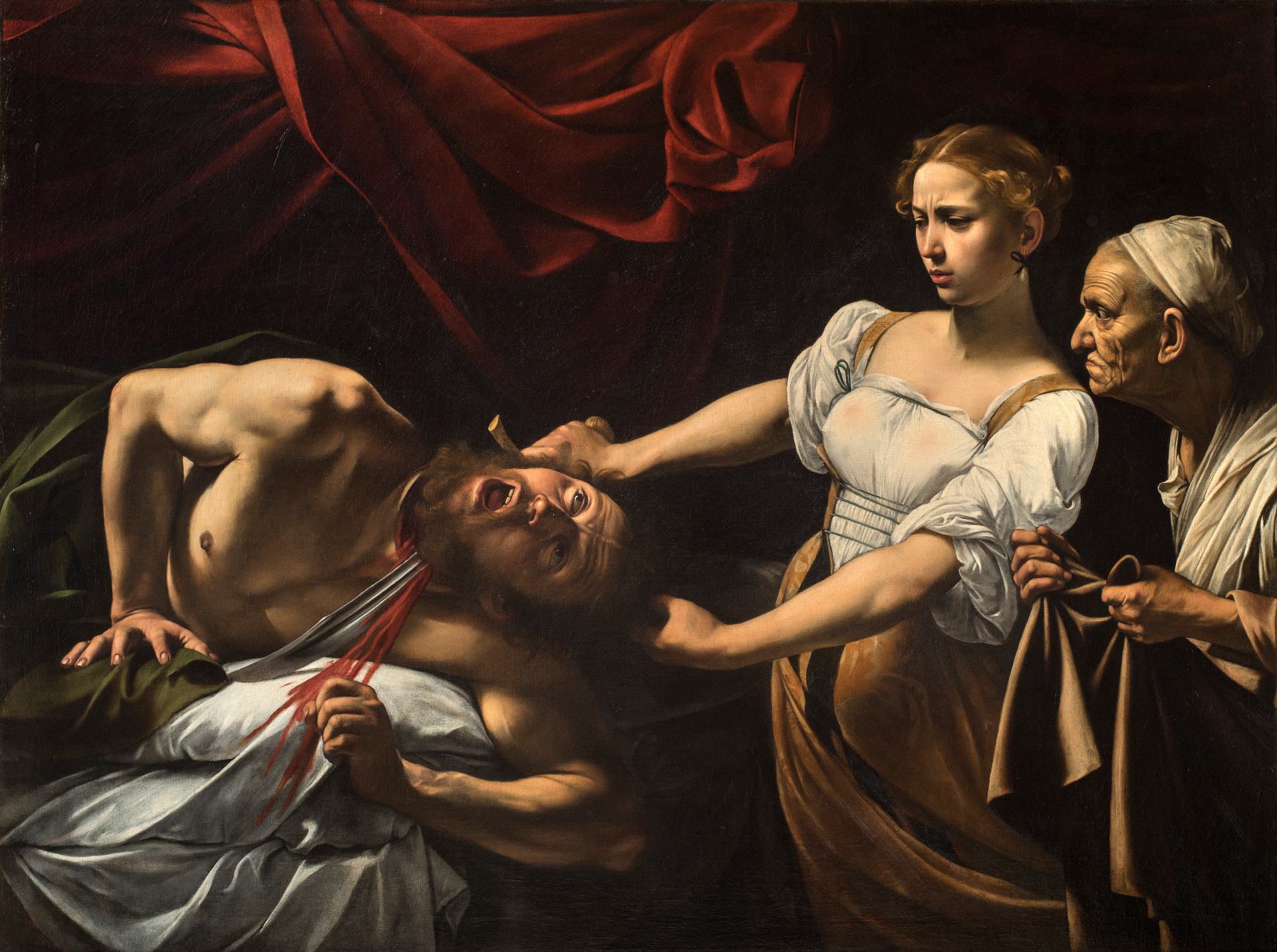
Judith Beheading Holofernes
Details
About
The moment of the killing itself â not before, not after. Judith is a young girl in a white blouse, arms extended stiffly, brow furrowed as she saws through the neck of the Assyrian general. The horror is that she looks uncertain, almost fastidious. Her elderly servant Abra grips the shroud with predatory readiness. Holofernes's mouth is open in a scream, his eyes rolled up. The blood spurts in three distinct jets â Caravaggio studied executions to get it right.
The full story
Technical details
- Medium
- Oil on canvas
- Dimensions
- 145 x 195 cm
- Date
- c. 1599–1602
- Commissioned by
- Ottavio Costa
- Location
- Galleria Nazionale d'Arte Antica, Palazzo Barberini, Rome
Historical context
In 1599, Rome was the beating heart of the Counter-Reformation, a period when the Catholic Church sought to use art as a powerful weapon to reassert its authority and inspire fervent devotion. Michelangelo Merisi da Caravaggio was the rising star of this era, a man whose volatile temperament was matched only by his revolutionary vision. Commissioned by the Genoese banker Ottavio Costa, *Judith Beheading Holofernes* represents a departure from the stylized, often bloodless depictions of the Renaissance. This was a time when the public execution of Beatrice Cenci for the murder of her abusive father had recently scandalized and mesmerized Rome; the visceral reality of state-sanctioned violence was fresh in the collective memory. Caravaggio tapped into this atmosphere of public spectacle and religious intensity, moving away from idealized beauty to embrace a gritty, tactile realism. In doing so, he provided the Church with an image of triumph over evil that felt dangerously, thrillingly alive.
Symbolism & iconography
- The Red Curtain: Symbolizes the theatrical nature of the scene and recalls the 'velarium' of a Roman theater, signaling a moment of high drama and destiny.
- White Blouse: Judith’s brilliant white garment represents her purity and the righteousness of her cause amidst the 'darkness' of the Assyrian camp.
- The Sword: A symbol of divine justice; Judith does not kill with her own strength, but as an instrument of God's will.
- Abra’s Wrinkles: The maidservant’s aged, 'ugly' appearance contrasts with Judith’s beauty to represent the passage of time and the harsh reality of life under occupation.
What to look for in person
- Look closely at the hands of Holofernes; the way his fingers clutch the bedsheets conveys a desperate, final struggle for life.
- Observe the painting from a slight angle to appreciate the 'chiaroscuro'—the way the light seems to physically push the figures out of the darkness toward you.
- Note the texture of the sword's blade; Caravaggio used lead tin yellow and white lead to create a metallic sheen that catches the gallery light.
Fun facts
- The blood spurting from the neck is painted with such anatomical accuracy that medical historians believe Caravaggio observed actual carotid artery injuries.
- X-rays of the canvas reveal that Caravaggio originally painted Judith with bare breasts, later covering her with the white blouse to adhere to contemporary standards of decorum.
- The model for Judith was Fillide Melandroni, a famous Roman courtesan and a frequent collaborator (and close friend) of Caravaggio.
- Ottavio Costa, the patron, was so protective of this painting that he forbade his heirs from ever selling or even copying it, keeping it hidden behind a silk curtain for decades.
Rating
Notes
Loading…