Masterpiece
Narcissus
Details
Artist
Caravaggio · Baroque
Where
Palazzo BarberiniAbout
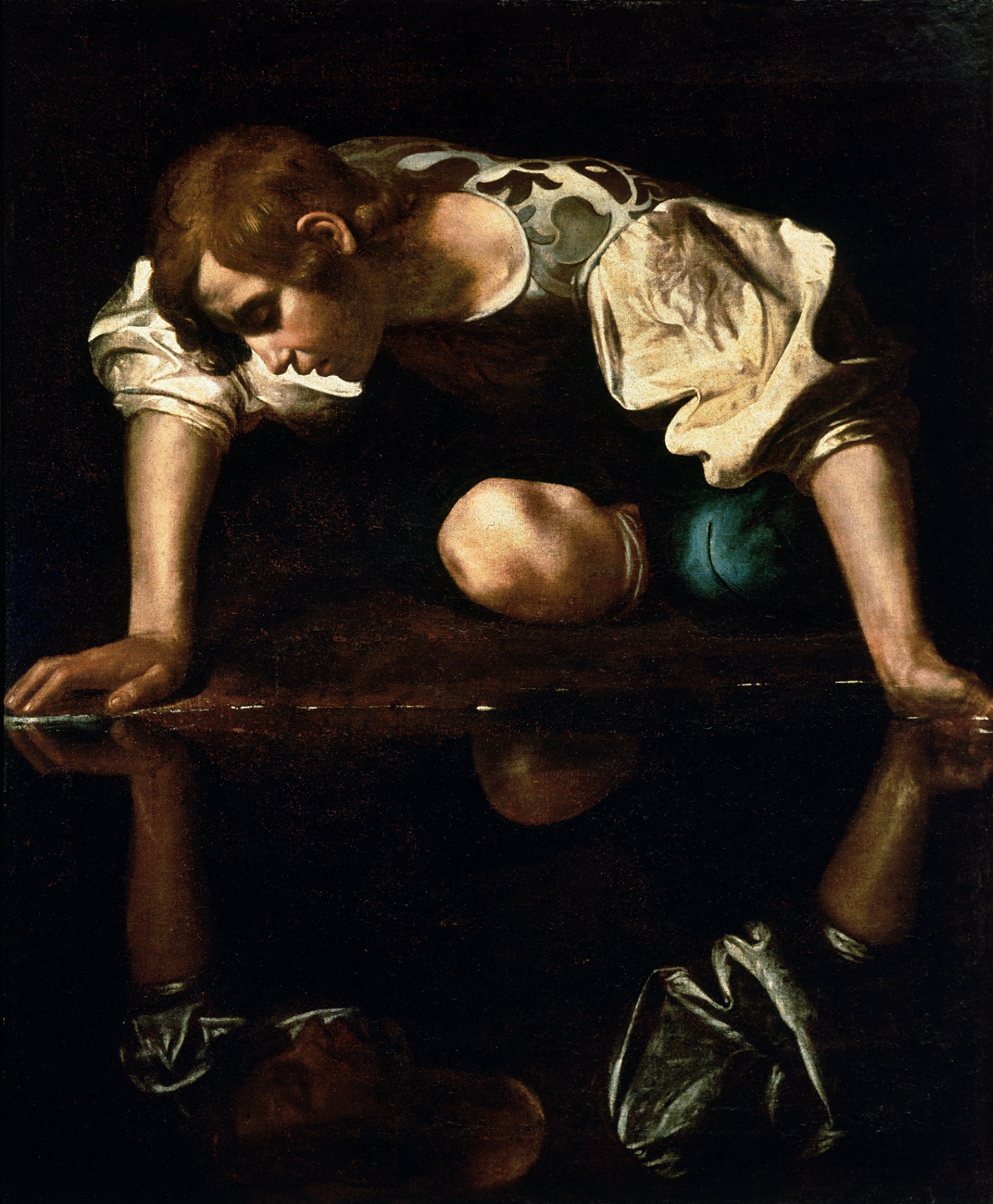
One of the strangest compositions in Western painting: a perfect circle formed by the youth and his reflection, joined at the knees. There is no background â only Narcissus, the pool, and darkness. The reflection is deliberately less finished than the boy above, as if the illusion is already slipping. Caravaggio reduced myth to its psychological core: self-love as a closed loop with no way out.
The full story
Technical details
- Medium
- Oil on canvas
- Dimensions
- 110 × 92 cm
- Date
- c. 1597–1599
- Commissioned by
- Unknown; likely private collector near the circle of Cardinal del Monte
- Location
- Palazzo Barberini, Room 22
Historical context
Created during the final years of the sixteenth century, this haunting image reflects the intellectual and artistic ferment of Rome under the patronage of cardinals like Francesco Maria del Monte. Caravaggio was revolutionizing the Roman art scene by dispensing with the idealized, Mannerist graces of the previous generation and replacing them with a gritty, psychological realism. During this period, Rome was the center of the Counter-Reformation, where the Church used art as a powerful tool for spiritual engagement; however, Caravaggio’s secular works, like Narcissus, often explored the darker, more introspective corners of the human condition. The story of Narcissus comes from Ovid’s Metamorphoses, a text that remained a cornerstone of Renaissance culture. At the time of this painting’s execution, Rome was a city of extreme contrasts—opulent wealth and brutal poverty, deep piety and sudden violence—a duality that mirrors the high-contrast lighting of Caravaggio’s emerging 'chiaroscuro' style. This work captures the precise moment of a tragic realization: the hunter who falls in love with an image that can never love him back.
Symbolism & iconography
- The Pool: Represents a threshold between the world of the living and the world of shadows, essentially acting as a tomb for the boy's identity.
- The Slashed Doublet: A sign of vanity and wealth, grounding the ancient myth in the contemporary reality of Baroque Rome.
- The Kneeling Posture: While typically a gesture of prayer or humility, here it is subverted into an act of idolatry directed toward the self.
- Darkness/Tenebrism: Symbolizes the spiritual 'blindness' of Narcissus, who cannot see beyond his own physical appearance.
What to look for in person
- Stand slightly to the right of the painting to see how the light on the knee and the shoulder creates a sense of three-dimensional depth that pushes out toward you.
- Look at the very center where Narcissus' fingers touch the water; Caravaggio painted the reflection slightly blurred to indicate the movement of the liquid.
- Observe the contrast between the healthy, luminescent skin of the real boy and the muddy, somber tones used for the reflection in the pool.
- Notice the absolute blackness of the background; in the gallery’s lighting, this helps focus your eye entirely on the geometry of the two figures.
Fun facts
- The painting was only rediscovered and attributed to Caravaggio in 1913 by the great art historian Roberto Longhi.
- Scholars have noted that the composition creates a 'circle of self-love,' where the arms of the boy and his reflection form a literal wheel.
- The costume Narcissus wears is a 'slashed' doublet, an expensive fashion of the 1590s that Caravaggio also used in works like The Cardsharps.
- X-rays of the canvas reveal that Caravaggio adjusted the position of the hands several times to find the perfect point of contact with the water.
Rating
Notes
Loading…