Masterpiece
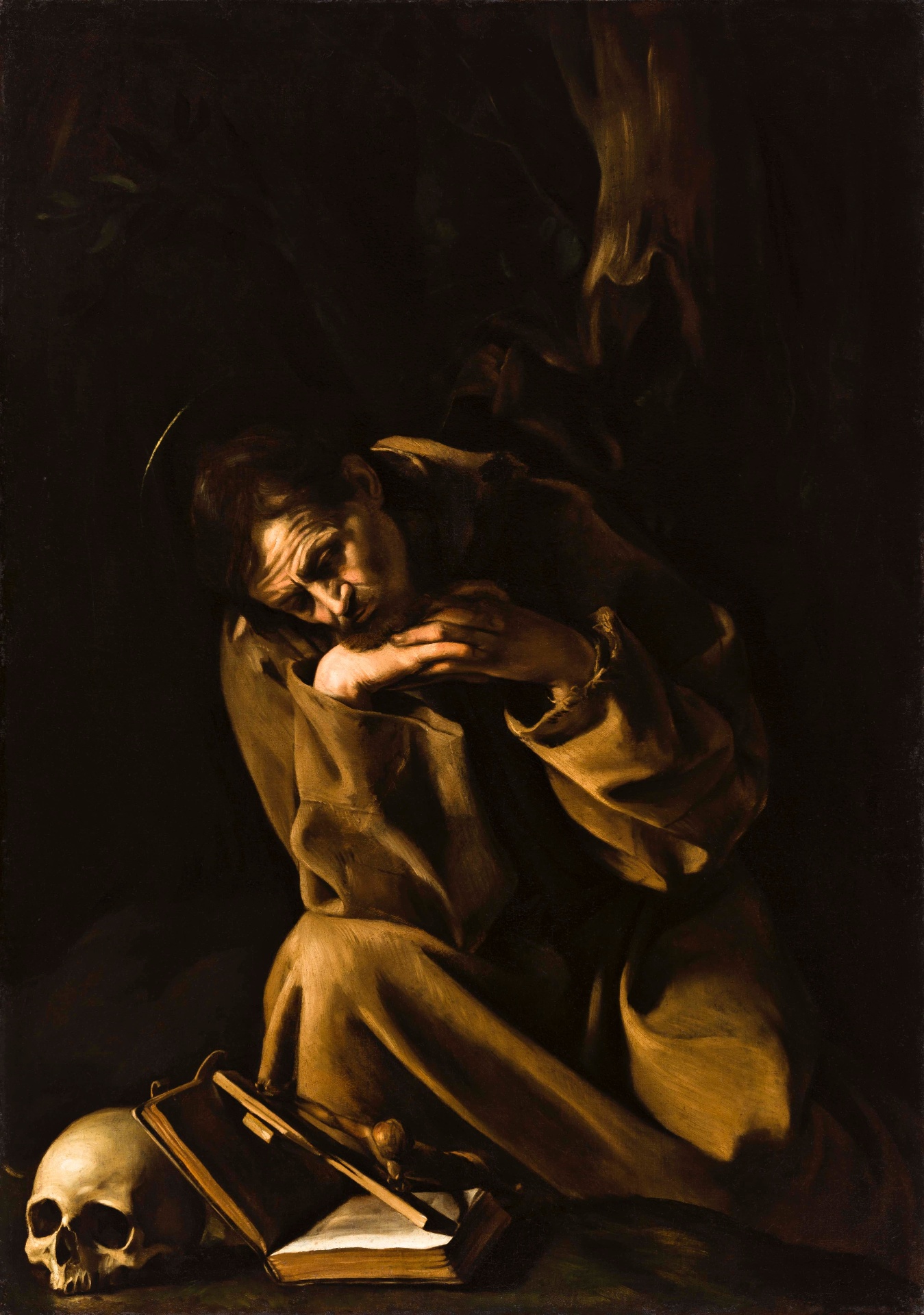
Saint Francis in Meditation
Details
About
Francis contemplates a skull by the light of a single candle â pure tenebrism, almost the entire canvas swallowed by black. His hands cradle the skull with a gentleness that turns the memento mori into something like affection. Barberini owned a version; the attribution and dating remain contested between Rome and Cremona.
The full story
Technical details
- Medium
- Oil on canvas
- Dimensions
- 128 × 94 cm
- Date
- 1603–1605
- Commissioned by
- Ottavio Costa (likely)
- Location
- Palazzo Barberini, Rome
Historical context
At the dawn of the seventeenth century, Rome was the beating heart of the Counter-Reformation. The Catholic Church, responding to the challenges of the Protestant Reformation, sought art that was direct, emotionally raw, and spiritually accessible. Within this atmosphere, Saint Francis of Assisi emerged as a vital symbol—a figure of radical poverty and absolute devotion who resonated with the Church's renewed focus on personal piety and the suffering of Christ. Caravaggio painted this work around 1603, during a period of professional height and personal volatility in Rome. The painting reflects the zeitgeist of the Franciscan reform movements, specifically the Capuchins, who championed a return to the saint's original, austere life. In a city filled with the golden splendor of the High Renaissance, Caravaggio’s choice to strip away ornament and focus on the gritty reality of mortality was a revolutionary act that spoke directly to the spiritual anxieties of the Roman populace.
Symbolism & iconography
- The Skull: A classic 'memento mori' symbol, representing the inevitability of death and the vanity of earthly life.
- The Torn Habit: Specifically the patched brown robe of the Capuchin order, symbolizing the vow of poverty and the imitation of Christ's suffering.
- The Cross: Positioned near the skull, it represents the hope of resurrection and the victory of spirit over the flesh.
- The Light: Not a natural sun, but a 'divine' light that pierces the darkness of the world to illuminate truth and grace.
What to look for in person
- Look closely at the saint's fingernails and the folds of his skin; Caravaggio used real-life models from the Roman streets to achieve this 'gritty' realism.
- Pay attention to the background; while it looks black, a very faint outline of a tree trunk can sometimes be seen, suggesting an outdoor grotto setting.
- Observe the way the light hits the 'stigmata' (the wound in the side of the habit); it is subtle, almost hidden by the saint's arm, emphasizing internal rather than external holiness.
Fun facts
- For years, a version in the church of Santa Maria della Concezione was thought to be the original, but technical analysis and a 1968 cleaning proved this Barberini version is Caravaggio's autograph work.
- The 'patch' on the Saint's shoulder is a recurring motif in Caravaggio's Francis paintings, signaling the saint's rejection of his wealthy father's silk trade.
- The painting was recorded in the 17th-century collection of the Roman banker Ottavio Costa, one of Caravaggio's most important early patrons.
- X-ray analysis reveals that Caravaggio did not use a preparatory drawing, but instead scored the wet primer with the butt of his brush to mark the positions of the saint's limbs.
Rating
Notes
Loading…