Masterpiece
Saint John the Baptist
Details
About
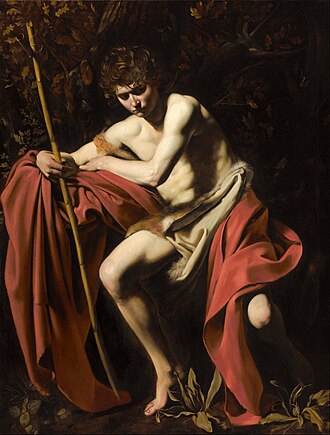
From Caravaggio's final months. John is a solitary boy in the wilderness, wrapped in a red cloak that engulfs him. The face is pensive, almost sad â none of the swaggering pride of his earlier Baptist portraits. Painted as Caravaggio hoped, again, for a papal pardon that never came.
The full story
Technical details
- Medium
- Oil on canvas
- Dimensions
- 159 × 124 cm
- Date
- 1610
- Commissioned by
- Cardinal Scipione Borghese (intended recipient)
- Location
- Galleria Nazionale d'Arte Antica, Palazzo Barberini, Rome
Historical context
This 'Saint John the Baptist' was painted during the final, frantic months of Caravaggio’s life. In 1610, the artist was a fugitive, fleeing a death sentence in Rome and searching for a way to secure a papal pardon. He was traveling from Naples back toward the Eternal City, carrying three paintings intended as gifts for Cardinal Scipione Borghese, the nephew of Pope Paul V and a powerful patron of the arts. This specific canvas was likely one of those intended bribes for his freedom. Italy at this time was dominated by the Counter-Reformation, a period when the Catholic Church sought to use art as a direct, emotional tool to reconnect with the faithful. Caravaggio’s late style responded to this climate with a stripped-down, haunting intimacy. Rather than the heroic, athletic figures of the High Renaissance, he presented a world of deep shadows and psychological vulnerability, reflecting his own desperate circumstances as he spent his final days navigating the coast of Lazio before his mysterious death at Porto Ercole.
Symbolism & iconography
- The Red Cloak: Symbolizes the blood of the saint’s future martyrdom and his ultimate sacrifice.
- The Tenebrist Darkness: Represents the 'dark night of the soul' or the spiritual wilderness, emphasizing John's isolation from the material world.
- The Downward Gaze: A departure from typical religious ecstasy, this symbolizes deep introspection and the weight of prophetic knowledge.
- The Camel Skin: A traditional attribute of John the Baptist, signaling his ascetic life and rejection of worldly comforts.
What to look for in person
- Walk to the far right of the canvas; the 'chiaroscuro' (light and dark) becomes even more dramatic as the saint's shoulder seems to push out from the darkness into your space.
- Look closely at the transition between the skin and the shadow on his torso; Caravaggio doesn't use lines to define form, but rather the abrupt meeting of light and dark.
- Note the lack of a halo; Caravaggio often omitted them to make his saints appear more like everyday people, a move that was highly controversial at the time.
- The light source comes from the upper left, a signature Caravaggio choice that mimics the natural light often found in the high windows of Roman chapels.
Fun facts
- This painting was part of the small cargo Caravaggio had with him when he died at Porto Ercole in July 1610.
- For many years, the painting's authenticity was debated, but recent restorations and X-rays have confirmed it as a definitive autograph work by Caravaggio.
- The model for this John appears to be the same young man used in Caravaggio's 'David with the Head of Goliath,' which the artist also painted during his final months.
- The red cloak is a masterclass in Baroque lighting; the deep shadows are achieved by using 'bitumen,' a tar-like substance that unfortunately darkens and degrades over centuries, making the darks even deeper today than they were in 1610.
Rating
Notes
Loading…